
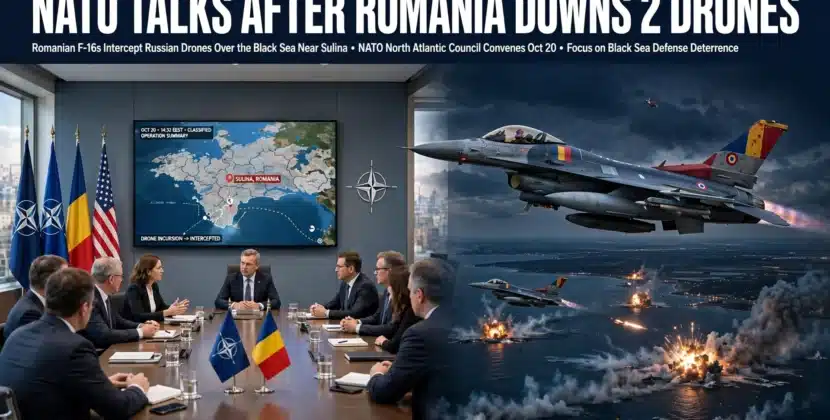






Romanian F-16s Down Two Russian-Style Geran Drones as NATO Heads Into Black Sea Talks
The Romania drone shootdown happened Saturday evening, when two Romanian air force F-16s destroyed a pair of Geran attack drones over the country’s territorial waters in the Black Sea after the fast-moving aircraft crossed into Romanian airspace. The encounter, confirmed by Romania’s defense ministry and covered by Stars and Stripes on October 19, is the sharpest sign yet of a widening Black Sea crisis that brings the alliance’s top decision-making body to Brussels this Tuesday for urgent talks on expanding NATO’s military presence and surveillance in the region. For US readers, the stakes are straightforward: an American-led alliance is now routinely shooting war hardware out of NATO skies.
Key Takeaways:
- – Two Romanian F-16s shot down two Geran attack drones Saturday over Romanian territorial waters; the drones were traveling roughly 280 mph.
- – Romania has logged 35 unauthorized drone incursions in 2026, up from nine in 2025, and shot down six drones this year after none last year.
- – The North Atlantic Council meets Tuesday in Brussels to discuss expanding NATO’s Black Sea presence and surveillance, per Romanian Foreign Minister Oana Toiu.
- – Several commercial vessels have been attacked near Romania and Bulgaria in recent weeks, with sailors killed or missing and no official attribution yet.
- – Bulgaria has requested additional allied aircraft and counter-drone capabilities.
What Happened Saturday, Minute by Minute
The sequence reconstructed from ministry statements and reporting is short. Romanian radar picked up the drones approaching national airspace from the Black Sea, F-16s on alert scrambled, and the intercepts came at 6:01 PM and 6:05 PM near Sulina, at the mouth of the Danube, above territorial waters. The aircraft were Geran attack drones, the Russian-associated loitering munition family now flying at roughly 280 miles per hour, fast enough that jet-powered propulsion rather than propeller drive is the practical inference, a hardware upgrade United24’s war desk flagged in its coverage of the incident. Scrap photography from the intercept site circulated within a day. The ministry’s statement afterward emphasized that the military continuously adapts procedures and response measures to defend airspace and territorial waters, which in official language means Romanian crews are now running live intercept drills as a standing mission rather than a novelty.
The Numbers That Changed This Year
The statistical jump is the story. Romania recorded 35 unauthorized drone incursions in 2026 against nine in 2025, roughly a fourfold increase, and Romanian forces downed six drones this year after shooting none down the previous year. Explanations divide into three: Russia’s air campaign against Ukraine’s ports and infrastructure drives more hardware westward toward NATO territory; the drones themselves got faster and longer-ranged; and Romanian detection and engagement doctrine matured, so more incursions are now tracked and shot rather than unnoticed. None of the three explanations are mutually exclusive, and all three point the same direction, which is why the alliance moved from watching to convening.
What NATO Is Actually Deciding Tuesday
The North Atlantic Council, the alliance’s top body, meets at NATO headquarters in Brussels on Tuesday, and Romanian Foreign Minister Oana Toiu laid out the agenda on Romanian television Sunday: how to expand the alliance’s military presence in the Black Sea region and increase surveillance capabilities. Bulgaria has already requested additional allied aircraft and counter-drone systems. Secretary-General Mark Rutte met Romanian President Nicusor Dan and Bulgarian Prime Minister Rumen Radev last week and said afterward that the alliance strengthened its eastern flank posture and would continue adjusting defenses. The genuinely hard problem, as Stripes’ reporting notes, lies outside alliance territory: drone and missile attacks on commercial shipping in international waters near Romania and Bulgaria, where numerous sailors have been killed or remain missing, investigations continue, and no official blame has been made public. NATO’s charter obligations run to alliance territory, not to neutral merchant ships, so the practical lever on shipping attacks is surveillance, convoying and national self-defense rather than Article 5.
The Wider War Context, From Starlink Sabotage to Drone Supply
The Black Sea pattern connects to a wider sabotage campaign US readers rarely see in one frame. Lithuanian authorities said Sunday that suspected saboteurs attempted to set fire to a facility housing SpaceX Starlink communications equipment near Vilnius, with the country’s National Crisis Management Center linking the incident to Russian efforts to disrupt Ukraine’s military communications. That attempted arson follows other attacks on Starlink facilities in Poland and Bulgaria this year, and Polish authorities have blamed Russia for a September attack on a Polish installation, with suspects detained in Germany. The through-line is deliberate: degrade whichever network, logistics node or sensor tracks and intercepts the drones. It also explains the Geran upgrade cycle, since a 280-mph jet-propelled drone exists precisely to exhaust defender missiles and response windows, a design trade that has now landed on NATO’s own intercept docket.
Why US Taxpayers and Shoppers Should Care
The material connection is air defense economics, not symbolism. Each F-16 intercept burns fuel, airframe hours and, in many NATO cases, expensive missiles at targets costing a fraction of the interceptor, a cost-per-kill asymmetry Russia’s drone designers exploit deliberately. The US has quietly backed Romania’s western Black Sea radar integration and contributed aircraft rotations, because a contested Black Sea is a global grain-export and energy-transit choke point: shipping insurance rates and freight costs trace the drone war directly into American food and fuel prices. And with Lithuania now reporting attacks on Starlink-linked infrastructure, US commercial satellite hardware is inside the conflict, which raises both the insurance question and the question of when privately owned infrastructure gets military protection.
What Happens Next
Watch three deliverables from Tuesday’s council meeting. A reinforced air-and-ISR package for Bulgaria and Romania, likely fighter detachments plus counter-drone systems and expanded radar coverage, is the cheapest consensus outcome. A shared attribution framework for the shipping attacks, where allied navies publish forensic findings jointly rather than letting each capital hedge, would mark a real policy shift. And the dry-run risk: the next Geran incursion that strays deeper than Sulina, toward a populated Romanian area, forces a NATO-vs-Russia decision inside a 90-second engagement window, which is exactly the scenario the alliance hopes expanded surveillance prevents. The path from here runs through Brussels this week; the alternative is more Saturdays like this one, with allied jets over the Danube delta and scrap raining into the reeds.
Frequently Asked Questions
Why did Romania shoot down the drones?
Two Geran attack drones approached from the Black Sea and entered Romanian airspace; F-16s scrambled and destroyed them over territorial waters near Sulina, at 6:01 PM and 6:05 PM Saturday.
How many drones entered Romanian airspace in 2026?
Romania logged 35 unauthorized drone incursions in 2026, compared with nine in 2025, and shot down six drones this year after none last year.
What will NATO decide in the Tuesday talks?
The North Atlantic Council meets in Brussels to discuss expanding NATO’s Black Sea military presence and surveillance, against the backdrop of Bulgaria’s request for more allied aircraft and counter-drone capabilities and ongoing attacks on commercial shipping nearby.
Sources:
- https://www.stripes.com/theaters/europe/2026-10-19/romania-drones-nato-meeting-23196504.html
- https://www.dw.com/en/romanian-fighter-jets-shoot-down-2-drones-over-black-sea/a-79689156
- https://united24media.com/war-in-ukraine/romanian-f-16-fighter-jets-shoot-down-two-russian-jet-powered-drones-over-nato-airspace-23554
- https://www.legion.org/information-center/news/security/2026/october/five-things-to-know-oct-19-2026