Seoul, South Korea | July 29, 2026
Samsung Electronics dropped 13 percent in one day, and SK Hynix fell even more. But when Wall Street opened on Tuesday, American investors hardly reacted. This difference between Seoul’s panic and New York’s calm is now influencing the global tech market story, showing U.S. investors where the real risks are this week.
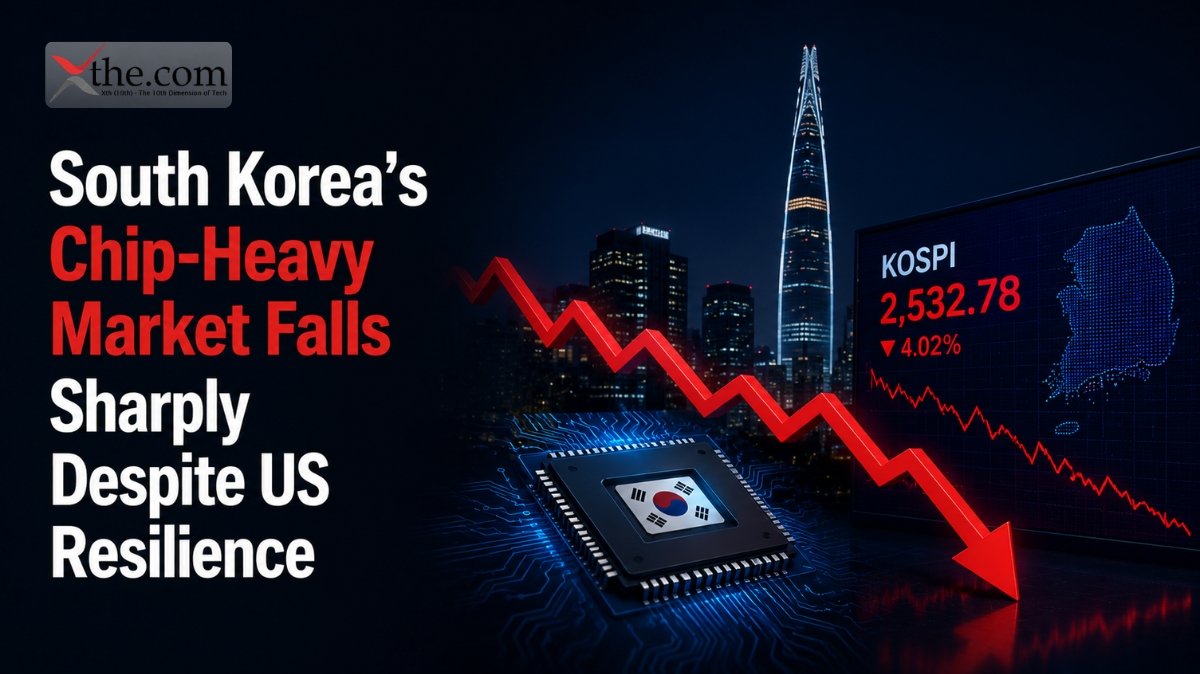
The South Korea chip market falls narrative dominated Tuesday’s trading session, as the Kospi index tumbled roughly 10 percent before a partial recovery, constituting one of its steepest single-day declines since April. Trading halts kicked in twice as the sell-off accelerated. Yet the divergence between that collapse and the comparatively restrained tone on U.S. exchanges is what deserves the closer look. This is a story about Korea’s decline, U.S. resilience, and about why American money managers are refusing to treat Seoul’s selling as gospel for their own portfolios.
What Happened in Seoul on Tuesday
The immediate cause was new worries about China’s growing ability to make memory chips, adding to an already nervous month for Asian semiconductor companies. News that Chinese manufacturers are increasing their own chipmaking tools brought back fears that South Korea’s lead in memory chips, a key part of its exports, could fade faster than investors expected.
The result was significant declines in South Korea Tuesday, with the Kospi’s benchmark index sliding to its weakest close since April. Samsung Electronics, the bellwether of the entire exchange, shed more than 13 percent. SK Hynix, still fresh off its record-setting Nasdaq debut earlier this month, fell even harder, dragging its U.S.-listed shares below their original offer price. The Korea Exchange invoked circuit breakers not once but twice, a mechanism used only eight times so far this year, underscoring just how violent the intraday swings became.
Japan’s Nikkei followed the region lower, sliding nearly 4 percent in sympathy, as the sell-off in chip-heavy stock market overnight trading rippled across Asian exchanges before the U.S. session even opened. For a few hours, it looked like the makings of a global rout.
Why Memory Chips Are the Epicenter
Memory chips are the basic building blocks behind the AI infrastructure boom. Every data center, large language model training, and big cloud contract needs a steady supply of high-bandwidth memory, an area where Samsung and SK Hynix have usually led. When investors worry that Chinese companies might catch up faster than expected, it puts pressure on South Korea’s tech-heavy stock market. That’s what happened on Tuesday, which is why the losses hit semiconductor companies the hardest instead of affecting the whole Kospi evenly.
Wall Street’s Different Calculus
Here is where the story shifts. Despite the overnight carnage in Seoul, the U.S. market’s relatively steady performance on Tuesday stood in sharp contrast. U.S. semiconductor names opened lower, as did the broader chip sector, but they extended a multi-day losing streak; the moves were measured rather than panicked. The VanEck Semiconductor ETF slipped roughly 3 percent in early trading, a meaningful decline but nowhere near the double-digit collapse seen in Seoul. Micron and Western Digital each fell close to 5 percent, painful but orderly.
This is the essence of US stocks decouple Korea chips: American investors are not simply importing Korea’s fear wholesale. They are running their own math. Domestic chip names are down sharply for the month already, which means Tuesday’s session was, in some sense, adding to a trend already priced in rather than reacting to fresh, unanticipated news. More importantly, U.S. traders had bigger fish to fry.
Earnings Season Is Doing the Heavy Lifting
Tuesday’s session occurred just ahead of a dense stretch of mega-cap earnings, with reports due from Amazon, Meta, Microsoft, and Apple later in the week, alongside a closely watched Federal Reserve rate decision. That calendar matters enormously. When investors know they will get concrete guidance on cloud spending, AI capital expenditure, and margin trends within 48 hours, they tend to discount overnight regional noise and wait for company-specific data instead. That is a textbook case of “South Korea chip market falls US resilient” dynamics playing out in real time: a foreign market convulses, but the domestic audience is preoccupied with its own catalysts.
It also shows that professional investors are getting better at telling the difference between Korean memory chip stocks, which depend a lot on DRAM and NAND market patterns, and the wider American AI infrastructure sector, which is more about computing power, software profits, and how big tech companies manage their spending. These areas are connected, but they are not the same, and Tuesday’s trading made that difference clear in a way that a quieter week would not have.
What This Means for Portfolios
For American investors watching their semiconductor holdings gyrate, the practical takeaway is nuanced. The “Korea decline US stocks decouple” pattern does not mean U.S. chip stocks are immune to Asian sentiment. It means the transmission is imperfect, and the size of the move matters. A 10 percent single-day Kospi decline does not translate into a 10 percent Nasdaq decline, because U.S. investors are weighing a different, more immediate set of variables: interest rate policy, corporate earnings, and capital expenditure guidance from the companies that actually build and buy American chips.
This difference really matters for portfolios. If you treat every drop in the Kospi as a warning sign for U.S. tech stocks, you might overreact to news that U.S. markets have already taken into account. On the other hand, ignoring weakness in Korean chip stocks completely overlooks a real issue about China’s manufacturing growth, which will eventually affect demand and prices for American semiconductors, even if it is not the main factor right now.
The Week Ahead
It is rare for markets to give such a clear example of decoupling. Tuesday showed that, for now, American investors see Seoul’s troubles as a local issue, not a global judgment on the AI sector. The real test will come with this week’s earnings reports. If Amazon, Meta, Microsoft, and Apple give spending guidance that supports ongoing AI investment, the gap between Korean worry and American calm will probably grow. But if those reports are disappointing, investors might realize that this week’s calm was only temporary.
Source: South Korea’s KOSPI posts biggest fall since early March as chipmakers slump