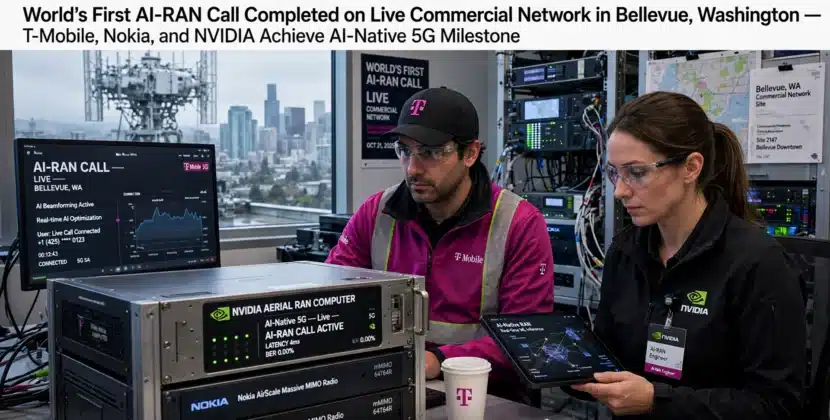





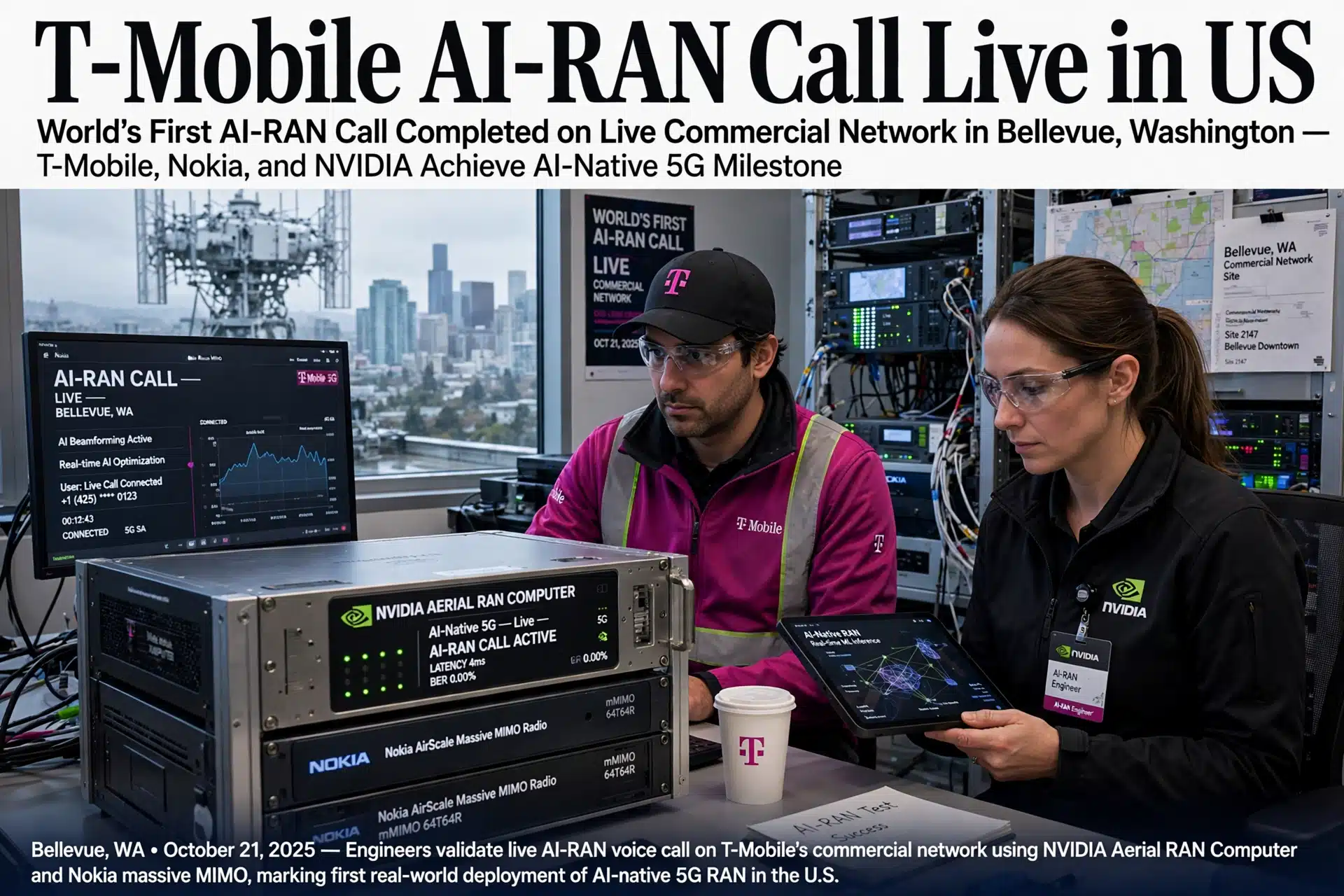
On October 21, 2026, a consortium comprising T-Mobile, Nokia, and NVIDIA announced a breakthrough in telecommunications infrastructure: the successful execution of the world’s first AI-RAN (Artificial Intelligence Radio Access Network) call on a live commercial network in Bellevue, Washington [cite: 2.1.1]. Operating over T-Mobile’s production 5G Standalone (SA) core using a standard commercial smartphone, this milestone marks the transition of artificial intelligence from closed laboratory environments into active, everyday cellular infrastructure [cite: 2.1.1]. For US consumers and enterprise networks alike, this convergence of radio frequency engineering and neural network inference promises to redefine how mobile data and real-time compute interact across the country.
What Is an AI-RAN and Why Does It Matter for US 5G?
Traditional telecommunications architecture treats cellular base stations and data centers as separate entities. Cell towers handle radio waves, demodulating signals and passing raw data packets back through regional gateways to centralized cloud servers for processing. This separation introduces latency and requires redundant hardware investments. An AI-RAN architecture fundamentally alters this paradigm by embedding powerful accelerated computing directly into the radio access network site.
During the Bellevue test, Nokia’s commercial base station hardware powered by NVIDIA accelerated computing platforms ran both standard 5G wireless protocol stacks and real-time AI inference workloads simultaneously on the same silicon. This dual-use capability enables cell towers to act as localized edge computing nodes. For US subscribers, the immediate benefit is reduced latency for latency-sensitive applications such as autonomous vehicle coordination, augmented reality headsets, and immersive cloud gaming, while carriers eliminate the need for costly parallel infrastructure builds.
Inside the Bellevue Deployment: Technical Architecture
The technical achievement required rigorous synchronization between radio frequency (RF) timing and high-throughput parallel processing. In a conventional cellular deployment, peak capacity must be provisioned to handle maximum potential user demand, leading to underutilized hardware during off-peak hours. By integrating AI inference engines directly into the RAN, the network can dynamically reallocate computational resources between telecommunications routing and edge AI tasks.
Industry analysts following the announcement note that this architecture allows mobile operators to monetize their real estate. With thousands of macro towers and small cell sites distributed across US metropolitan and rural areas, carriers possess an unparalleled distributed physical footprint. Transforming these sites into intelligent compute hubs opens new revenue streams for enterprise edge services, smart city telemetry, and localized industrial automation without requiring clients to route data back to distant hyperscale data centers.
Industry Implications: NVIDIA, Nokia, and Carrier Competition
The collaboration highlights an intensifying race among hardware manufacturers and infrastructure vendors to dominate next-generation telecom standards. While NVIDIA continues to expand its footprint from enterprise data centers into telecommunications infrastructure, legacy equipment makers like Nokia are pivoting aggressively toward software-defined networking and virtualized RAN (vRAN) frameworks.
For T-Mobile, early deployment on a live production core demonstrates a strategic commitment to network modernization following its nationwide 5G Standalone rollout. Competitors across the US telecom sector are closely evaluating the trial results to determine capital expenditure timelines. As data consumption driven by generative AI applications surges across mobile devices, carriers face mounting pressure to optimize spectral efficiency and reduce power consumption per gigabit transmitted.
What Happens Next for US Mobile Subscribers?
While everyday smartphone users will not immediately notice a visual change in their signal bars, the backend transformation will gradually manifest in improved reliability during network congestion and faster response times for cloud-connected services. Enterprises building localized IoT deployments can expect greater support for edge processing directly through carrier partnerships.
As Nokia and NVIDIA prepare to scale AI-RAN deployment kits for broader carrier adoption into 2027, the focus will shift toward software ecosystem maturity, multi-vendor interoperability, and stringent cybersecurity standards for distributed network nodes.
Frequently Asked Questions
Q: What is an AI-RAN call? An AI-RAN (Artificial Intelligence Radio Access Network) integrates AI compute directly into cellular base stations, allowing the same hardware to handle radio signals and AI tasks simultaneously.
Q: Where did the milestone test occur? It took place on October 21, 2026, at a live commercial cell site in Bellevue, Washington, on T-Mobile’s production 5G network [cite: 2.1.1].
Q: How does this benefit everyday mobile users? It significantly reduces latency, optimizes cellular spectral efficiency, and turns cell towers into localized edge computing nodes for advanced applications.
Conclusion
The successful execution of the first US AI-RAN call marks a pivotal turning point for the telecommunications industry. By proving that cellular infrastructure and artificial intelligence can share processing workloads efficiently on live networks, T-Mobile, Nokia, and NVIDIA have established a blueprint for the future of connectivity. As adoption expands across the US, the integration of intelligent computing into the network core will redefine digital capabilities for consumers and enterprises alike.
Sources
Reference 1: • NVIDIA Newsroom (October 21, 2026): ‘NVIDIA, Nokia and Leading Telecom Operators Turn Networks Into Distributed Intelligence Platforms’ – https://nvidianews.nvidia.com/news/nvidia-nokia-and-leading-telecom-operators-turn-networks-into-distributed-intelligence-platforms [cite: 2.1.2]
Reference 2: • Shattered.io Tech Reporting (October 21, 2026): ‘T-Mobile’s AI-RAN Call Pulls In 3 More Carriers’ – https://shattered.io/t-mobile-ai-ran-call-pulls-3-carriers-2026/ [cite: 2.1.1]