






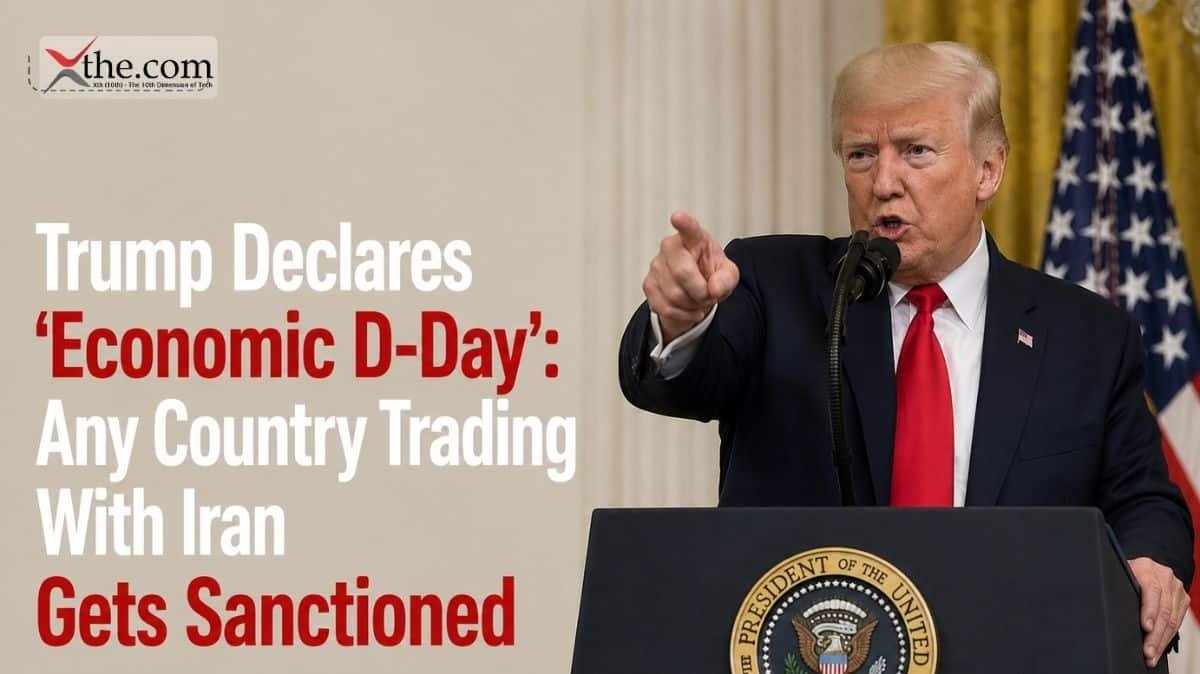
The president’s sweeping threat comes just hours after the U.S.-Iran ceasefire deadline expired with no deal in sight.
President Donald Trump has declared what he called ‘economic d-day’ against Iran, announcing that any nation trading with the Islamic Republic will face immediate U.S. sanctions. The provocative statement, delivered on August 20, 2026, marks a dramatic escalation in the economic dimension of a war that has already stretched past six months.
The announcement comes on the heels of a failed 60-day negotiation window that expired without a final agreement. Trump had previously urged Iran to ‘put up the white flag of surrender’ after the deadline passed, making clear that the United States was not interested in extending the memorandum of understanding that had temporarily halted direct military strikes.
“No Exceptions, No Exemptions”
In his statement, Trump left no room for interpretation. Any country — ally or adversary — that continues commercial ties with Iran would find itself in the crosshairs of American sanctions. The move effectively attempts to impose a global economic blockade on Tehran, cutting off the few remaining lifelines that have kept the Iranian economy afloat since the war began.
“This is economic d-day,” Trump told reporters. “Any country that trades with Iran trades against the United States. There will be no exceptions and no exemptions.”
The threat has already sent shockwaves through global markets. Oil prices spiked nearly 8% in early trading as traders priced in the risk of further supply disruptions. European allies, many of whom have maintained limited trade relationships with Iran despite U.S. pressure, are scrambling to assess their exposure.
Global Fallout
China, Iran’s largest trading partner, is the elephant in the room. Beijing has repeatedly defied U.S. sanctions throughout the conflict, importing Iranian oil at discounted rates and supplying Tehran with critical drone components and technology. A direct sanctions confrontation between the world’s two largest economies could trigger a trade war with consequences far beyond the Middle East.
European nations are caught in an impossible position. Germany, France, and Italy all have energy and industrial ties to Iran that predate the current conflict. Forcing them to choose between Washington and Tehran could fracture the NATO alliance at a moment when unity is already strained.
“This is not diplomacy — this is economic warfare on a global scale,” said former Treasury Secretary Larry Summers. “If Trump follows through, we are looking at a potential fragmentation of the global trading system that could take decades to repair.”
What Happens Next
The Treasury Department is expected to issue detailed guidance within days, identifying specific sectors and transaction types that would trigger sanctions. Financial institutions around the world are already running stress tests, and several major banks have reportedly frozen Iranian-related accounts preemptively.
For Iran, the timing could not be worse. The country’s economy has contracted by an estimated 30% since the war began, inflation has soared past 70%, and the rial has lost nearly two-thirds of its value. A total trade blockade could push the regime toward either collapse or a desperate military escalation — neither of which serves American interests.
As markets tumble and allies nervously watch, one thing is clear: the Iran war has entered a new and dangerous phase. And this time, the battlefield is not the Strait of Hormuz — it is the global economy itself.








