






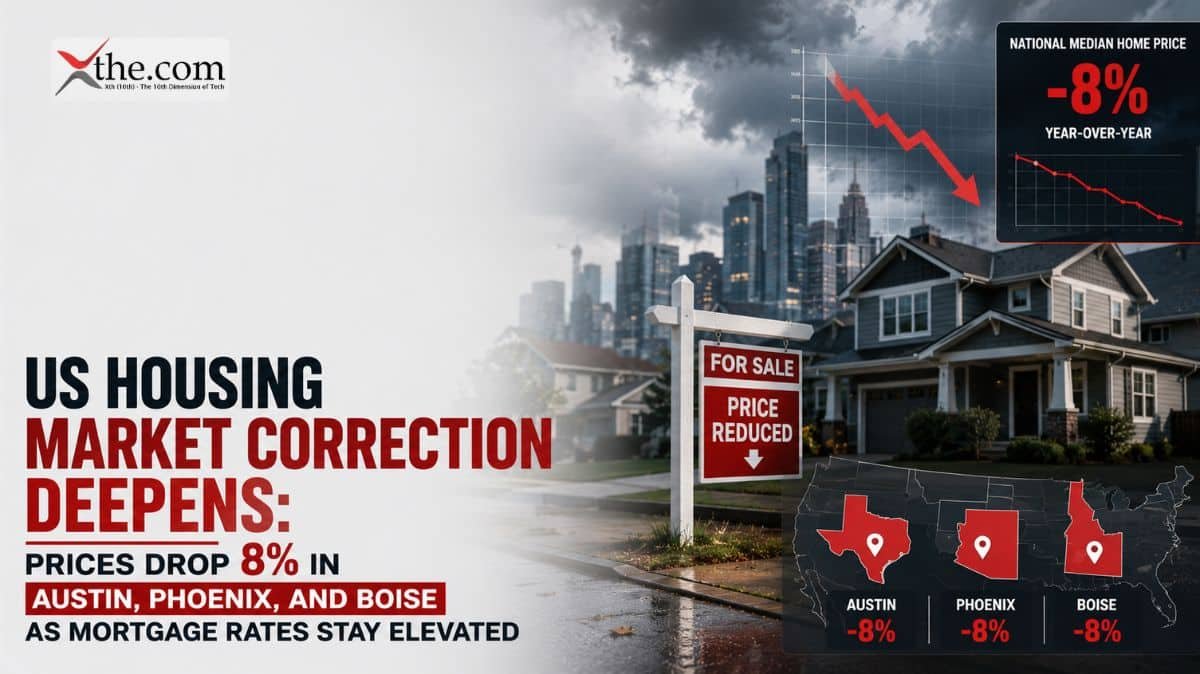
The American housing market is experiencing its sharpest correction since the 2008 financial crisis — though this time, the dynamics are fundamentally different. According to data released Tuesday by the S&P CoreLogic Case-Shiller Index, home prices in previously red-hot markets have fallen 6% to 11% from their 2025 peaks, with Austin, Texas leading the decline at 11.3%, followed by Phoenix (-9.1%) and Boise, Idaho (-8.7%). Nationally, prices have slipped 2.4% year-over-year, the first annual decline since 2012.
Why Prices Are Falling
The correction stems from a toxic combination of persistently high mortgage rates and deteriorating affordability. Despite Federal Reserve hints at September rate cuts, the average 30-year fixed mortgage rate remains stubbornly at 6.4% — down from 7.2% in June but still double the pandemic-era lows of 2.8%. At these rates, the monthly payment on a median-priced $420,000 home with 20% down is $2,115, up from $1,380 in 2021.
“Buyers have simply hit a wall,” said Lawrence Yun, chief economist at the National Association of Realtors. “Wages grew 4.2% last year, but housing costs grew 18% over three years. The math no longer works for median-income families.”
Additionally, the “lock-in effect” is cracking. Homeowners who secured 3% mortgages during 2020-2021 are increasingly willing to sell and accept higher rates, either due to job relocations, divorce, or simply exhaustion from waiting for rates to drop. Housing inventory has risen 34% nationally since January, shifting the market from extreme seller scarcity toward balance.
The Austin Collapse
Austin exemplifies the boom-to-bust cycle. The Texas capital saw median home prices skyrocket from $350,000 in 2019 to $620,000 in mid-2025, fueled by tech relocations from California and remote workers flush with stock market gains. Now, prices have retreated to $550,000 and continue falling.
Local real estate agent Jennifer Walsh described the shift: “In 2025, we had 20 offers on every listing, $100,000 over asking, waived inspections. Last week, I had a listing in Round Rock sit for 45 days, then sell for $40,000 under asking with the seller paying $8,000 in buyer closing costs. The power dynamic has completely flipped.”
New construction is also suffering. PulteGroup and Lennar have both announced 15% reductions in Austin-area starts for Q3 and Q4 2026, fearing oversupply.
Phoenix and Boise: Pandemic darlings stumble
Phoenix, which attracted thousands of California refugees during remote-work exodus, has seen demand evaporate as employers enforce return-to-office mandates. The city now has 5.2 months of housing inventory — a six-year high. Boise, once the fastest-appreciating market in America with 45% price growth in 2021 alone, has fallen back to 2023 price levels as speculative investment dries up.
Where Prices Are Still Rising
Not all markets are suffering. Midwestern and Northeastern cities with more affordable baselines continue seeing modest appreciation. Pittsburgh (+3.1%), Cleveland (+2.8%), and Hartford, Connecticut (+4.2%) remain resilient, buoyed by stable local economies and limited new construction. The “Great Migration” to Sun Belt states is showing signs of reversal as affordability vanishes.
Investor Activity Drying Up
Institutional investors like Blackstone’s Invitation Homes and American Homes 4 Rent, which purchased over 14% of US starter homes between 2020 and 2024, have dramatically slowed acquisitions. Invitation Homes bought just 127 properties nationwide in Q2 2026, down from 2,400 in Q2 2024. Higher borrowing costs have made the single-family rental model less profitable, removing a key source of demand that had propped up prices.
What Buyers Should Do
For the first time in years, buyers hold leverage. Negotiation is back: sellers are accepting contingencies, repair credits, and rate buydowns. First-time buyers with stable employment and 10-20% down payments should seriously consider entering the market this fall, particularly if the Fed cuts rates in September and triggers a winter buying rush.
However, buyers should avoid timing the bottom perfectly. “Housing is a long-term asset,” cautioned Zillow senior economist Jeff Tucker. “If you plan to stay five-plus years, buying at a 5% discount from peak with rates near 6% is reasonable. Waiting for 4% mortgages again could mean waiting until 2028.”
The Rental Market Ripple
Falling home prices are pressuring rents, which had risen 22% nationally since 2022. Apartment List reported that median rents in Austin declined 4.1% year-over-year, with Phoenix (-3.8%) and Boise (-5.2%) following suit. This provides relief to the 35% of American households that rent, though affordability remains stretched in coastal cities like New York and San Francisco.
Recession Fears Linger
Some economists warn that housing weakness could trigger broader economic contraction. Residential construction accounts for roughly 4% of GDP, and the sector has shed 78,000 jobs since March. If housing continues deteriorating through Q4, it could drag the entire economy into recession regardless of Fed policy.








