






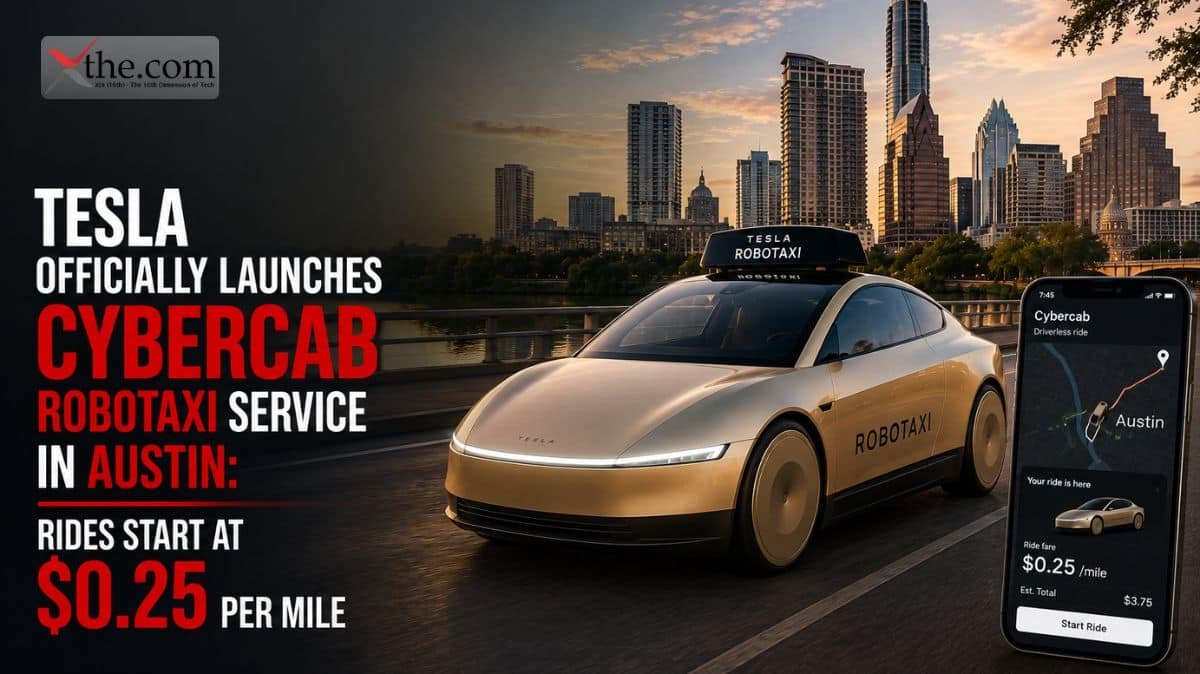
Elon Musk took the stage at Tesla’s Gigafactory Texas on Tuesday night to flip the switch on the company’s long-promised robotaxi network. Starting August 13, 2026, Austin residents can hail a fully autonomous Cybercab through the Tesla app — no safety driver, no steering wheel intervention, and no human backup behind the curtain. The launch makes Austin the first city in the world where a major automaker operates a commercial driverless ride-hailing fleet using only cameras and neural networks, rejecting the lidar-heavy approach favored by Waymo and Cruise.
How the Cybercab Network Works
Users open the Tesla app, enter a destination, and a white, two-door Cybercab with butterfly doors arrives within 5 to 12 minutes. The vehicle has no steering wheel, no pedals, and no rearview mirrors — just a minimalist interior with two seats, a 15-inch touchscreen, and a panoramic glass roof. Fares are aggressively undercutting Uber and Lyft: $0.25 per mile plus a $1.50 base fee, meaning a 10-mile trip across Austin costs roughly $4.00 compared to $18-$24 on traditional ride-sharing platforms.
Tesla is deploying 300 Cybercabs across Austin initially, concentrated in downtown, the Domain, South Congress, and the airport corridor. The company plans to expand to 1,000 vehicles by October and enter San Francisco, Los Angeles, and Phoenix by early 2027.
The Technology Behind the Wheel
Unlike Waymo’s fifth-generation Jaguar I-PACEs that carry $30,000 in lidar and radar hardware, Tesla’s Cybercab relies entirely on a suite of eight cameras feeding into an upgraded Full Self-Driving (FSD) computer. Musk claims the system, dubbed “FSD v13,” has been trained on over 20 billion miles of real-world driving data from Tesla’s customer fleet.
“Tesla’s approach is fundamentally different,” said Dr. Karl Iagnemma, former CEO of NuTonomy and now an autonomous vehicle consultant at MIT. “Waymo maps every centimeter of road beforehand. Tesla believes its neural network can generalize to any road, any city, without pre-mapping. It’s riskier, but if it works, it’s infinitely more scalable.”
However, critics note that camera-only systems struggle in heavy rain, direct sunlight glare, and complex construction zones — all common in Texas summers.
Safety Record and Regulatory Backing
The Texas Department of Transportation granted Tesla a statewide autonomous vehicle deployment permit in June 2026, citing the company’s safety data from 50 million miles of supervised FSD testing. Tesla reported 0.28 at-fault accidents per million miles during its pilot phase, compared to the national human driver average of 1.35 per million miles.
Still, the launch is not without controversy. The National Highway Traffic Safety Administration opened a preliminary evaluation last month after three separate incidents where FSD-enabled Teslas failed to detect stationary emergency vehicles on Interstate 35. No injuries were reported, but consumer advocacy groups have demanded a pause.
“NHTSA is closely monitoring Tesla’s robotaxi deployment,” said agency spokesperson Lucia Sanchez. “We have the authority to order an immediate suspension if safety data warrants it.”
Economic Disruption
Austin’s 12,000 Uber and Lyft drivers are watching nervously. The Rideshare Drivers United union issued a statement warning that “Tesla is pricing rides below cost to destroy human-driving jobs, then will raise prices once competition is eliminated.” Tesla counters that the Cybercab creates new jobs in fleet maintenance, remote monitoring, and charging infrastructure.
Local economists project mixed outcomes. The Perryman Group estimates robotaxis could reduce drunk driving incidents in Austin by 40% and save commuters $220 million annually in transportation costs. Conversely, the city could lose $8 million in annual ride-sharing tax revenue if traditional platforms are pushed out.
Public Reaction
Early riders who tested the service during Tesla’s employee-only beta described the experience as “eerily smooth” and “like riding in the future.” However, some reported confusion when the Cybercab hesitated at unprotected left turns or slowed excessively for jaywalkers near Sixth Street nightlife districts.
“I felt safe, but I also felt like I wanted to grab a steering wheel that wasn’t there,” said beta tester Marcus Chen, a UT Austin student. “It drives like a very cautious grandma.”
What’s Next
Tesla plans to allow Cybercab owners to add their personal vehicles to the robotaxi network when not in use — Musk’s long-promised “Airbnb for cars” model. The company will take a 25% cut of fares from owner-operators. Whether Tesla can maintain its safety record while scaling nationwide remains the billion-dollar question that will define the future of American transportation.








