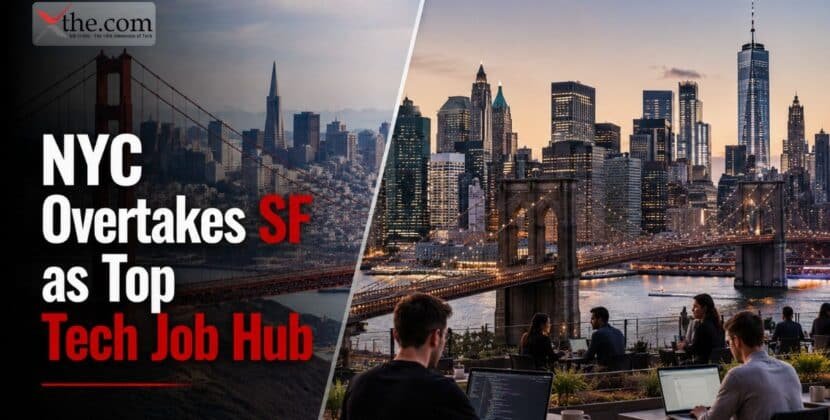





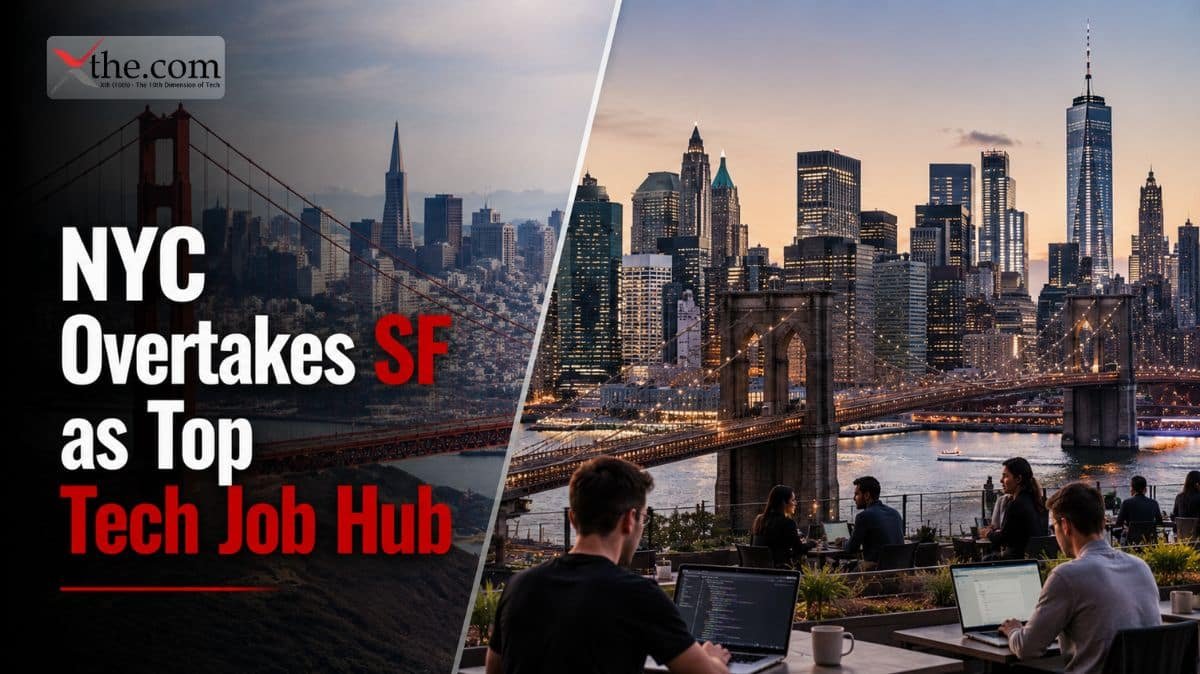
For the first time in 13 years, New York City has officially overtaken San Francisco as the top tech job market in the United States, according to a comprehensive new report from commercial real estate firm CBRE. The findings, published in August 2026, mark a historic shift in the geography of America’s technology industry.
The data, sourced from the U.S. Bureau of Labor Statistics, reveals that New York’s tech talent workforce grew to 394,300 in 2025, compared to San Francisco’s 375,730. The gap of nearly 19,000 workers represents a significant lead and ends Silicon Valley’s long dominance as the undisputed capital of American tech employment.
The Numbers Behind the Shift
The CBRE report provides a detailed breakdown of tech employment across major U.S. cities. New York’s tech workforce grew by approximately 12,000 positions in 2025, driven primarily by expansion in fintech, AI startups, and enterprise software companies. Meanwhile, San Francisco saw a decline of roughly 8,500 tech positions — the largest single-year drop in the city’s history.
Other cities also showed strong growth. Austin, Texas added approximately 15,000 tech jobs, bringing its total to 125,000. Seattle, home to Amazon and Microsoft, grew by 5,000 positions to reach 210,000. Boston and Washington D.C. also posted gains, though at smaller scale.
The shift is particularly notable because San Francisco has been synonymous with the tech industry since the dot-com boom of the late 1990s. The term Silicon Valley itself refers to the region south of San Francisco, and for decades, the city and its surrounding areas were the unquestioned center of the technology universe.
What Is Driving New York’s Rise?
Multiple interconnected factors are contributing to New York’s ascension as the top tech market. The most significant is the permanent shift toward remote and hybrid work that began during the COVID-19 pandemic. When companies allowed employees to work from anywhere, many tech workers left the Bay Area for more affordable cities — and New York, despite its high cost of living, offered something San Francisco could not: a vibrant, diverse culture and a massive non-tech economy.
The second major factor is the convergence of Wall Street and Silicon Valley. New York’s financial sector has increasingly merged with technology, creating thousands of high-paying roles in fintech, algorithmic trading, blockchain development, and AI-powered financial services. Companies like Bloomberg, Citadel, and Two Sigma now compete directly with Google and Meta for top engineering talent.
Third, big tech companies have dramatically expanded their New York presence. Google’s Hudson Yards campus now houses thousands of employees. Amazon’s Long Island City campus continues to grow. Meta, Apple, and Microsoft have all opened or expanded New York offices in recent years.
Fourth, New York’s startup ecosystem has exploded. The city is now the second-largest venture capital market in the country, with particularly strong clusters in AI, healthtech, climate tech, and enterprise software. New York-based startups raised over $35 billion in venture capital in 2025, nearly matching the Bay Area’s total.
The Human Story Behind the Numbers
Behind these statistics are thousands of individual decisions. Software engineers who grew tired of San Francisco’s housing crisis and moved to Brooklyn. AI researchers who chose New York’s universities and research labs over Bay Area companies. Product managers who preferred the energy and diversity of Manhattan over the suburban campuses of Silicon Valley.
Consider the case of Sarah Chen, a machine learning engineer who moved from San Francisco to New York in 2024. In San Francisco, she was paying $3,800 per month for a one-bedroom apartment in the Mission District. In New York, she found a similar apartment in Williamsburg for $3,200 — and she was closer to restaurants, cultural institutions, and her extended family.
I thought I would miss the Bay Area, Chen told CBRE researchers. But New York has everything Silicon Valley has, plus a hundred things it does not.
What This Means for Job Seekers
If you are a technology professional considering your next career move, this data has important implications. New York now offers the highest concentration of tech jobs in the country, with particularly strong opportunities in fintech, AI, advertising technology, and media tech.
However, San Francisco still leads in startup culture and venture capital funding per capita. If you are an entrepreneur looking to raise a seed round, the Bay Area remains the best place to be.
Austin offers the best combination of tech job growth and affordability. The city added 15,000 tech positions in 2025 and continues to attract major employers including Tesla, Oracle, and numerous AI startups.
Remote work remains the most flexible option for many roles. According to CBRE, approximately 40% of tech positions in the United States now offer full or partial remote work, giving professionals the freedom to live wherever they choose.
The Future of Tech Geography
This historic shift reflects a broader trend that is reshaping the American technology industry. Tech is no longer synonymous with Silicon Valley. As artificial intelligence, fintech, healthtech, and climate technology grow, tech talent is spreading across the country — and New York is leading the charge.
The implications extend beyond employment numbers. As tech workers move to new cities, they bring their spending power, their networks, and their entrepreneurial energy. This creates virtuous cycles of innovation and job creation that benefit entire regions.
For San Francisco, the challenge is clear: adapt or decline. The city must address its housing crisis, improve public safety, and create a more welcoming environment for both workers and businesses. Otherwise, the exodus will continue.
For New York, the opportunity is enormous. The city has the talent, the capital, and the culture to become the permanent home of America’s tech industry. The question is whether it can maintain this momentum over the next decade.
Sources: