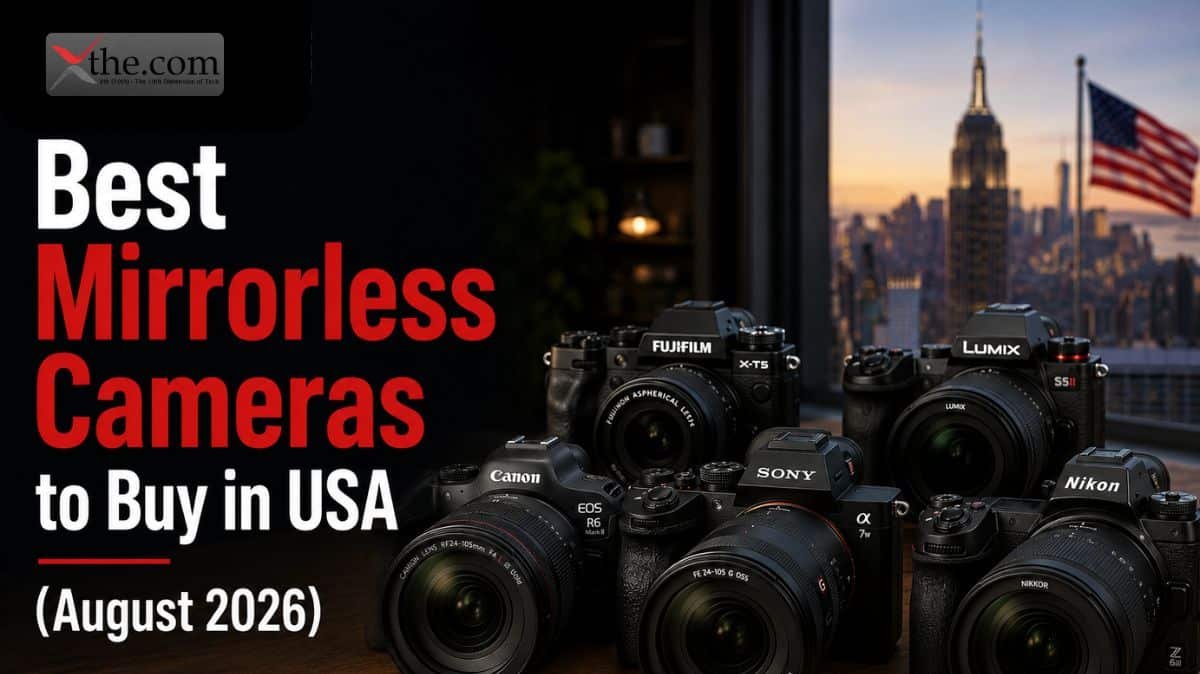
Why Mirrorless Cameras Dominate in 2026
The digital camera market in the United States is experiencing a renaissance, and mirrorless cameras are leading the charge. According to industry analysis, the global digital camera market reached $7.51 billion in 2026, growing at a compound annual growth rate of 5.5%. Mirrorless systems now command 57.85% of the market share, having decisively overtaken DSLRs as the preferred choice for both professionals and enthusiasts.
In the USA specifically, North America leads the global market with a 27.3% share, driven by high disposable incomes, strong uptake of mirrorless systems, and the explosive growth of content creation as a profession.
What’s driving this growth? Three factors:
- Content Creator Economy: YouTube, TikTok, and Instagram have turned camera ownership from a hobby into a business necessity
- AI-Assisted Features: Modern cameras offer computational autofocus, subject recognition, and auto-framing that make professional results accessible to beginners
- Compact Professional Quality: Mirrorless bodies deliver full-frame image quality in packages smaller than yesterday’s consumer DSLRs
Best Overall: Sony a6700
Price: ~$1,398 (body only) Best For: Most travelers, hybrid shooters, enthusiasts
The Sony a6700 is, without question, the best all-round mirrorless camera for most people in 2026. It hits a sweet spot of size, image quality, features, and price that’s genuinely hard to beat.
Why It Wins:
- 26MP APS-C sensor with in-body image stabilization (IBIS)
- Autofocus borrowed from Sony’s professional cameras — recognizes people, animals, birds, and vehicles
- 4K video with excellent color science
- Weather-sealed body with tilting touchscreen
- Compact enough for all-day carry, powerful enough for professional work
The a6700 is the camera we recommend to friends who ask, “Which camera should I buy?” It’s not cheap, but you’re getting technology that will handle everything from street photography in New York to wildlife in Yellowstone. Pair it with the Sony 18-135mm lens and you have a kit that covers 95% of shooting situations in a bag small enough for airline carry-on.
Best Full-Frame Value: Canon EOS R6 III
Price: ~$2,800 (body only) Best For: Enthusiasts stepping up to full-frame, wedding photographers
The Canon EOS R6 III is the best full-frame camera for the money in 2026. It offers professional-grade features at a price that undercuts flagship models by thousands of dollars.
Key Specs:
- 32.5MP full-frame sensor (up from 24MP on the R6 II)
- 40 fps continuous shooting
- 7K RAW video — a rarity at this price point
- Dual memory card slots
- Canon’s superb Dual Pixel autofocus system
What makes the R6 III special is that its autofocus system is practically as good as the $4,400 Canon R5 II. For action photography, weddings, and events, the R6 III delivers flagship performance at a mid-tier price. The original R6 II is still available for around $2,000 on sale, making it an exceptional budget alternative.
Best for Professionals: Canon EOS R5 II
Price: ~$4,400 (body only) Best For: Professional photographers, commercial work, high-end enthusiasts
The Canon EOS R5 Mark II is the best travel camera money can buy, and arguably the most capable hybrid camera on the market. It combines a 45-megapixel sensor with 30 fps continuous shooting and 8K 60p video — specifications that would have required multiple specialized cameras just five years ago.
Who Should Buy It:
- Professional landscape photographers who need 45MP resolution
- Wedding photographers who shoot both stills and video
- Commercial shooters who deliver 8K content
- Wildlife photographers who need speed and resolution
The R5 II goes on sale frequently, and the original R5 — still an exceptional camera — can be found for as low as $2,600 during promotional periods. For most buyers, the original R5 offers 90% of the Mark II’s performance at 60% of the price.
Best High-Resolution: Sony A7R V
Price: ~$4,200 (body only) Best For: Landscape, architecture, studio, and detail-oriented photographers
If resolution is your priority, the Sony A7R V remains the king. Its 61-megapixel sensor captures detail that medium-format cameras struggled to match just a few years ago. Despite the massive resolution, it still manages 10 fps continuous shooting with a buffer of 583 images — more than enough for wildlife and action work.
The A7R V’s autofocus system uses Sony’s newest AI subject-recognition algorithms, meaning it can track birds, people, and animals even when they face away from the camera or adopt unusual poses. For photographers who need maximum detail for large prints or heavy cropping, the A7R V is unmatched outside of dedicated medium-format systems.
Best Compact: Fujifilm X100VI
Price: ~$1,600 Best For: Street photographers, travel minimalists, film enthusiasts
The Fujifilm X100VI is the camera that proves you don’t need interchangeable lenses to create professional work. This fixed-lens compact features a 40MP APS-C X-Trans sensor, in-body stabilization rated at 6EV of correction, and Fujifilm’s legendary film simulation modes that produce JPEGs requiring no editing.
The X100VI is difficult to find in stock — demand has consistently outstripped supply since its launch. But for photographers who want a camera that fits in a jacket pocket yet produces images that rival full-frame systems, it’s worth the wait.
Why It Stands Out:
- Fixed 35mm equivalent F2 lens forces creative composition
- Film simulations (Classic Chrome, Acros, Velvia) produce stunning straight-out-of-camera JPEGs
- Hybrid optical/electronic viewfinder is unique in the market
- Built-in ND filter for shooting wide open in daylight
Best Budget: Nikon Z50 II
Price: ~$1,000 (with kit lens) Best For: Beginners, students, second-camera body
The Nikon Z50 II is the best entry-level mirrorless camera in the USA for 2026. It borrows its autofocus system from the flagship Nikon Z9, giving beginners access to professional-grade subject tracking at a fraction of the cost.
What You Get:
- 20MP APS-C sensor (sufficient for social media and moderate prints)
- Excellent ergonomics and menu system
- Compact size with substantial grip
- Access to Nikon’s growing Z-mount lens ecosystem
The 20MP resolution is lower than competitors, which limits cropping flexibility. But at around $1,000 with a kit lens, the Z50 II delivers professional autofocus performance that no other camera at this price can match.
Best for Travel: Sony a7CR
Price: ~$3,200 Best For: Travel photographers who need full-frame quality in a compact body
The Sony a7CR packs a 61MP full-frame sensor into a body barely larger than Sony’s APS-C cameras. It offers the resolution of the A7R V with the portability of the a6700, making it the ideal travel camera for photographers who refuse to compromise on image quality.
USA Camera Market Trends 2026
The American camera market is evolving rapidly. Here are the trends shaping purchases in 2026:
Rising Prices Due to Tariffs: Supply-chain shocks and U.S. tariffs have pushed retail prices 20-40% higher across leading brands. Buying during Amazon Prime Day, Black Friday, and holiday sales is more important than ever.
AI-Powered Features: Computational autofocus, auto-framing, and AI subject detection are now standard on mid-tier cameras. These features are particularly valuable for solo content creators who don’t have a camera operator.
Creator Economy Growth: Content creators now represent the fastest-growing camera buyer segment, with a 6.44% CAGR through 2031. Manufacturers are prioritizing video features, live-stream integration, and vertical video support.
Compact Camera Revival: After years of decline, premium compact cameras are experiencing a resurgence. Models like the Fujifilm X100VI and Ricoh GR IV are selling out, driven by demand for “anti-smartphone” photography tools that offer tactile control and superior image quality.
Frequently Asked Questions
Q: What is the best mirrorless camera for beginners in 2026? A: The Canon EOS R100 with an 18-45mm kit lens is the best budget pick at around $679. For slightly more, the Nikon Z50 II at ~$1,000 offers professional autofocus.
Q: Are DSLR cameras dead in 2026? A: Effectively yes. Canon, Nikon, and Sony have all ceased DSLR development. Mirrorless cameras now offer superior autofocus, video, and compactness. Existing DSLRs still work, but new buyers should choose mirrorless.
Q: Should I buy full-frame or APS-C? A: Choose full-frame if you need the best low-light performance, shallow depth of field, or plan to print large. Choose APS-C if you prioritize compact size, lower cost, and lighter lenses.
Q: When do cameras go on sale in the USA? A: The best deals appear during Amazon Prime Day (July), Black Friday (November), and post-holiday clearance (January). Sony rarely discounts, but Canon and Nikon offer significant savings during these periods.
Q: Is the camera market growing or shrinking? A: The digital camera market is growing at 5.5% CAGR, reaching $7.51 billion in 2026. While smartphone cameras have replaced point-and-shoots, demand for professional and enthusiast cameras is increasing.
External Sources:
- Photography Life: https://photographylife.com/best-mirrorless-camera
- Mordor Intelligence: https://www.mordorintelligence.com/industry-reports/digital-camera-market
- Finding the Universe: https://www.findingtheuniverse.com/best-travel-camera/