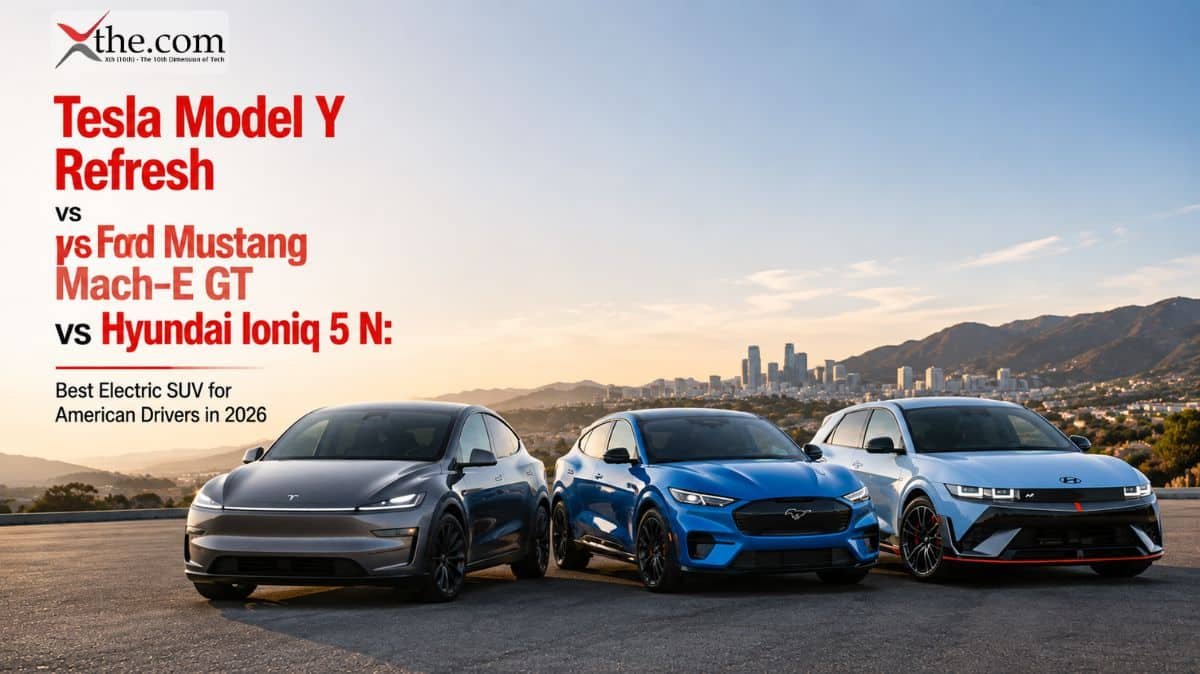
The American electric vehicle market has matured beyond early-adopter novelty into mainstream family transportation. Three vehicles dominate the midsize electric SUV segment in 2026: Tesla’s Model Y Juniper Refresh, Ford’s Mustang Mach-E GT Performance, and Hyundai’s Ioniq 5 N. All three qualify for the federal $7,500 EV tax credit, offer over 250 miles of range, and seat five passengers comfortably. Yet they appeal to fundamentally different buyers.
This comparison examines real-world range, charging infrastructure, interior quality, performance, safety, and total cost of ownership to determine which electric SUV deserves your garage space.
Core Differences
Tesla’s Model Y Refresh is the efficiency champion — a minimalist tech product disguised as transportation. The Mustang Mach-E GT brings American muscle heritage into the electric age with aggressive styling and engaging driving dynamics. The Hyundai Ioniq 5 N is the wildcard — a Korean performance crossover that out-accelerates supercars while offering vehicle-to-load power outlets that can run your house during blackouts.
Key Comparison Table
Table
| Feature | Tesla Model Y Refresh | Ford Mustang Mach-E GT | Hyundai Ioniq 5 N | Winner |
| Starting Price | $48,990 | $59,995 | $67,475 | Model Y |
| Tax Credit Eligible | Yes ($7,500) | Yes ($3,750 partial) | Yes ($7,500) | Model Y / Ioniq |
| Range (EPA) | 320 miles | 270 miles | 221 miles | Model Y |
| 0-60 mph | 4.6 seconds | 3.5 seconds | 3.2 seconds | Ioniq 5 N |
| Top Speed | 135 mph | 124 mph | 162 mph | Ioniq 5 N |
| Horsepower | 384 hp | 480 hp | 641 hp | Ioniq 5 N |
| Charging (10-80%) | 18 minutes (Supercharger V4) | 32 minutes (DC fast) | 18 minutes (350kW) | Tie |
| Charge Port | NACS (Tesla + Ford adapter) | NACS native | NACS adapter included | Tie |
| Cargo Space | 76 cu ft | 59 cu ft | 59 cu ft | Model Y |
| Infotainment | 15.4″ touchscreen, no buttons | 15.5″ touchscreen + physical dial | 12.3″ dual screens + buttons | Subjective |
| Autonomy | Autopilot standard, FSD $8,000 | BlueCruise 1.2 (hands-free) | Highway Driving Assist 2 | Model Y |
| Build Quality | Improved panel gaps, softer materials | Traditional Ford fit and finish | Premium materials, solid assembly | Ioniq 5 N |
| Warranty | 4 yr / 50,000 mi | 3 yr / 36,000 mi | 5 yr / 60,000 mi + 10 yr battery | Ioniq 5 N |
Real-World Range and Efficiency
EPA ratings tell only part of the story. In InsideEVs’ 70-mph highway range test conducted in Texas during July 2026, the Model Y Refresh achieved 298 miles — 93% of its EPA rating. The Mach-E GT managed 241 miles (89% of EPA). The Ioniq 5 N, hampered by its performance tires and aggressive aerodynamics, delivered 196 miles (89% of EPA).
For daily commuting, all three are adequate. But for road trips — the psychological barrier that still deters many Americans from going electric — Tesla’s advantage is decisive. The Model Y’s superior efficiency means fewer charging stops and less time plugged in.
Charging Infrastructure: Tesla’s Moat Cracks
Tesla’s Supercharger network remains the gold standard, with 28,000 stalls nationwide and 99.5% uptime reliability. The Model Y Refresh charges at 250kW on V3 Superchargers and 350kW on the new V4 stations rolling out along I-95 and I-10 corridors. A 10-minute charge adds approximately 120 miles of range.
However, Ford and Hyundai now have Tesla Supercharger access. Ford began shipping NACS adapters to Mach-E owners in May 2026, and Hyundai includes the adapter at purchase. Both vehicles can charge at Tesla stations, though non-Tesla cars currently pay $0.03-$0.05 per kWh more than Tesla owners.
Electrify America — Hyundai’s primary charging partner — has improved reliability significantly, with 94% uptime in 2026 compared to 78% in 2024. But station density remains lower than Tesla’s, particularly in rural Mountain West states.
Performance and Driving Dynamics
The Ioniq 5 N is the shock of this comparison. With 641 horsepower and 568 lb-ft of torque from dual motors, it launches from 0-60 mph in 3.2 seconds — faster than a Porsche 911 Carrera. Hyundai’s N e-Shift system simulates gear shifts with torque interruptions, creating a visceral driving experience that other EVs lack. Drift Mode allows controlled oversteer on racetracks. The chassis, developed on the Nürburgring, handles corners with sports-car precision.
The Mach-E GT is no slouch at 3.5 seconds to 60 mph, but it feels heavier and less agile than the Hyundai. Ford tuned the suspension for American highway comfort rather than canyon carving. The Mach-E excels at merging onto interstates and passing slow traffic, but push it hard on winding roads and understeer appears earlier than in the Ioniq.
The Model Y Refresh is the slowest at 4.6 seconds, but Tesla’s instant throttle response and low center of gravity still make it feel quicker than most gasoline SUVs. The revised suspension for 2026 finally addresses the harsh ride quality that plagued earlier Model Ys, though it remains firmer than the Mach-E.
Interior and Technology
Tesla’s minimalist interior remains polarizing. The 15.4-inch touchscreen controls everything — wipers, mirrors, glovebox, even the turn signal stalks have been replaced with steering wheel buttons. Build quality improved significantly in the Refresh: softer touch materials, real aluminum trim, and panel gaps that no longer invite internet mockery. But the lack of a driver’s instrument cluster forces eyes off the road to check speed.
The Mach-E GT offers the most familiar layout to drivers switching from gasoline vehicles. A 10.2-inch digital instrument cluster sits behind the steering wheel, while a 15.5-inch portrait touchscreen handles infotainment. Ford’s Sync 4A system supports wireless Apple CarPlay and Android Auto — features Tesla stubbornly refuses to offer. Physical climate controls and a volume knob reduce distraction.
The Ioniq 5 N splits the difference with dual 12.3-inch screens under a single glass panel, augmented by physical buttons for climate and drive mode. The seats are aggressively bolstered N sport buckets that hold occupants during high-G cornering but may feel restrictive for larger drivers. Hyundai’s use of recycled and vegan leather materials appeals to environmentally conscious buyers.
Safety Ratings and Autonomy
All three vehicles earned five-star overall ratings from NHTSA and Top Safety Pick+ designations from IIHS. Tesla’s Autopilot remains the most capable highway driving assistant, though Full Self-Driving (FSD) at $8,000 still requires driver supervision and cannot handle complex urban environments reliably. Ford’s BlueCruise 1.2 offers hands-free driving on 130,000 miles of mapped highways — impressive, but less comprehensive than Tesla’s network.
The Ioniq 5 N’s Highway Driving Assist 2 provides solid lane-centering and adaptive cruise control but lacks the sophistication of American competitors. Hyundai has not yet deployed a true hands-free system in the US market.
Total Cost of Ownership
Over five years and 75,000 miles, the financial picture shifts from the upfront sticker price:
Table
| Cost Component | Model Y Refresh | Mach-E GT | Ioniq 5 N |
| Purchase Price (after tax credit) | $41,490 | $56,245 | $59,975 |
| 5-Year Fuel (Electricity) | $3,200 | $3,800 | $4,100 |
| Maintenance | $1,500 | $2,100 | $1,800 |
| Insurance (annual avg) | $1,680 | $1,920 | $2,240 |
| Depreciation (5 yr) | $18,400 | $24,800 | $27,300 |
| 5-Year Total | $66,270 | $88,865 | $95,415 |
The Model Y’s lower purchase price, superior efficiency, and slower depreciation make it the clear financial winner. Tesla’s resale value remains the strongest in the EV industry, with 3-year-old Model Ys retaining 68% of original MSRP compared to 52% for the Mach-E and 48% for the Ioniq 5.
Who Should Buy Which?
Buy the Tesla Model Y Refresh if you:
- Want the best range and charging convenience for road trips
- Value minimal operating costs and strong resale value
- Are comfortable with touchscreen-centric controls
- Need maximum cargo space (76 cu ft with seats folded)
- Want the most mature autonomous driving features
Buy the Ford Mustang Mach-E GT if you:
- Prefer traditional automotive controls and familiar brand heritage
- Want engaging performance without sacrificing daily comfort
- Need wireless Apple CarPlay and Android Auto
- Qualify for X-Plan or A-Plan pricing through employer partnerships
- Want a balance between sportiness and practicality
Buy the Hyundai Ioniq 5 N if you:
- Are an enthusiast who wants supercar acceleration in a practical SUV
- Value the best warranty coverage in the industry (10-year battery)
- Want vehicle-to-load capability to power camping equipment or home appliances
- Appreciate unique, retro-futuristic design that stands out in parking lots
- Plan to track the vehicle or enjoy backroad driving
Verdict
The Tesla Model Y Refresh wins for the mainstream American buyer. Its combination of range, charging infrastructure, lower total cost of ownership, and improved build quality make it the rational choice for families transitioning from gasoline vehicles.
The Hyundai Ioniq 5 N wins for driving enthusiasts who refuse to accept that electric vehicles must be boring appliances. It is the most exciting vehicle in this comparison by a wide margin — but that excitement costs $20,000 more than the Tesla and sacrifices 124 miles of range.
The Ford Mustang Mach-E GT occupies the middle ground — more exciting than Tesla, more practical than Hyundai, but outperformed by both on their respective strengths. It is the safe choice for buyers who want an American-branded EV without Tesla’s polarizing reputation.
FAQs
1. Which electric SUV has the longest range in 2026?
The Tesla Model Y Refresh leads with 320 miles EPA-rated range, followed by the Ford Mustang Mach-E GT at 270 miles and the Hyundai Ioniq 5 N at 221 miles.
2. Can the Hyundai Ioniq 5 N charge at Tesla Superchargers?
Yes, Hyundai includes a NACS adapter with the Ioniq 5 N, allowing charging at Tesla Supercharger stations. However, non-Tesla vehicles typically pay slightly higher per-kWh rates.
3. Is the Ford Mustang Mach-E GT faster than a Tesla Model Y?
The Mach-E GT accelerates from 0-60 mph in 3.5 seconds, faster than the Model Y Refresh’s 4.6 seconds. However, the Hyundai Ioniq 5 N is fastest at 3.2 seconds.
4. Which EV qualifies for the full $7,500 federal tax credit?
The Tesla Model Y Refresh and Hyundai Ioniq 5 N qualify for the full $7,500 credit. The Ford Mustang Mach-E GT qualifies for a partial $3,750 credit due to battery sourcing requirements.
5. How long does it take to charge these electric SUVs from 10% to 80%?
The Tesla Model Y Refresh and Hyundai Ioniq 5 N both charge in approximately 18 minutes on high-speed DC fast chargers. The Ford Mach-E GT requires about 32 minutes.
Sources: