



Houston, Texas
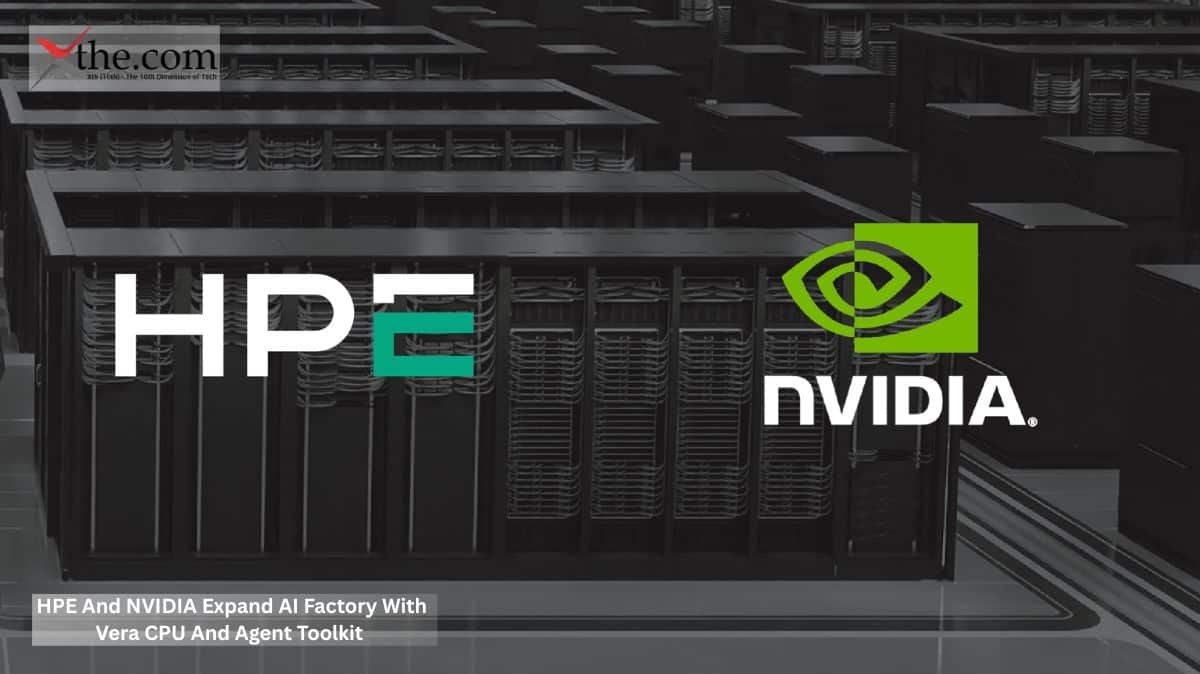
About 40% of companies testing autonomous AI agents have stopped before reaching production, based on several industry surveys this year. The main issue is not the AI model itself, but the supporting infrastructure. On June 16, HPE and Nvidia addressed this problem by expanding the HPE Nvidia AI Factory. This full-stack architecture is designed for the next stage of enterprise computing, where agents take action instead of just answering questions, such as chatbots.
The announcement, made at HPE Discover in Las Vegas, introduces three new features to HPE Private Cloud AI, the companies’ jointly developed platform. The Nvidia Vera CPU now leads a new compute layer designed for managing AI agents. The Nvidia Agent Toolkit adds tools for governance and monitoring agent behavior in real-world use. Nvidia Confidential Computing brings hardware-based data protection to the entire system, a key requirement that has slowed agent deployments in finance, healthcare, and government for nearly two years.
Why HPE And Nvidia Are Betting On Agentic AI Infrastructure
Generative AI was built to answer questions. Agentic AI, on the other hand, takes actions such as querying databases, executing trades, rewriting code, or escalating tickets, all without human approval at every step. This shift completely changes the infrastructure requirements. If a chatbot makes a mistake, it only wastes time. But if an autonomous agent with access to a financial system makes a mistake, it could move money, it should not.
HPE CEO Antonio Neri explained that as AI becomes more autonomous, organizations need systems designed to run it securely, manage it responsibly, and scale it efficiently. Nvidia CEO Jensen Huang agreed, saying that every part of the computing stack is being redesigned for what he calls the age of AI agents.
This redesign is exactly what HPE agentic AI infrastructure has been designed to deliver: not just a faster chip, but a coordinated package of computing, networking, governance software, and security hardware. This allows a CIO to move an agent from a test environment to a real production workflow with customer data, without having to rebuild the security model from the ground up.
The Vera CPU: A Compute Layer Built For Reasoning, Not Just Throughput
The main new hardware is the HPE ProLiant Compute DL394 Gen12, which uses the Arm-based Nvidia Vera CPU. This is where Nvidia Vera CPU enterprise AI workloads find a dedicated home. Unlike GPU-centric training clusters, the Vera CPU targets the sequential logic required by agentic reasoning. It manages tasks such as chaining decisions, evaluating tool calls, running reinforcement learning loops, and processing complex fiscal models, where single-core performance and RAM bandwidth are more important than mere parallel processing power.
The server provides about 1.2 terabytes per second of memory bandwidth, enabling faster multi-step agent reasoning in real workloads. For example, a financial reconciliation agent that goes through 10 steps can maintain its state between decisions instead of starting over each time. HPE has combined the chip with iLO 7 firmware and a secure enclave that meets NIST’s quantum-resistant security standards. This is important for regulated companies making long-term infrastructure choices. The DL394 Gen12 will be available in fall 2026, with HPE Private Cloud AI support coming in 2027.
The Vera CPU is part of the larger Vera Rubin platform, which powers extensive deployments. The HPE Nvidia Blackwell GPU AI Factory remains the main option for current projects. The new Vera Rubin NVL72 rack-scale system is designed for advanced models with over one trillion parameters. The HPE Compute XD700, built on Nvidia HGX Rubin NVL8 and supporting up to 128 Rubin GPUs per rack, increases capacity for companies with the largest training and inference needs.
Governing Autonomous Agents Before They Become A Liability
Computing power by itself does not solve the trust issue. This is where the Nvidia Agent Toolkit production deployment enters the picture. The toolkit includes Nvidia Nemotron open models, the NemoClaw blueprint, and the OpenShell secure runtime. HPE calls this an agent operating system, software designed to monitor agent behavior in real time, enforce governance policies, and flag problems before they become bigger risks.
In practice, this acts as a permissions layer for autonomous software. HPE Private Cloud AI now allows secure local agent registration, so IT teams can approve which models, skills, and tools an agent can use based on central policies. This prevents agents from accessing systems without approval. New HPE Zerto features help by detecting unauthorized agent actions and providing continuous data protection, so the environment can be restored to a clean state if an agent misbehaves when no one is watching.
Imagine a customer service agent who can issue refunds over an extended period. Without governance tools, a logic mistake or a harmful prompt could cause thousands of unauthorized operations before anyone notices. With the Agent Toolkit’s policy enforcement and Zerto’s rollback feature, such problems can be caught and fixed quickly rather than found much later during an audit.
Confidential Computing: The Missing Piece For Sensitive Workloads
For the past two years, enterprise security teams have asked the same question before allowing AI agents near regulated data: who can see the data while the model is working on it? Encryption protects data when it is stored or transmitted, but data being processed is usually exposed in memory. This creates a risk that attackers or even cloud providers could exploit.
HPE Confidential Computing AI tackles this risk by bringing Nvidia Confidential Computing to the entire HPE AI Factory lineup. Every chip in the Vera Rubin series now includes built-in hardware protection. This keeps model weights and sensitive data encrypted even while in use, and this is verified by hardware, not just a vendor’s policy. For example, a hospital using diagnostic agents on patient records or a bank using fraud-detection agents on transactions can move from pilot projects to full production that meets compliance standards. Nvidia Confidential Computing will be generally available for HPE AI Factory in the fourth quarter of 2026.
The Networking Backbone: Spectrum-X And BlueField
All of this depends on networking that can move huge amounts of data between thousands of GPUs without slowing things down. Nvidia Spectrum-X BlueField enterprise infrastructure is now the standard networking layer for HPE’s AI Factory, combining Nvidia Vera BlueField-4 DPUs and ConnectX-9 SuperNICs with Spectrum-X Ethernet switches. Nvidia’s benchmarks show about 1.6 times higher AI communication speed compared to regular Ethernet, which makes a big difference when training models or supervising multiple agents. For large or sovereign deployments, HPE also offers Nvidia Quantum-X800 InfiniBand through the HPE Cray Supercomputing GX5000, allowing customers to scale up without changing their governance or security setup.
The Bigger Picture: HPE’s Full-Stack Bet Against The Hyperscalers
This is where comparisons with AWS and Google Cloud help enterprise buyers make decisions. AWS Bedrock Agents and Google’s Gemini Enterprise Agent Platform, which replaced Vertex AI Agent Builder, both offer mature, API-based ways to use agentic AI and are closely tied to their own cloud systems. For companies already using AWS for data storage or BigQuery for analytics, this built-in integration is valuable and hard to match elsewhere.
HPE and Nvidia are offering something different: the HPE Nvidia AI Factory expansion Vera CPU, Agent Toolkit Blackwell GPU agentic AI enterprise 2026 as a deployable, on-premises or as a hybrid setup, with hardware, networking, governance software, and confidential computing all packaged together, instead of being pieced together from various cloud services. For regulated industries that need data control, or for organizations concerned about ongoing cloud costs at scale, this full-stack ownership model delivers a unique value compared to API-based solutions. It is not meant to replace Bedrock or Gemini Enterprise, but provides an alternative for buyers who want to own the infrastructure, not just use it.
This difference is especially clear when it comes to HPE Nvidia AI infrastructure for agentic multi-agent systems and confidential computing in enterprise deployments. Most large cloud providers use software-based isolation and contracts to manage data. HPE’s approach uses hardware-based confidential computing, which can prove that data was never exposed in clear text, no matter who runs the infrastructure. For defense contractors or multinational banks navigating data residency laws, this can be the deciding factor when choosing a solution.
What Enterprise IT Buyers Should Take From This
The rollout will happen in stages, not all at once. New HPE Private Cloud AI features will be available in July 2026, and HPE Data Fabric Software will come in October. Most of the agentic observability tools and Confidential Computing will be generally available in the fourth quarter. The Vera CPU server will be ready for production in fall 2026, but full Private Cloud AI integration will not happen until 2027.
This timeline is important for planning. Companies looking at agentic AI now should see this announcement as an outline for planning and budgeting, not as a product they can use right away. Organizations that start early with governance, secure agent registration, and confidential computing will be better prepared when all features become available than those that wait until everything is ready.
Autonomous agents are on the way, ready or not. HPE and Nvidia believe that the companies that succeed in the coming years will be those that establish strong control systems before agents start acting independently.
Source: HP accelerates enterprise workflows with OpenAI Frontier