





Menlo Park, California
For years, Meta Platforms invested tens of billions of dollars building AI infrastructure to support its own products, from Facebook and Instagram to WhatsApp and generative AI initiatives. Those investments were largely viewed as internal expenses aimed at improving advertising, recommendation systems, and AI-powered consumer services.
That strategy appears to be changing.
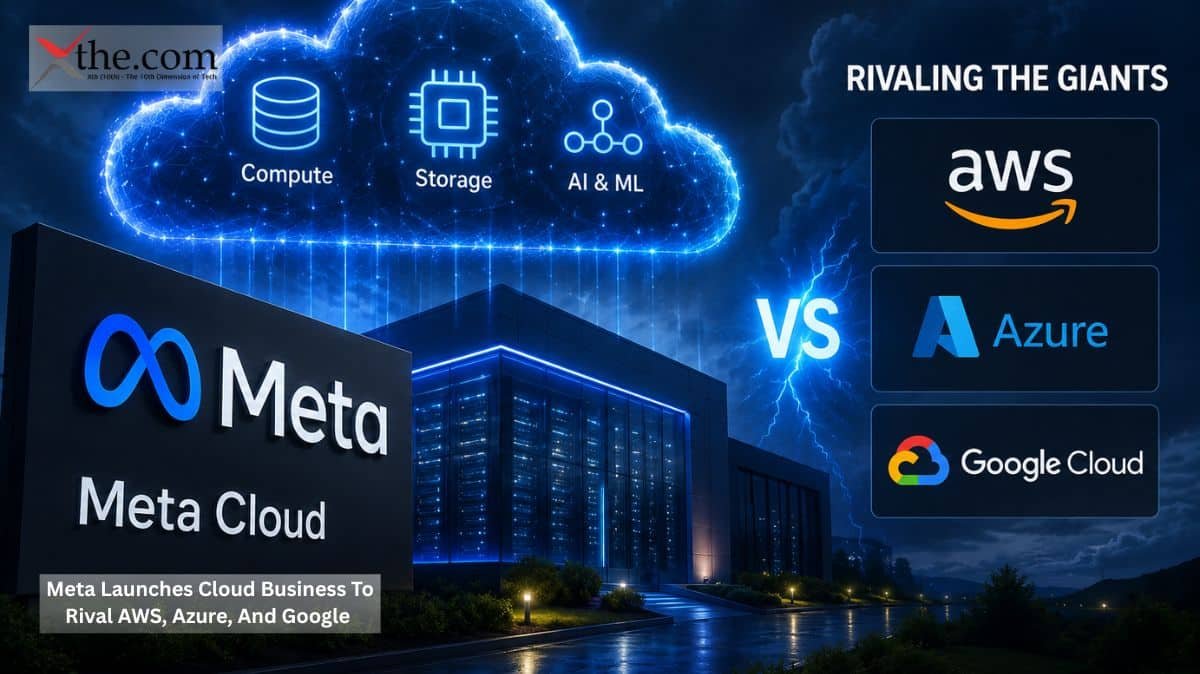
According to reports, Meta is developing a commercial cloud offering that would allow outside companies to purchase access to its AI infrastructure, creating a new Meta cloud business designed to compete directly with Amazon Web Services (AWS), Microsoft Azure, and Google Cloud. Rather than limiting its massive data centers to internal workloads, Meta could begin monetizing excess capacity while simultaneously expanding its presence in enterprise AI.
For technology executives, investors, and enterprise customers, the implications extend well beyond another cloud product launch.
Meta Cloud Business Marks A Strategic Shift.
Meta has never operated a traditional enterprise cloud platform. Unlike AWS, Azure, or Google Cloud, its infrastructure has been built almost entirely for internal use.
Now, Bloomberg reports suggest that the company wants to commercialize those assets.
The proposed Meta Compute initiative would reportedly generate revenue through two complementary services. One would provide customers with hosted access to Meta’s proprietary AI models, while the second would offer direct compute capacity for organizations that simply need graphics processing power without having to build expensive infrastructure themselves.
That approach immediately positions the Meta AWS rival strategy against two of the fastest-growing segments in enterprise AI.
Companies increasingly want access to large language models without having to manage the underlying hardware. Others simply need enormous quantities of GPUs to train proprietary AI systems. Meta appears interested in serving both markets simultaneously.
Why Meta AI compute for sale Changes The Competitive Landscape
Cloud computing has evolved far beyond virtual machines and storage.
The fastest-growing cloud revenue now comes from AI infrastructure.
Every major technology company is racing to secure GPU capacity as businesses deploy increasingly complex models requiring thousands of high-performance processors. Building that infrastructure internally costs billions of dollars, making cloud providers essential partners for AI development.
This explains why Meta AI compute for sale represents more than just another product announcement.
Instead of allowing unused processing capacity to remain idle during certain workloads, Meta could convert those resources into recurring enterprise revenue. The business model resembles airlines selling unused seats or utilities distributing excess electricity during periods of lower internal demand.
Infrastructure utilization improves profitability.
Enterprise customers gain immediate access to advanced hardware.
Meta gains a new revenue engine outside digital advertising.
Meta Compute initiative Could Mirror AWS Bedrock.
One reported component of Meta’s plans involves hosted AI services.
Rather than forcing developers to download open-source models and deploy them independently, Meta could allow customers to access AI models directly through managed cloud services.
That concept resembles Amazon’s Bedrock platform.
Reports indicate these services could feature Meta Muse Spark models, enabling developers to integrate advanced generative AI capabilities without maintaining their own infrastructure.
For businesses, this dramatically simplifies AI deployment.
A financial services company building customer support automation, for example, could access Meta Muse Spark models via APIs rather than purchasing expensive GPU clusters and maintaining complex software environments.
The result lowers technical barriers while expanding Meta’s reach into enterprise software.
Raw Infrastructure Could Challenge The Neocloud Market
The second part of Meta’s strategy may prove even more disruptive.
Rather than focusing exclusively on hosted AI models, Meta reportedly intends to sell raw computing power similar to specialized infrastructure providers.
This places Meta Cloud vs CoreWeave squarely into one of AI’s fastest-growing competitive battles.
CoreWeave built its business around providing GPU capacity optimized specifically for artificial intelligence workloads. Rather than competing broadly with AWS, it concentrated almost entirely on high-performance computing.
Meta enters that market with an enormous advantage.
Its infrastructure already supports billions of users worldwide. If excess computing resources become commercially available, Meta immediately becomes one of the largest suppliers of AI infrastructure without having to construct an entirely new cloud network.
The emerging Meta cloud vs CoreWeave competition illustrates how AI infrastructure has become a standalone business rather than simply an operational necessity.
Zuckerberg Cloud Infrastructure Vision Extends Beyond Social Media
Chief Executive Mark Zuckerberg has repeatedly emphasized AI as Meta’s long-term priority.
Building larger data centers, expanding GPU deployments, and increasing capital expenditures all support that objective.
The reported Zuckerberg cloud infrastructure strategy extends those investments into commercial enterprise markets.
Instead of viewing infrastructure solely as a cost center that supports Facebook and Instagram, Meta could begin treating its computing network as a revenue-generating asset.
That shift resembles Amazon’s transformation two decades ago.
AWS originally emerged from infrastructure Amazon built to support its retail operations. Over time, that internal capability evolved into one of the world’s most profitable cloud businesses.
Meta may be attempting a similar transition, although today’s AI-driven cloud market differs significantly from the internet infrastructure landscape AWS entered in 2006.
Investors Should Watch Infrastructure Economics
The AI race has often focused on models.
OpenAI.
Anthropic.
Google Gemini.
Meta Llama.
Yet many investors increasingly believe infrastructure providers may generate more consistent long-term returns than model developers.
Training advanced AI systems requires enormous capital investments in data centers, networking equipment, cooling systems, and electricity. Every new model increases demand for infrastructure regardless of which developer ultimately wins.
This perspective explains growing attention around “Meta building cloud business selling AI compute power models like AWS explained July 2026”.
If Meta successfully commercializes infrastructure already financed for internal operations, incremental revenue could improve returns on billions of dollars in existing capital expenditures.
That changes investor expectations considerably.
Instead of valuing Meta solely as an advertising company investing heavily in AI, markets may begin evaluating it as both an advertising platform and a cloud infrastructure provider.
What Enterprise Customers Stand To Gain
Competition generally benefits enterprise buyers.
AWS, Azure, and Google Cloud have dominated enterprise cloud infrastructure for years, but demand for AI computing continues to exceed available supply in many regions.
Additional providers increase capacity while creating pricing pressure.
Organizations developing AI products may gain access to alternative GPU resources, hosted AI models, or both.
That matters because infrastructure shortages have delayed numerous enterprise AI deployments over the past two years.
If Meta introduces large-scale commercial compute offerings, businesses could diversify their supplier base while reducing dependence on a single cloud ecosystem.
The Bigger Picture For Cloud And AI Markets
Perhaps the most interesting development isn’t that Meta wants to compete with AWS.
It’s that every major technology company increasingly recognizes infrastructure itself as the product.
Data centers once supported software.
Now, they have become the software business.
That broader trend gives greater relevance to “Meta cloud infrastructure plans impact on CoreWeave AWS Azure Google stock investors”.
Investors evaluating Amazon, Microsoft, Alphabet, CoreWeave, and Meta must now consider how expanding infrastructure competition affects margins, customer acquisition, and long-term capital spending.
Cloud providers may face increased pricing competition.
AI startups may gain additional suppliers.
Enterprise customers could enjoy more flexibility than ever before.
Companies capable of financing multi-billion-dollar infrastructure projects may ultimately hold the strongest competitive advantages, regardless of whose AI model generates the best benchmark scores.
Meta’s reported cloud ambitions suggest the next phase of artificial intelligence will revolve less around algorithms and more around ownership of the physical infrastructure powering them. Whether the Meta cloud business becomes a direct threat to AWS, Azure, Google Cloud, and specialized providers remains to be seen, but one reality is already emerging: in the AI economy, data center owners may capture as much value as the creators of the models themselves.
Source: Meta Plans Cloud Business to Take on Big Tech Rivals