




Santa Clara, California.
A single AI rack now uses more electricity than a small manufacturing floor. Many enterprise operators are realizing that cooling infrastructure, not the accelerator itself, has become the most expensive part of deployment.
That reality sits at the center of the escalating competition between Advanced Micro Devices and NVIDIA as hyperscalers race to secure next-generation AI compute capacity. The debate is no longer limited to raw processing performance. It now revolves around memory throughput, thermal limits, the availability of advanced packaging, and the rising burden of data center liquid cooling infrastructure costs.
AMD Pushes Memory Bandwidth To Solve AI Inference Delays
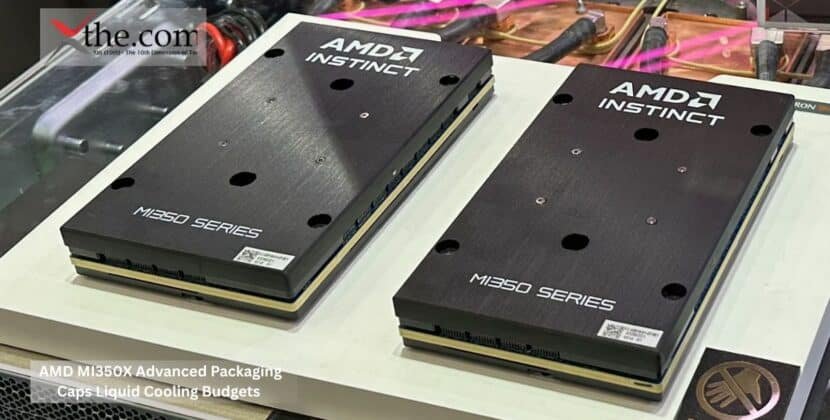
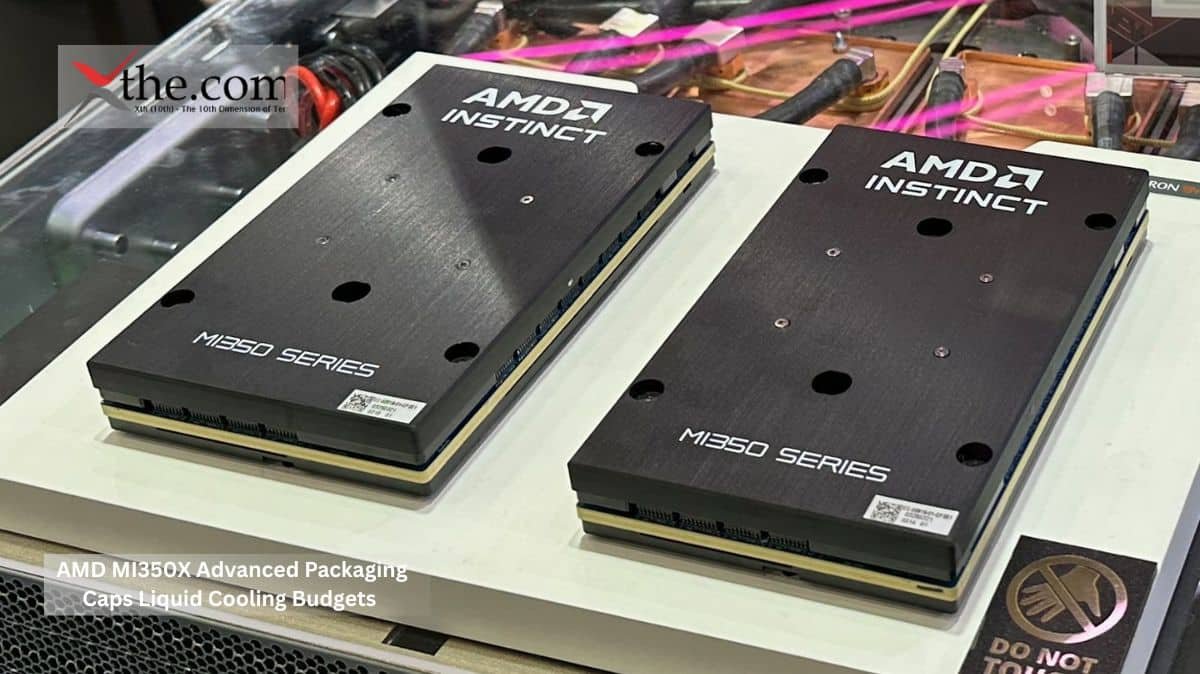
The conversation around the AMD Instinct MI350X accelerator files cannot be separated from the platform’s engineering goals. AMD created the MI350X series to tackle one of the biggest challenges in large language model inference: moving data efficiently between memory and compute.
Training large AI models requires a lot of computing power, but running inference now depends more on how quickly accelerators can feed data to models. This is where HBM3E memory bandwidth bottlenecks become financially significant.
Modern generative AI systems often move terabytes of data between compute cores and memory during inference. Older memory designs cause delays that slow down token generation and make the infrastructure less efficient.
AMD’s MI350X architecture uses HBM3E memory to help solve these problems. The accelerator is built for high throughput, so enterprise inference clusters can handle larger model contexts without frequent memory delays.
For cloud providers running large‑scale inference systems, even a small boost in throughput can reduce the need to add more racks throughout their data centers.
The Packaging Constraint Few Buyers Can Ignore
Deployment success is no longer determined solely by performance metrics. Supply chain limitations are now just as important.
The pressure surrounding TSM’s advanced packaging capacity, AMD, has become one of the defining operational risks in AI inference procurement. Advanced accelerators such as the MI350X rely on sophisticated chiplet design and CoWoS packaging technologies that remain capacity-constrained at Taiwan Semiconductor Manufacturing Company.
This is important because the demand for accelerators is now higher than the industry’s ability to package them.
A Fortune 500 company planning to add 5,000 GPUs for AI may sign purchase agreements months in advance, but still face deployment delays caused by packaging bottlenecks rather than chip manufacturing.
This challenge is even greater for AMD since NVIDIA uses a large share of the same advanced packaging resources. This overlap makes it harder for buyers to get timely deliveries when they want to move away from NVIDIA’s CUDA infrastructure.
As a result, CIOs now consider both benchmark performance and the visibility and reliability of manufacturing allocations when making procurement decisions.
Thermal Limits Are Reshaping Data Center Economics
The bigger problem might not be computing power, but heat.
The newest accelerators have raised data center thermal design power (TDP) to levels that older facilities were never built to handle. Modern AI accelerators now consume over 1,000 watts per module during heavy workloads.
This shift affects every aspect of the physical data center.
Air-cooled data centers designed for traditional CPU clusters struggle to maintain stable temperatures when packed with AI racks. Cooling problems can quickly become operational risks, especially during long periods of heavy AI use.
This is why data center liquid cooling infrastructure costs are becoming a central boardroom discussion for enterprise AI expansion projects.
Upgrading an existing facility for liquid cooling often involves installing new pipes, rear-door heat exchangers, coolant distribution units, and improved power systems. In older buildings, these upgrades can cost more than the accelerators themselves.
Enterprise AI Hardware Is Becoming an Infrastructure Decision
The rise of enterprise generative AI server hardware shows that the industry is changing. Buying AI hardware is no longer a simple process. It now often requires a complete redesign of infrastructure.
A financial services company setting up a private generative AI system for sensitive workloads may find that only a small part of its current data center can handle the latest accelerator density. The main limits are cooling and power, not computing resources.
This shifts the economics of the AMD Instinct MI350X accelerator price conversation. Buyers are increasingly evaluating total deployment costs rather than just accelerator pricing.
A cheaper accelerator does not help much if the facility needs tens of millions of dollars in cooling upgrades before it can be used.
AMD and NVIDIA Are Fighting for Physical Space, Not Just Market Share
The competition between AMD and NVIDIA is now about who can secure the first limited data center space. Every rack capable of handling high-density liquid-cooled AI hardware is now highly valuable.
AMD’s MI350X architecture gives the company a strong position against NVIDIA in environments where inference and memory bandwidth are as important as raw computing power. However, the bigger market battle involves more than just chip design.
It also depends on packaging availability, thermal engineering, and whether companies can support the next generation of accelerator density without having to rebuild much of their infrastructure.
For years, the AI industry focused on making models bigger. Now, the next phase will likely focus on ensuring infrastructure can keep up with power delivery, cooling, and packaging logistics, making them as important as performance benchmarks.