






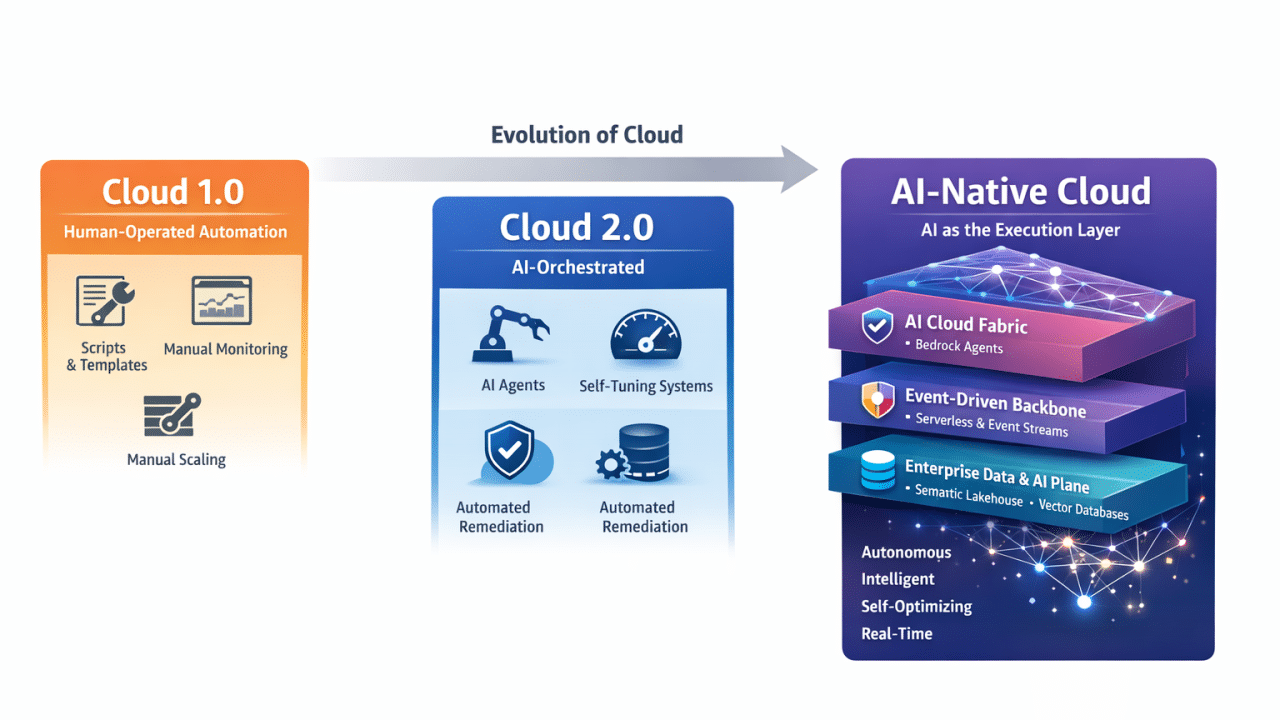
Cloud updates are shifting focus from model development to how systems execute decisions in production. Vendors are now introducing new layers that sit between data models and applications to manage real-time actions. This transition is redefining the role of AI infrastructure cloud environments in enterprise operations. The emphasis is moving toward systems that can coordinate, trigger, and adapt processes without constant oversight.
Why AI Infrastructure Cloud is Evolving toward Execution
Traditional cloud platforms have focused on storage, compute, and model training. While these remain essential, they do not address how decisions are carried out at scale. Enterprises now require systems that can bridge the gap between insight and execution.
Because of this need, the execution layer has become a key part of cloud operations. It works as the engine that turns model outputs into real actions. Adding this layer helps cloud providers deliver faster and more reliable system responses.
Orchestration ensures these actions occur in a coordinated manner. It manages how services depend on each other and maintains workflow consistency. Without this, execution can become scattered and less efficient.
From Model Hosting to Action-Oriented Systems
Earlier, cloud strategies focused on hosting models and providing APIs. These allowed applications to ask for predictions but did not control the next steps. As a result, execution logic is often spread across multiple systems.
Adding an execution layer changes this setup. It consolidates decision-making into a single place, creating a single control point. This makes it easier to see what is happening and reduces the complexity of managing different processes.
This shift also underscores the importance of orchestration for maintaining system reliability. When workflows are coordinated, actions happen in the right order. This helps reduce mistakes and makes the whole system more dependable.
Operational Impact Across Enterprise Workflows
Companies are already noticing these changes in important areas. For example, customer service platforms now use execution layers to automate replies and escalate issues when needed. This leads to faster responses and better service.
In supply chain management, execution systems adjust inventory and logistics in real time. They react to changes in demand or disruptions automatically without people having to step in. This makes operations more efficient and better uses resources.
Financial operations are also seeing benefits. Execution layers enable real-time fraud detection and automated compliance checks. These features help lower risk while keeping things fast and accurate.
Integration Challenges With Legacy Infrastructure
Even with these benefits, adding new execution features to existing systems is not easy. Many organizations still use older infrastructure that was not built for real-time coordination. This causes compatibility issues and makes scaling difficult.
Data silos are another big challenge. Execution systems need data to be consistent and easy to access across all parts. Without good integration, these systems cannot work well.
This shift also means changing how systems are built. Organizations need to redesign workflows to get the most out of execution layers. This usually takes a lot of time and resources.
Strategic Role of Cloud Providers
Cloud providers are becoming key players in this change by adding execution capabilities to their platforms. They give enterprises a more complete solution. This means fewer custom integrations and faster deployment.
The AI infrastructure cloud is now a base for both intelligence and action. Providers are developing tools that make it easier to manage execution processes, such as monitoring, debugging, and optimization.
These changes also affect how companies choose vendors. Enterprises now look at how well platforms support execution at scale, not just performance. This shows a shift from focusing solely on speed to considering overall capabilities.
Risk and Opportunity in Execution-Driven Architectures
Adding execution layers brings both opportunities and risks. Organizations can run faster and more efficiently, but if these systems are poorly set up, they can become more complex and expensive.
Older infrastructure can hold companies back in this area. Systems that cannot handle real-time execution may fall behind. This puts pressure on organizations to modernize and invest in new technology.
Organizations also need to think about governance and control. Since execution systems operate independently, they need clear rules and oversight. Without good management, these systems might cause unexpected results.
Future Direction of Cloud Execution Layers
Cloud platforms are moving toward deeper integration of execution features. In the future, improvements will likely focus on making systems simpler and more effective. This will help enterprises adopt and scale these systems more easily.
Better tools will also be important. Easier interfaces and more automation will make it simpler to manage execution processes. This lets organizations focus more on results instead of the underlying infrastructure.
Developers’ roles will keep changing, too. They will need to build systems that smoothly integrate data, models, and execution. This means taking a new approach to application design.
Closing Perspective on Cloud Transformation
Aligning Infrastructure with Execution Needs
Organizations are matching their strategies to what modern cloud platforms can do. By adding execution layers, systems can act on insights right away. This helps make operations more efficient and responsive.
Balancing Innovation And Stability
Moving to execution-driven systems takes careful planning. Enterprises need to make sure new features do not disrupt current operations. Keeping things stable while adding new technology is another challenge.
Building Long-Term Operational Advantage
Companies that successfully add execution layers will have a significant advantage. They will work faster and more accurately than their competitors. The AI infrastructure cloud will continue to play a key role in this change.
Source: News, tips, and inspiration to accelerate your digital transformation








