





Santa Clara, California
In the past, a single rack of servers managed only a small part of a factory’s digital operations. Now, Intel believes its 288-core processor can completely change the economics of heavy manufacturing, and the numbers it is showing plant managers are difficult to overlook.
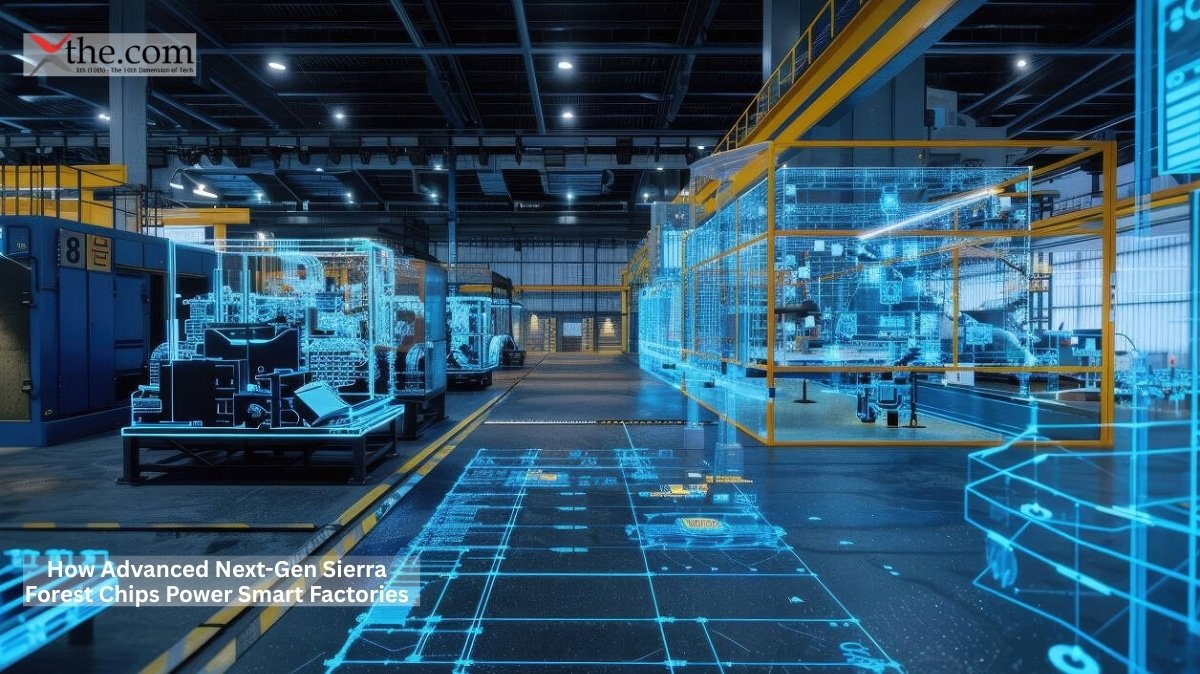
Sierra Forest chips represent Intel’s biggest move yet into efficiency-core architecture, and their introduction to factory floors is changing how American manufacturer’s view compute density. The main idea is that Intel Xeon Architecture is now designed for parallel workloads at scale, not just single-thread performance. These processors are designed to handle multiple tasks simultaneously, which is exactly what industrial automation needs.
Why 288 Cores Changes the Math for Power Smart Factories
Putting 288 efficiency cores into a single socket is more than mere decoration. It directly addresses a real problem that plant operations executives have faced for years: the cost of floor space and electricity is increasing faster than the performance of the systems that use them.
Intel’s benchmarks show that Sierra Forest offers about 2.7 times the performance per rack compared to earlier Xeon models. For a facility using 20 racks to run robotic assembly lines, predictive maintenance, and quality-inspection cameras simultaneously, this could mean cutting the physical infrastructure in half without reducing throughput.
Performance Per Rack is now the key metric that sets leading vendors apart from those who only make it onto spec sheets. A typical high-core-count server using over 300 watts might handle about a dozen machine-vision inference threads at once. Sierra Forest’s efficiency-core design, based on Intel’s experience with consumer E-cores, changes this trade-off. You get more threads, lower power use per core, and the same rack size.
Industrial Core Optimization at the Assembly Line Level
Take a mid-sized electronics manufacturer in Ohio that assembles printed circuit boards in large numbers. At any time, the facility’s software checks for defects on every board leaving the soldering station, adjusts robotic arms based on conveyor speed, and records data to meet customer quality standards. This isn’t just one task it’s dozens of processes happening at once, each needing responses in milliseconds.
Older computing systems forced plant IT teams to choose between two bad options: either buy too many expensive, high-performance cores that sit idle between production cycles, or buy too few and risk delays that can stop the production line. Neither choice works when an unexpected shutdown can cost a mid-sized factory about $22,000 per hour, according to Aberdeen Group.
Industrial Core Optimization means pairing the number and type of processor cores to the specific needs of factory software. This is where Sierra Forest’s design really shines. The efficiency cores do not try to force single heavy threads. Instead, they spread moderate workloads across many cores, keeping latency steady even as more processes run at once.
Real-time industrial automation software, the kind running SCADA systems and MES platforms from vendors like Siemens, Rockwell Automation, and Honeywell, is fundamentally a many-small-tasks problem. Sierra Forest was built for exactly that profile.
Edge Network Scaling Without the Square Footage Penalty
Modern factories are not centralized. Sensors are placed at the press, the conveyor, and the loading dock. Edge compute nodes process data locally before sending summaries to the main data center, reducing latency and bandwidth usage. In the past, managing this setup meant having several physical servers at each edge node servers that needed cooling, power, and space.
Edge Network Scaling with Sierra Forest changes that equation. Since the processor delivers much higher thread density per watt, edge deployments can use fewer physical units. For example, a plant that once needed four 1U servers at a production cell can now, in some cases, run the same tasks on just one. That means three fewer boxes to rack, cool, connect, and maintain.
The impact on electrical use is clear and measurable. With fewer active servers, there are fewer power supplies drawing standby current, fewer fans running, and fewer UPS systems required to handle large power loads. For a facility aiming for eco-friendly objectives or just trying to keep utility costs stable as grid prices rise, this is important.
The Intel Xeon Sierra Forest Industrial Processor Data Center Deployment Log Appears as a New Operational Standard
Early adopters who track the Intel Xeon Sierra Forest industrial processor data center deployment log the documentation IT and OT teams use during workload migration are seeing consolidation ratios that closely match Intel’s projections. This is notable because there are usually big differences between enterprise benchmarks and actual results.
The first deployment patterns show a clear approach: commence by identifying workloads that need high concurrency and moderate per-thread performance. Move those first. Use the extra rack space to delay or even avoid planned capacity expansions. Then, decide if the remaining high-single-thread workloads should run on Sierra Forest or on another Xeon model designed for that purpose. Intel is not presenting Sierra Forest as a catch-all solution, but as the right tool for the workload category that now makes up most factory compute traffic.
What This Means for U.S. Manufacturing Competitiveness
U.S. electronics and durable goods manufacturers face tough cost pressures from global rivals, especially in regions with lower labor and energy costs. Every percentage point saved in operating costs, without sacrificing quality, strengthens the case for keeping production in the United States.
Sierra Forest chips that make smart factories more efficient aren’t merely a theory. They give plant operators a real way to cut energy costs, delay spending on new facilities, and handle more sensor data without hiring more IT staff. The 288-core processor does not make the factory smarter on its own. But it provides the computing power the software such as schedulers, inference engines, and anomaly detectors needs to do its job.
Factories that adopt this architecture early will not only operate more efficiently. They will also collect operational data faster than their competitors, increasing their advantage over time.
Source: Intel Unleashes 2.7x Performance per Rack Improvement for 5G Core