






Santa Clara, California
The Assembly Line Is No Longer a Human Monopoly
Imagine a cleanroom floor in a semiconductor factory, one of the most tightly controlled places in the world. Airborne particles are tracked in fractions of a micron, and tolerances are measured in nanometers. For years, only intelligent people brought it to these floors. Now, that is changing, thanks to a new device about the size of a thick paperback book.
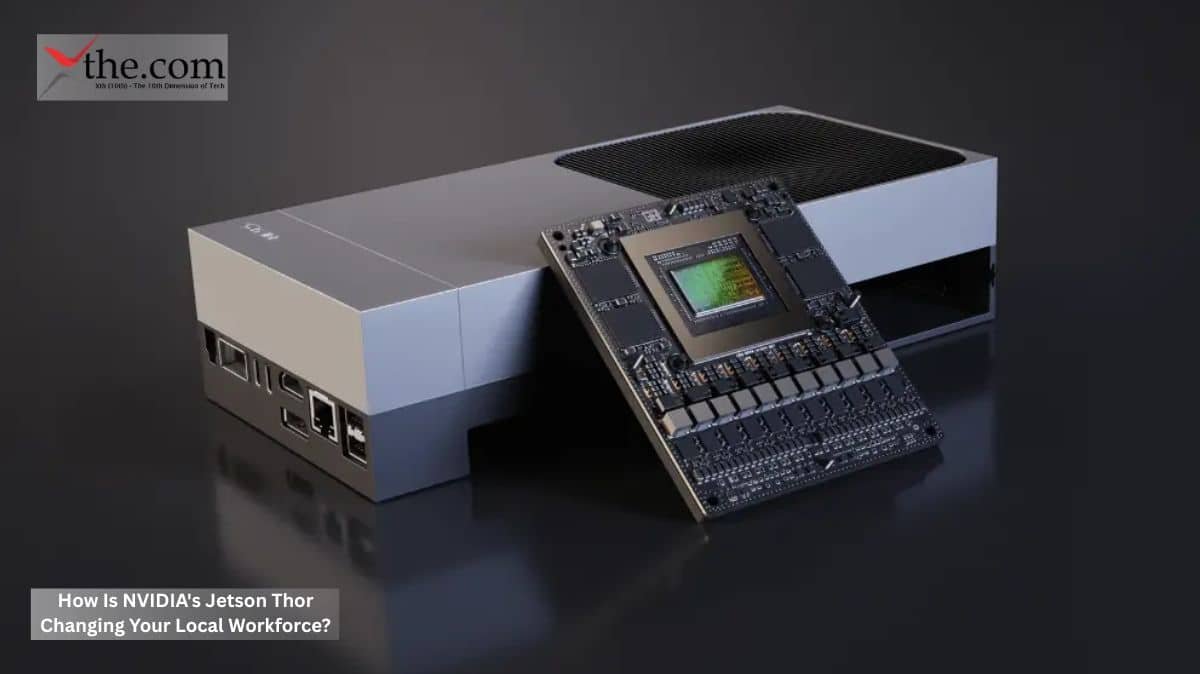
NVIDIA Jetson Thor was released in August 2025 as a robotics computer designed to power millions of robots across industries such as manufacturing, logistics, and healthcare. Less than a year later, it became even more important to the global chip supply chain. On June 7, 2026, NVIDIA and SK Hynix announced a multiyear partnership to develop next-generation memory for the global AI factory expansion and to speed up semiconductor design and manufacturing. The development of the NVIDIA Jetson Thor robotic computing platform sits at the center of that agreement.
This partnership matters for American consumers who rely on a steady supply of memory chips for devices like laptops and data centers. It is worth taking a closer look at what it means.
What the NVIDIA–SK Hynix Agreement Actually Covers
This agreement goes far beyond a typical supplier deal. SK Hynix will work with NVIDIA to develop High Bandwidth Memory 4 for all four of NVIDIA’s upcoming product lines: Vera Rubin supercomputers, Vera CPUs, RTX Spark personal AI computers, and Jetson Thor robotics platforms.
The Jetson Thor platform will have the biggest impact on factory operations. SK Hynix will expand into new markets that NVIDIA is building, including AI infrastructure, personal AI, and physical AI. Together, they will develop memory for NVIDIA Vera Rubin AI supercomputers, Vera CPUs, RTX Spark-powered PCs, and Jetson Thor robotic computing platforms.
The structure of this agreement is important. Models are trained at scale on the Vera Rubin supercomputer, which is designed specifically for AI workloads. These models are afterward compressed and sent to Jetson Thor units at the edge. This process is more complex than a simple download. It requires shrinking and simplifying large neural networks so they can run within the power and heat limits of an embedded device. Jetson Thor uses NVIDIA’s Blackwell GPU architecture, providing up to 2,070 FP4 teraflops of AI performance with 128GB of memory, all within a 130-watt power limit. This is 7.5 times more AI performance and 3.5 times better energy efficiency than the previous version.
Inside the SK Hynix AI Factory: What Changes on the Floor
From Digital Twin to Autonomous Operation
SK Hynix plans to improve its factory digital twins by using NVIDIA Omniverse, OpenUSD scene optimization, and NVIDIA cuOpt to enable fully autonomous fab operations. Here, a digital twin means a virtual model of the factory that is always up to date. The software mirrors every conveyor, robot path, and component bin. If something changes in the real world, such as a tray out of place, an unexpected obstacle, or a part shifting due to temperature, the digital twin detects the difference, and the Jetson Thor-equipped robot adjusts its actions.
This shift away from pre-programmed automation is a big deal. Older industrial robots follow set instructions. They move precisely from one spot to another, but only if everything goes as planned. In semiconductor factories, even tiny changes in the environment can make a difference. A robot that can sense, think, and adapt on its own, without waiting for a cloud response that could add 80 milliseconds of delay, is a completely new kind of tool.
Memory Co-Development as an Enabler, Not an Afterthought
SK hynix controls about 60-70% of the High Bandwidth Memory used in NVIDIA’s Vera Rubin platform. This strong position gives the company significant influence. By working with NVIDIA to develop the memory for Jetson Thor modules, SK hynix is more than merely a supplier. It helps define the bandwidth that affects how quickly spatial tracking data can be collected and processed at the edge. Tech Times
LiDAR, depth cameras, and inertial sensors produce large amounts of data that LPDDR5 memory often cannot handle without delays. The HBM4 plan that SK Hynix and NVIDIA are working on solves this problem. It lets Jetson Thor robots process data from multiple sensors simultaneously without slowing the memory bus.
Why This Matters Specifically to American Consumers and Businesses
Supply Chain Stability Through On-Site Intelligence
As AI factories grow around the world, this partnership helps ensure that memory supply matches NVIDIA’s plans for expanding AI infrastructure. For American consumers, this leads to fewer unexpected hardware shortages.
Semiconductor factories are very sensitive to mistakes. Just one contamination, a mishandled wafer, or an incorrect setting can significantly reduce the yield of a whole batch. While people catch many of these problems, a Jetson Thor robot using models developed on the Vera Rubin supercomputer can catch even more. It works nonstop, does not get tired, and avoids the health risks that kept human workers out of cleanrooms in 2020 and 2021.
SK hynix will also use NVIDIA’s GPU-powered TCAD and computational lithography software to speed up chip design and manufacturing. This shortens the time from developing a new process to producing chips in large numbers, so new consumer devices reach stores faster after they are announced.
The Broader Workforce Implication
Executives and plant managers are already asking not if these systems will replace workers, but which workers and when. The NVIDIA Jetson Thor robotic computing platform development roadmap prioritizes replacing repetitive, high-precision physical tasks first the roles most susceptible to ergonomic injury and hardest to staff in cleanroom environments. In parallel, it creates demand for robotics commissioning technicians, model validation engineers, and edge infrastructure specialists. As humanoid robots start to appear in factory environments, concerns about physical safety, data privacy, and transmission latency are becoming more important. This is pushing the industry toward deploying physical AI at the edge. TrendForce
The Competitive Threshold Is Moving
NVIDIA is now focusing on building national AI ecosystems instead of just selling GPUs. The SK Hynix agreement is just one example of this trend. Semiconductor makers that use Jetson Thor-class edge intelligence early will have a lasting advantage over those who wait. This advantage will grow with each new model trained on the Vera Rubin supercomputer and used in more robot fleets. Converge Digest
For the U.S. economy, the main issue is not theoretical. The real question is whether the global supply of advanced memory, which sets the performance limit for almost every AI device, will stay available and reasonably priced. The partnership between NVIDIA and the SK hynix AI factory ecosystem is one of the clearest ways the industry is trying to solve this problem.
The assembly line has always been about more than just labor. It has also been about intelligence. Now, that intelligence is shifting to the edge.
Source: NVIDIA and SK hynix Announce Multiyear Technology








