






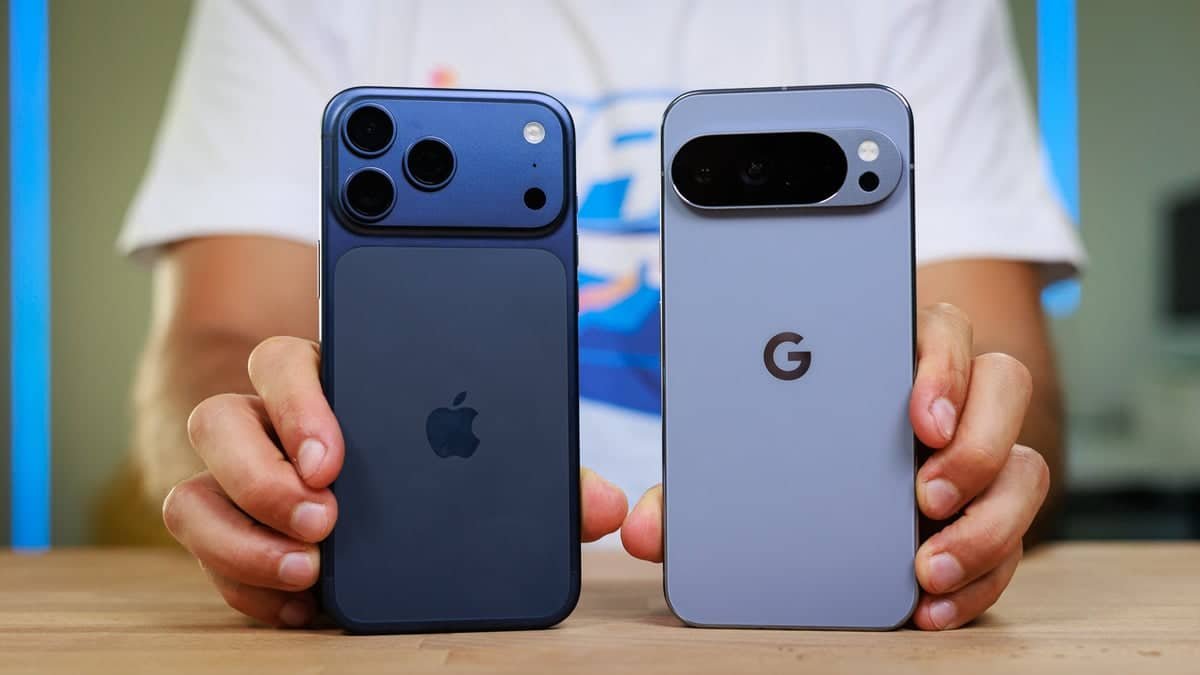
The competition between flagship smartphones is back, and if you’re deciding between Apple’s new iPhone 17 Pro and Google’s Pixel 10 Pro, you’re in good company. Apple has gone beyond its usual updates, giving the program a fresh direction. At the same time, Google improves the Pixel 10 series with features powered by the new Google Tensor G5 processor, available on both Android phones and iPhones. But each takes a different approach to being the best.
Here’s the main difference. Apple focuses on top performance and display improvements using powerful processors and high-end materials; you’ll notice every day. Google puts its energy into AI-powered photography and smart software using machine learning to improve both the camera and the overall experience. The best choice depends on which strengths matter most to you both now and in the future.
Display and Design: Where Premium Meets Personality
Let’s begin with the display and design. The iPhone 17 Pro features a 6.3-inch Super Retina HDR OLED with a resolution of 2622 x 1206 pixels at 460 ppi. The Pixel 10 Pro is also 6.3 inches. Both brands chose this size because it’s easy to use with one hand, but still big enough for maps, movies, and conversations.
Screen brightness matters, especially outside. The iPhone 17’s display reaches up to 3,000 nits, with a minimum of 1 nit. The Pixel 10 Pro’s six-point-three-inch Super Actua panel goes even higher, peaking at 3,300 nits. That extra brightness can make a difference in sunlight or under bright indoor lights.
The materials used for the screens are also important. The iPhone 17’s display is protected by Ceramic Shield 2, which is more scratch-resistant and offers better anti-reflective properties. The Pixel 10 uses Gorilla Glass Victus, which offers more protection and may help prevent small scratches from everyday use.
Refresh rates are another difference. The iPhone 17 uses a 120 hertz ProMotion OLED display and can go down to 1 hertz, which is useful for always-on displays and for saving battery when viewing still images. The Pixel 10’s screen switches between 60 and 120 hertz, so it may use a bit more power when you’re reading or viewing photos.
Camera Systems: Computational Photography Versus Traditional Excellence
Both phones have excellent cameras, but they achieve great results in different ways. One relies on traditional methods, while the other uses the latest digital technology. Either way, you’ll get impressive photos.
The iPhone 17 Pro stacks its rear system with 48MP Fusion Main, 48MP Fusion Telephoto at 48mm, 48MP Fusion Ultra Wide at 113mm, and 48MP Fusion Telephoto at 100mm, plus an 18MP Center Stage front camera. High-resolution sensors across the board give you wiggle room for cropping and digital zoom while keeping detail. You get Photonic Engine, Deep Fusion, Smart HDR 5, Portrait Lighting, Night mode, ProRAW, and m-macro photography, and spatial photos.
The Pixel 10 Pro has a 50MP main sensor, a 48MP ultrawide lens, a 48MP telephoto lens, and a 48MP selfie camera. Google’s approach stands out here, using AI features for ProRes zoom up to 100X and Camera Coach powered by Gemini models. This advanced zoom relies on software to keep images clear, where regular digital zoom would struggle.
The Pixel 10 Pro has the same rear cameras as the Pro XL: a 50MP main, a 48MP ultrawide, and a 48MP telephoto with 5X optical zoom. While some sensors have fewer megapixels than Apple’s, Google relies on more software, which helps Pixel photos look natural and balanced from the start.
When it comes to selfie cameras, the Pixel 10 Pro stands out with a 42MP front camera, a big improvement for Google. The iPhone 17 uses an 18MP multi-aspect camera with a square sensor. The Pixel’s higher resolution helps with video calls and selfies.
Apple still leads in videos. The iPhone 17 can record Dolby Vision in 4K at 60 fps and in cinematic mode at 4K 30 fps. The Pixel 10 doesn’t offer the same level of Dolby Vision recording. If you care about mobile video, Apple gives you more professional options.
Performance and Processing Power: Silicon Showdown
Performance differences reflect each company’s priorities, not just benchmark scores.
The iPhone 17 Pro runs the A19 Pro with a six-core CPU, a six-core GPU with neural accelerators, and a 16-core neural engine. Apple’s A19 is considerably faster and more power-efficient than Google’s Tensor G5, so gaming, video editing, and other heavy tasks feel instant.
The Pixel 10 Pro uses the Google Tensor G5 on a 3nm process, which Google says delivers a 60% faster TPU and a 34% faster CPU compared to the previous chip built by TSMC on 3nm. The Tensor G5 also offers a claimed 30% faster boot time on the Pixel 10 Pro.
The differences become clear with specialized tasks. Apple focuses on leading in all areas, while Google optimizes on AI. The Pixel’s TPU is designed for on-device machine learning, which helps with computational photography, real-time translation, and other AI features, even if it doesn’t always lead in benchmarks.
Memory is important for heavy users. The Pixel 10 has 12GB of RAM, while the Pixel 10 Pro offers 16GB. The iPhone 17 Pro comes with 12GB of RAM and storage options of 256GB, 512GB, or 1TB. The extra RAM in the Pixel Pro is useful for multitasking and demanding AI tasks.
Battery Life and Charging: Endurance Meets Efficiency
Both phones have the same screen size, but their batteries differ. The iPhone 17’s battery is about 4,252 mAh, while the Pixel 10’s is 4,870 mAh. The iPhone 17 Pro is rated for up to 33 hours of video playback, and the Pixel 10 Pro also has a 4,870 mAh battery.
Even though the iPhone’s battery size is smaller, Apple’s efficient hardware and software help it last just as long in daily use. The A19 Pro chip uses power carefully during browsing, messaging, and media, so real-world battery life stays competitive.
Charging speeds are also different. The iPhone 17 can reach 50% charge in about 20 minutes, while the Pixel 10 takes about 10 minutes longer. The iPhone 17 Pro supports fast charging to 50% in 20 minutes with a 40-watt charger, and MagSafe can reach 50% in 30 minutes with a 30-watt adapter.
Apple leads in wireless charging speed. The iPhone 17 supports up to 25 watts of wireless charging, while the Pixel 10 supports up to 15 watts. The Pixel 10 Pro offers 30-watt wired and 15-watt wireless charging with Pixel Snap accessories and now supports Qi 2 up to 15 watts. The Pro XL can charge wirelessly at 25 watts. If you often use wireless charging, Apple’s faster speeds can be helpful.
Storage, Connectivity, and Special Features
Storage options highlight different strategies. The iPhone 17 starts at 256GB, while Google’s base model offers 128GB. With double the base storage, many iPhone buyers may not need to upgrade. The iPhone 17 goes up to 512GB, and the Pixel tops out at 256GB.
Both phones offer strong connectivity. The iPhone 17 Pro supports cellular 5G, LTE, UMTS/HSPA+, GSM/EDGE, Wi-Fi 7, Bluetooth 6, and Apple’s second-generation ultra-wideband. Wi-Fi 7 is especially important as it provides faster speeds and better performance in busy areas.
Long-term software support is a real value. The Pixel 10 Pro runs Android 16, which will receive seven years of updates, a serious commitment that keeps the phone secure and current well into the 2030s.
Security features reflect different approaches. The iPhone 17 Pro uses Face ID with TrueDepth and LiDAR, plus sensors such as a barometer, gyroscope, accelerometer, proximity sensor, and ambient light sensor. The Pixel Pro uses an ultrasonic fingerprint scanner. Both are dependable, but Face ID can be more convenient if your hands are wet or you’re unlocking from an unusual angle.
Which Flagship Deserves Your Investment?
Price doesn’t make the decision easier. Both the Pixel 10 and iPhone 17 cost $799 in the US. The Pixel 10 Pro is $999 on Amazon, and the iPhone 17 Pro starts at $1,999 for the 256 GB model.
Choose the iPhone 17 Pro if you want top performance, high-quality materials, and seamless integration with Apple’s ecosystem. The A19 Pro chip handles gaming, video editing, and demanding apps with ease. Features like Ceramic Shield, a flexible display refresh rate, and faster wireless charging add extra value. You also get double the base storage and better video tools, making it a great choice for creators and anyone who values speed.
Go with the Pixel 10 Pro if you want AI-powered photography, a bigger battery, and Google’s advanced software features. The 4870 mAh battery is great for long days. Tools like Camera Coach and 100X ProRes Zoom highlight Google’s software strength. The 16 GB RAM option is ideal for multitasking, and the 42 MP selfie camera is a big improvement for front-facing photos. Google also promises seven years of software and security updates, lasting until at least 2032.
In summary, choose the iPhone 17 Pro for top performance, premium build, excellent video, and smooth integration. Pick the Pixel 10 Pro for AI-enhanced photography, longer battery life, more RAM for multitasking, and Google’s clean Android with smart features. Personally, I’d choose the iPhone 17 Pro for video work and the Pixel 10 Pro for photography and all-day use. Both phones are great in their own ways, so the best choice is one that matches your needs.








