




Cape Canaveral, Florida, July 3, 2026
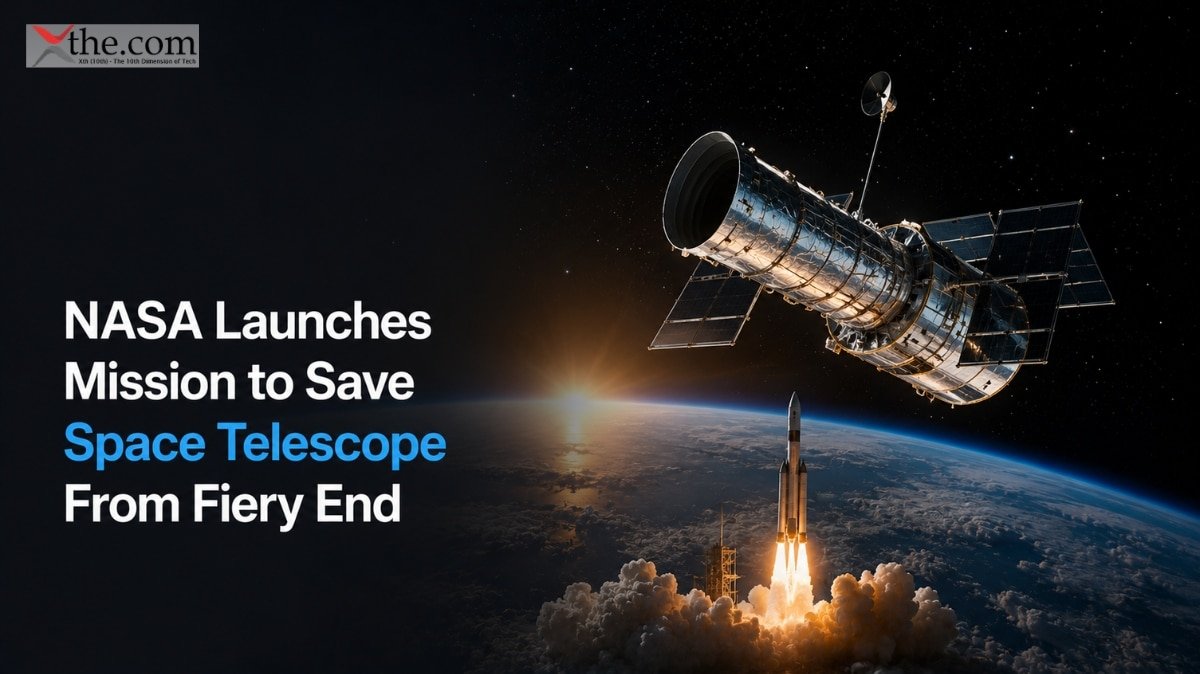
A spacecraft about the size of a refrigerator is now on a mission to catch up with a satellite that has been in space for 22 years. What happens next will determine if one of astronomy’s most productive tools burns up over the ocean or continues searching for exploding stars for another ten years. The NASA Swift telescope rescue 2026 effort began this week when a Pegasus XL rocket, released from a modified aircraft over the Marshall Islands, put the Katalyst Space LINK spacecraft into orbit. Its goal is the Neil Gehrels Swift Observatory, a telescope that has been tracking gamma-ray bursts since 2004 and is now struggling to stay in orbit.
Swift was not expected to need help this early. NASA thought the observatory would stay in orbit until the early 2030s. But in 2024, a stronger-than-usual solar maximum heated and expanded Earth’s upper atmosphere, increasing drag on everything in low orbit. This caused the Swift observatory’s altitude to decay, compressing a problem NASA thought it had years to solve into one that now needs fixing in just a few months.
Why Swift Matters Enough to Save
Swift is not a general-purpose observatory. It was made to catch rare space events as they happen. Gamma-ray bursts, which are the brightest explosions since the Big Bang, last only seconds or minutes and disappear before most telescopes can even turn to look at them. Swift can spot a burst, find its location, and point its instruments in about a minute, sending data to ground-based telescopes before the afterglow fades. Thanks to this speed, the NASA Swift X-ray telescope has become essential for astronomers studying phenomena such as colliding neutron stars and the deaths of massive stars.
There is no backup for Swift. NASA has made it clear that there is no budget to build a replacement, and no other mission matches Swift’s quick response and ability to observe in ultraviolet, X-ray, and gamma-ray light. If Swift were lost, it would not just end a program—it would leave a gap in our ability to observe brief astronomical events that no other instrument can currently fill.
The Physics of a Falling Telescope
Swift has dropped to about 370 kilometers above Earth, and without help, it was expected to fall into the atmosphere and burn up before the year ends. In February, NASA shut down Swift’s science instruments and turned the spacecraft to reduce drag by nearly thirty percent, while still keeping its photovoltaic panels working. This move was bought some time but did not fix the main problem. If Swift drops below about 300 kilometers, the drag will be so strong that a rescue spacecraft might not be able to dock or lift it. The chance to save Swift is real, but it is running out.
Inside the Katalyst Space Rescue Mission
NASA awarded the contract for this Katalyst Space rescue mission in September 2025. The company, based in Flagstaff, Arizona, had about nine months to design, build, test, and launch a spacecraft capable of finding, grabbing, and moving a satellite that was never meant to be serviced. This is a tight schedule for any space mission, especially for something that has never been tried at this scale.
LINK weighs about 880 pounds, stands roughly five feet tall, and carries three xenon-fueled ion engines, solar panels generating four kilowatts of power, sixteen orientation-control thrusters, and three robotic arms built specifically for proximity operations. Over the next month, LINK will close the distance to Swift using autonomous rendezvous systems, then use its robotic arms to grip a flange on Swift originally intended only to secure the telescope during ground transport. Electric thrusters will then fire gradually over ten to twelve weeks, easing Swift up to an altitude near 370 miles; an operation NASA hopes extends the observatory’s working life by roughly another decade. If the sequence holds, Swift could resume scientific observations by September, a timeline that has made this space telescope reboot mission 2026one of the most closely watched programs in NASA’s astrophysics portfolio this year.
Katalyst Space CEO Ghonhee Lee has openly talked about what is at stake. The bigger risk was doing nothing and watching Swift break apart during reentry, with no hope of saving it. This explains why NASA, which is usually very careful, agreed to move quickly with a company that had never handled such a complex mission before.
A Policy Shift With Investment Implications
This mission is important for more than just one telescope. It comes after NASA canceled its own satellite-servicing project, OSAM-1, in 2024 because of high costs. By giving the job to a private company, NASA is clearly moving toward using commercial partners. Katalyst is also using the Swift mission to work through technical challenges before launching a new servicing spacecraft, NEXUS, planned for 2027.
For investors watching the commercial space industry, the idea is simple even if the technology is not. Right now, satellite operators view orbital degradation, fuel depletion, or component failure as the end of a satellite’s life. They write off satellites worth hundreds of millions of dollars and replace them at similar cost. If in-space servicing becomes common, operators could pay much less to keep satellites working for years longer. Analysts think this market could be worth tens of billions of dollars over the next decade as more satellites are launched and become more expensive to replace. The Swift mission is a real-world test of whether this business idea works outside of presentations.
What Comes Next
If the rendezvous and capture work, Swift will not merely survive but also return to normal operations, focusing again upon the brief, high-energy events that made it so valuable. If the mission fails, NASA will lose a telescope with 20 years of unique data, and the commercial servicing industry will lose its most important example to date. Coverage has already shown how this story will be told, no matter the outcome. As one industry summary said, “NASA launches rescue mission save Swift space telescope fiery reentry Katalyst Space 2026” sums up a story that mixes advanced science with a big bet on new commercial space capability. Engineers and analysts alike are treating the coming weeks as a real-time answer to the question “Katalyst Space LINK spacecraft boost NASA Swift observatory altitude July 2026 explained,” since the steps of rendezvous, capture, and reboost will either validate or complicate every future pitch for orbital servicing.
No matter what happens in the next three months, people in the industry will not judge this mission only by whether Swift survives. They will be judging whether NASA space telescopes save operations of this kind from becoming rare rather than normal. That is the difference between a one-time engineering achievement and starting a whole new business in space.
Source: NASA launches mission to save space telescope from fiery death