






San Jose, California
When a single AI rack draws more than 120 kW, it can disrupt cooling for an entire co‑location floor. This is the challenge now facing CIOs, CTOs, IT buyers, and infrastructure architects as NVIDIA Blackwell’s power consumption pushes enterprise facilities beyond design thresholds established only a few years ago. In places like Northern Virginia, Phoenix, and Silicon Valley, some operators are delaying AI projects because their chilled‑water systems cannot handle the constant heat generated by Blackwell GPU clusters. The problem is not just about buying new hardware; companies must rethink airflow, liquid cooling, rack layout, and utility planning, all while dealing with rising energy costs and deployment risks.
Why NVIDIA Blackwell Power Consumption Has Become an Enterprise Infrastructure Crisis
The focus in AI has moved from just computing power to whether systems can handle the electrical demands.
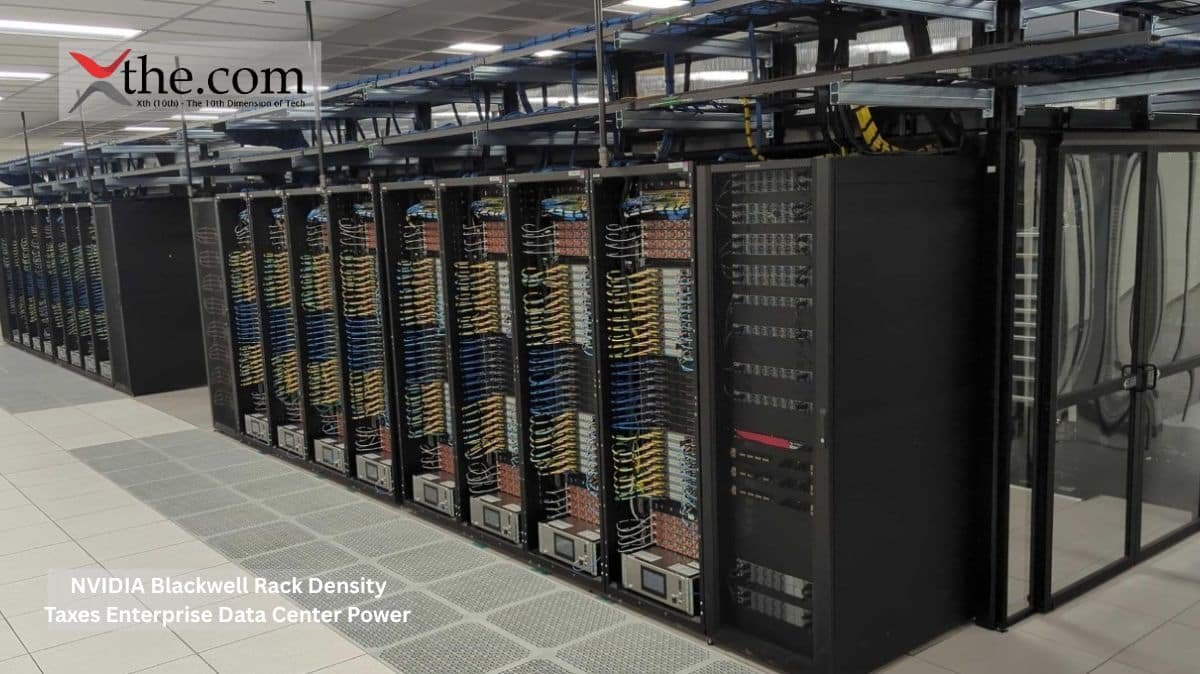
Enterprise data centers have long been designed for rack densities of 10-25 kW. Blackwell systems changed this dramatically. The GB200 NVL72 rack uses so much power that its heat output is similar to what was once seen only in large research labs. When fully loaded, a GB200 NVL72 rack power can draw over 120 kW during ongoing AI tasks, placing significant strain on power distribution units, backup generators, and utility connections.
This is important because most enterprise data centers were not built to handle such concentrated AI workloads.
For example, a financial services company might buy Nvidia GPUs for fraud analytics, only to discover that its current data center cannot remove enough heat to keep operations safe. This can lead to project delays, emergency upgrades, and higher operating costs that may exceed the original hardware budget.
Concerns about the Nvidia B20’s TDP watts make matters even more challenging. The B200’s thermal design power means infrastructure teams must rethink how they manage hot and cold aisles. Air cooling alone is no longer sufficient for dense AI clusters that run continuously.
The Rapid Shift In Data Center Cooling Trends
Direct-to-chip liquid cooling is no longer experimental. Semicon is now a must-have for many data centers.
This change has big engineering consequences. Most enterprise data centers rely on raised floors and perimeter cooling, but Blackwell systems need coolant distribution units, cold plates, special plumbing, and backup liquid circulation, all built into the racks.
The disruption gets worse when companies add NVLink switch fabrics to their older networks. Most still use Fiber Channel for storage‑heavy tasks. Mixing NVLink with existing optical cables creates more complex cabling, routing issues, and maintenance challenges, slowing deployments.
Now, infrastructure teams often spend months planning coolant flow and heat management before they can even start installing equipment.
This is where the industry’s most urgent operational question arises: how to cool high-power-density AI server racks without forcing a complete facility reconstruction.
The solution is often to separate infrastructure. Operators put AI clusters in their own liquid‑cooled areas and keep regular workloads in air‑cooled spaces. While this sounds practical, it adds more maintenance and monitoring and can split up facility teams’ work.
AMD Computation Changes The Financial Calculation
AMD is becoming more popular among companies evaluating AI acceleration, mainly because some CIOs see AMD systems as easier on infrastructure during the early stages of deployment.
But this comparison is important because equipment spending is now closely tied to cooling costs.
When companies look for the best GPU for AI inference, they no longer rely solely on performance benchmarks. They also consider long-term utility bills, facility operating costs, how many racks they can deploy, and how easily they can scale cooling. NVIDIA still leads in software with CUDA and optimized frameworks, but companies are paying more attention to the operational challenges of using Blackwell systems.
At first, using AMD may cost less for older scratch tech, especially for older data centers that cannot quickly add advanced liquid cooling. However, NVIDIA systems usually deliver better long-term returns for companies running large-scale AI services, thanks to higher performance and better software support.
This trade-off shapes how companies buy AI hardware today. Infrastructure limits now matter just as much as how well the models perform.
Power Grid Strain Creates a New Bottleneck
These issues go well beyond single data centers.
Utility companies in major US tech hubs are warning that AI’s electricity needs could grow faster than the power grid can expand.
Large Blackwell deployments make this problem much worse.
One AI campus can use as much energy as a small factory.
Collocation providers with many tenants face difficult choices.
If one company installs multiple Blackwell racks, it can affect cooling and power for other tenants using the same systems.
Because of this, some providers now limit the number of racks that can be deployed or require special liquid-cooled rooms before allowing large AI setups.
Investors watching Nvidia’s supply chain are starting to see that companies making cooling systems, electrical gear, and modern utilities could benefit from AI growth just as much as chip makers.
The next stage of enterprise AI growth will depend less on acquiring GPUs and more on powering and cooling them reliably.
Data centers that were once cutting-edge now need upgrades that can take years, not months.
Companies that wait too long to modernize risk missing out on large-scale AI projects altogether.








