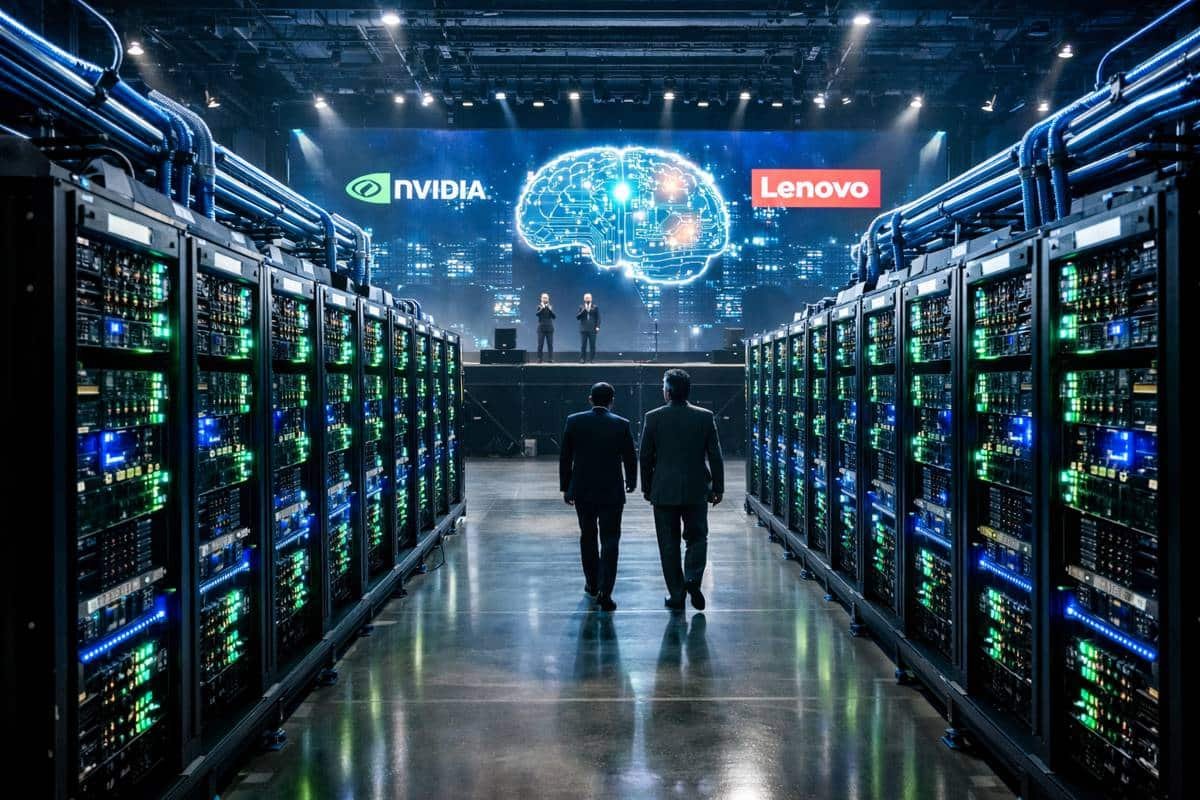
NVIDIA and Lenovo have established a partnership to develop artificial intelligence networks that will enhance edge computing capabilities and support smart city systems. The current trend in the industry shows organisations deploying AI technologies to work directly with data sources instead of depending on conventional data center operations.
NVIDIA develops AI-ready infrastructure through its partnerships with hardware manufacturers such as Lenovo, which enables organisations to manage urban traffic and industrial operations in real time from different locations.
Moving AI Closer to the Edge
The expansion signals a shift to edge computing, where data is processed at its source rather than sent to remote cloud servers. This approach reduces latency by minimising round-trip data travel time.
Smart city environments rely on edge AI infrastructure to process the enormous data generated by their sensors, cameras, and connected devices. By processing data locally, organisations make faster decisions for traffic control, public safety, and energy management.
NVIDIA’s AI RAN-ready infrastructure platform enables telecommunications and enterprise networks to incorporate artificial intelligence capabilities into their network operations.
The Role of NVIDIA’s AI Infrastructure
NVIDIA extends its partnership through AI computing platforms that execute advanced computational tasks across distributed systems. The platform combines GPU acceleration with integrated networking to enable high-speed data transfer between components.
NVIDIA uses its infrastructure to build AI systems that operate in real-world conditions, performing video analysis, sensor data processing, and real-time predictive modelling.
NVIDIA enables organisations to implement continuous AI edge systems that adapt their operations to actual environmental conditions through its infrastructure capabilities.
The partnership leverages Lenovo’s expertise in enterprise hardware and system integration. Lenovo’s servers and edge solutions support AI workloads in data centres and remote locations.
The NVIDIA-Lenovo collaboration delivers comprehensive AI solutions tailored for Lenovo hardware. These systems achieve top performance and high reliability while maintaining energy efficiency.
Integrated solutions used by smart city organisations streamline project initiation and reduce the need for multiple vendors.
Smart City Applications and Use Cases
Urban areas depend on smart city systems that use AI infrastructure alongside their interconnected technologies to improve living conditions while achieving more efficient resource management.
The AI-powered edge infrastructure supports traffic-optimisation applications that use real-time data to adjust signals and reduce congestion. The public safety system uses video surveillance to monitor locations, which helps them detect incidents and respond more quickly.
AI systems track and manage energy to enhance efficiency. The system needs to process local data because it requires immediate processing to deliver quick outcomes.
Integration with Telecom Networks
The partnership relies on seamless integration with telecommunications systems. AI RAN (Radio Access Network) technology deploys AI workloads within network operations.
Telecom providers apply AI to optimise network operations, predict maintenance needs, and manage traffic. Combining AI with 5G networks supports high-speed, low-latency urban applications.
The system enables large-scale deployment of connected devices, essential for smart city networks.
Addressing Performance and Efficiency Challenges
The deployment of AI systems in edge environments creates special challenges because of their restricted processing capabilities. The system needs to process advanced tasks while operating within its limited space.
NVIDIA and Lenovo solve these problems through their joint hardware and processing solutions, which help organisations operate advanced AI models with high efficiency.
Edge performance improvements decrease the need for central data centres while they also cut operational expenses and boost system dependability.
Implications for US Infrastructure Development
The United States uses its expanding artificial intelligence system to support both urban development and digital transformation efforts. Municipalities pursuing operational efficiency and sustainability now focus their resources on developing smart city projects.
Organisations achieve service improvements through AI deployment at scale while reducing expenses and promoting economic growth. Strategic development protects security and reliability while enabling public access.
The business partnership between NVIDIA and Lenovo shows how technology firms create solutions to solve problems that emerge when they operate in large environments.
Building the Foundation for Intelligent Environments
The AI infrastructure development work by NVIDIA and Lenovo enables the creation of smart environments that adjust to their changing surroundings. The partnership extends AI to edge locations through its integration with telecom networks while introducing new operational methods for urban environments. The future development of systems will rely on distributed computing as its essential component during the next several years. Organisations that succeed in creating scalable systems will achieve their digital transformation goals because they need systems that deliver efficient performance while adapting rapidly to new business environments.
Source: NVIDIA, T-Mobile and Partners Integrate Physical AI Applications on AI-RAN-Ready Infrastructure