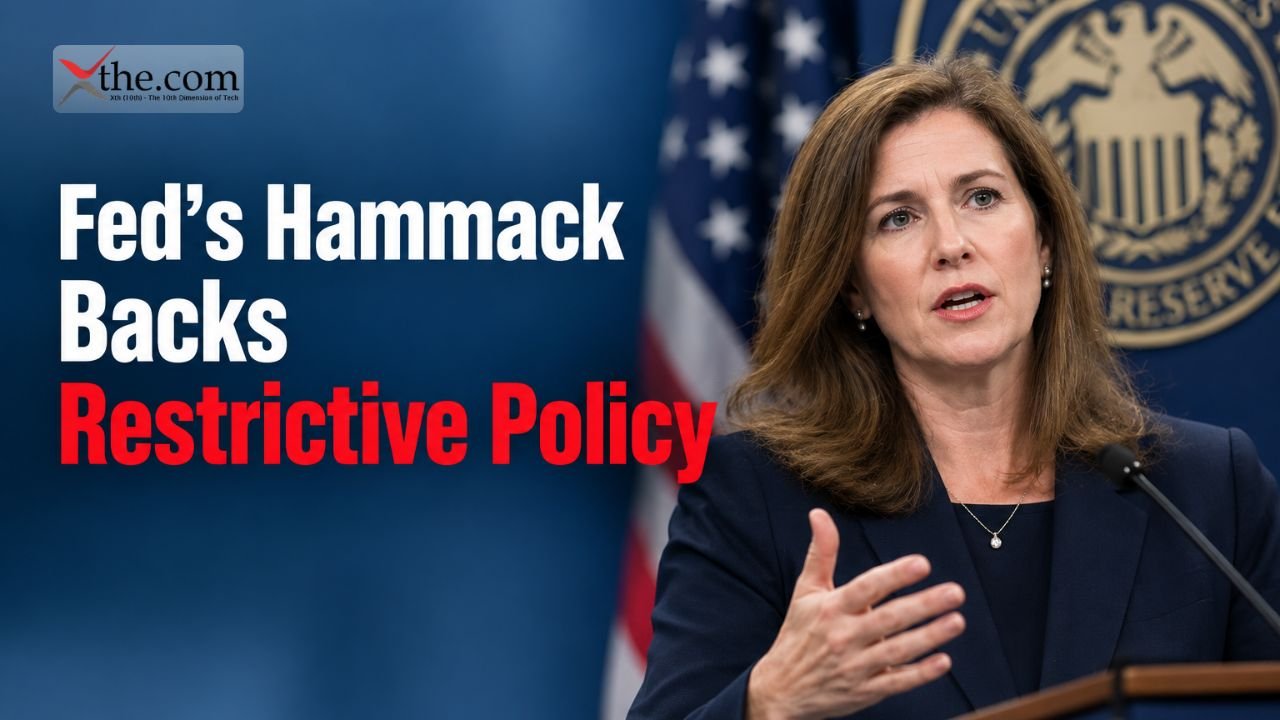
Cleveland Fed’s Hammack Makes the Case for Keeping Rates Restrictive
Cleveland Federal Reserve President Beth Hammack argued Monday that a restrictive monetary policy stance is appropriate to return inflation to the central bank’s 2 percent goal in a timely way, using a speech to the National Association of Business Economics’ 68th annual meeting to explain what she called her reaction function rather than to forecast a specific rate path. The remarks land in a week that pairs the September inflation report with the start of bank earnings season, and they reinforce the message markets have been pricing all year: the era of steady rate cuts is over.
Hammack’s core argument was about sequencing and speed. When feasible, she said, smaller policy adjustments made relatively quickly are preferable to waiting and risking a larger correction later, a framing that treats delayed tightening as its own source of risk rather than as caution. She acknowledged that inflation remained above target and that bringing annual price growth down to 2 percent would take some time, language that manages expectations while keeping the policy direction unambiguous.
The Market Math
The reaction function Hammack described has already been priced into futures markets. CNBC reported traders putting a greater than 78 percent probability on no change at the Fed’s late-October meeting and a nearly 88 percent probability of a hike at the final meeting of the year in December. Those market-implied odds are not Fed commitments, and Hammack was careful to frame her speech as explanation rather than prediction, but the convergence of rhetoric and pricing tells a consistent story.
The backdrop includes the rate increase the Fed delivered the previous month, its first hike in three years, which ended the easing cycle and reset the framework for everything that follows. August year-over-year PCE inflation, the Fed’s preferred gauge, stood at 3.4 percent with core PCE at 3 percent, both above target, and energy costs driven by regional conflict have added fresh upward pressure to the headline figures heading into autumn.
Communicating a Reaction Function
The title of Hammack’s speech, Trimming the Sails: Communicating My Reaction Function, signals the intent. Central bankers increasingly use speeches not to preview specific decisions but to explain the internal logic that will govern their votes, giving markets a model to simulate rather than a decision to await. For Hammack, that model prioritizes timely return to target, smaller-but-faster adjustments when feasible, and an explicit acknowledgment that the last mile of disinflation is the hardest.
Her stated hope, reported by Reuters, was to cool demand and inflation without job market pain, the soft-landing formulation that every Fed official recites and that no Fed official can guarantee. The tension is real. Restrictive policy works by slowing demand, and demand slowing shows up eventually in hiring decisions, which is why the labor market data will be scrutinized as closely as the inflation prints in the weeks ahead.
Why This Week Matters
Hammack spoke into a week dense with market-moving events. The September CPI report lands Wednesday, producer prices follow Thursday, and the quarter’s first major bank earnings arrive from JPMorgan Chase, Bank of America, Citigroup, Goldman Sachs, Morgan Stanley and Wells Fargo, giving investors a direct read on consumer health and credit conditions alongside the macro data.
Monday’s market close set the tone. The Dow rose about 0.38 percent to 51,850 for its third straight positive session, while the S&P 500 was roughly flat and the Nasdaq slipped 0.44 percent, with Micron falling nearly 4 percent on semiconductor weakness. Crude oil climbed, with West Texas Intermediate settling near 93 dollars and Brent near 107, a reminder that the energy-driven inflation Hammack is describing has a geopolitical engine that no rate decision controls.
Why 2 Percent Still Governs
The 2 percent inflation target has survived years of public debate about whether it should be raised, and Hammack’s speech treated it as settled rather than open for revision. Reaching it from 3.4 percent headline PCE means closing a gap of more than a full percentage point, and the final portion of that distance is typically the slowest, because it depends on the components that respond least to interest rates. Housing costs and services prices move gradually, which is why officials describe the last phase in terms of extended time rather than a fixed date.
That is the real content of her phrase in a timely way. It functions as a hedge against promising a calendar while still committing to a direction. For a committee that has been accused of tolerating inflation too long in one cycle and tightening too aggressively in the next, framing progress as a sequence of smaller decisions rather than one dramatic move is itself a signal about how individual votes will be cast.
What Would Shift the December Odds
Two outcomes would move the pricing that Hammack’s speech reinforced. A September CPI running hotter than expected would strengthen the case for acting in December, since energy-driven headline inflation is the component that consumers and legislators notice first. A soft print, by contrast, would revive the argument that policy is already restrictive enough and that another increase risks unnecessary damage to hiring.
Bank earnings complicate that calculation, because results from the largest lenders offer the first direct read on whether households are still spending and whether delinquencies are climbing. With futures already putting nearly 88 percent odds on a December hike, the bar for a surprise is high, and Hammack’s own framing suggests the committee would rather confirm the market’s read than accelerate past it.
What It Means for Borrowers and Savers
The practical translation of restrictive policy is straightforward. Borrowing costs for mortgages, auto loans and credit cards are unlikely to fall meaningfully in the near term, and could rise again if December’s meeting delivers the hike markets currently expect. Savers continue to earn meaningful returns on deposits and short-term instruments, a silver lining that restrictive policy preserves for as long as it lasts.
For businesses planning capital expenditures into 2027, the message from Cleveland is that the cost of money will stay elevated until the inflation numbers cooperate, and that the Fed would rather adjust in smaller increments quickly than be forced into a large emergency move later. That preference, faster and smaller, is the practical definition of the reaction function Hammack outlined, and it is likely to shape how the December meeting is framed once Wednesday’s inflation numbers are in hand.
Frequently Asked Questions
What did Fed’s Beth Hammack say on October 12?
Speaking at the National Association of Business Economics’ annual meeting in Cleveland, Hammack said a restrictive monetary policy stance is appropriate to return inflation to the Fed’s 2% target in a timely way, and that smaller policy adjustments made relatively quickly are preferable to waiting and risking a larger correction.
What are the odds of a Fed rate hike in December?
CNBC reported traders pricing in a nearly 88 percent probability of a hike at the Fed’s final meeting of the year, and greater than 78 percent odds of no change at the late-October meeting. Those are market-implied probabilities, not Fed commitments.
Why is Fed policy restrictive right now?
Inflation remains above the 2% target, with August PCE at 3.4 percent year over year and core PCE at 3 percent, and energy costs have added fresh upward pressure. The Fed raised rates the previous month for the first time in three years, ending the easing cycle.
What events could move markets this week?
The September CPI report Wednesday, producer prices Thursday, and first-quarter bank earnings from JPMorgan Chase, Bank of America, Citigroup, Goldman Sachs, Morgan Stanley and Wells Fargo, alongside ongoing oil market volatility driven by Middle East conflict.