





Milpitas, California.
Imagine a YouTube creator getting ready to record a voiceover, only to be interrupted by the loud whirr of their desktop tower. It sounds almost like a leaf blower inside a metal box. This background noise has ruined more professional recordings than any bad microphone ever has. Corsair listened to these complaints and brought a solution to Computex 2026 in Taipei, using steel, rubber, and careful engineering to create a quieter experience.
The company’s exhibition floor presence this year was not about raw clock speeds or flashier RGB lighting. It was about making a Corsair custom PC feel powerful without appearing like one. That shift in priority deserves serious attention.
What Corsair Brought to the Computex Chassis Floor
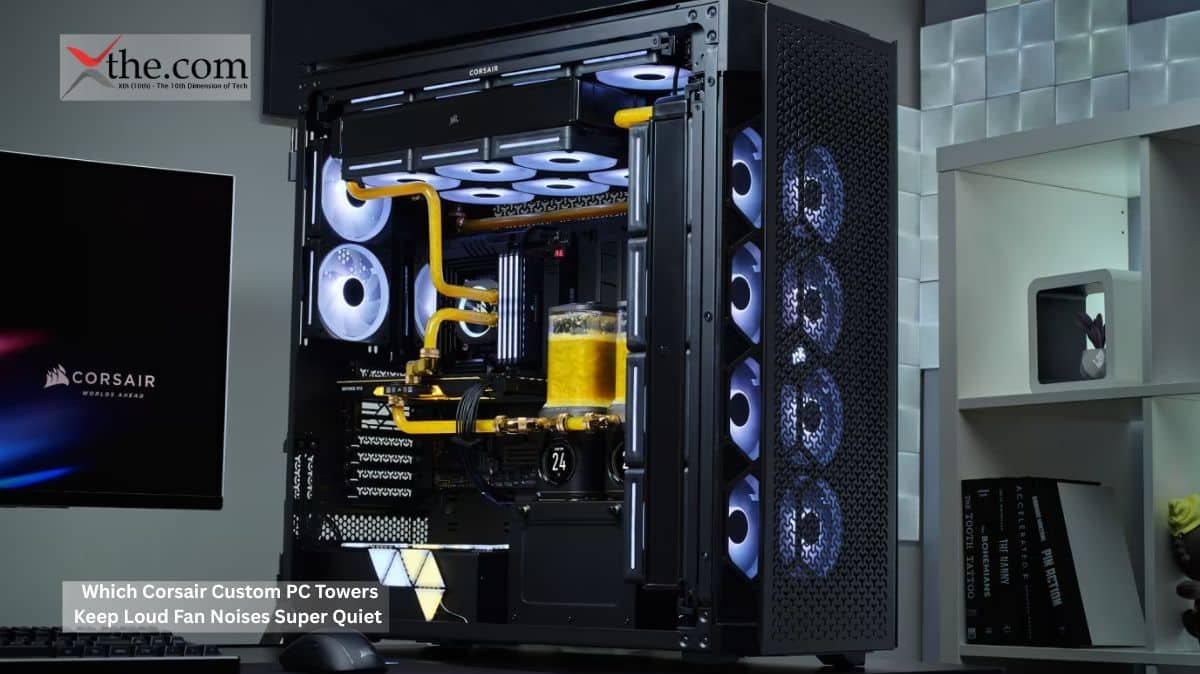
At Computex 2026, Corsair introduced several new products, such as the WARTHOG and 2800X RS-ARGB cases, the iCUE LINK TITAN II ULTRA LCD AIO cooler, and an updated FRAME 5000D case series. All these products share the same goal: to control heat effectively while keeping fan noises super quiet enough for professional use.
The WARTHOG mid-tower is inspired by the popular C70 Vengeance. It features thick steel, built-in handles, and easy-to-remove side panels, making it sturdy and practical. For content creators who move their computers between studios, this strong build is just as important as quiet performance.
The 2800X RS-ARGB, meanwhile, targets the premium Corsair custom PC builder who needs expansive cooling real estate without sacrificing a silent workspace. Both cases are Corsair’s answer to a market that has put up with too much noise for too long.
Hydraulic Fan Bearings and the Science Behind the Peace
The biggest technical improvement in Corsair’s Computex 2026 lineup is found in the fans. Both the standard and reverse-rotor LX360 fans use Magnetic Dome bearings, which make them quieter and more reliable. They also have a Zero RPM mode that keeps them completely silent when the system is under a light load.
Hydraulic fan bearings, which include both fluid-dynamic and magnetic types, work by holding the fan’s spinning shaft in a thin layer of lubricant or a magnetic field. This removes the metal-on-metal contact that causes the whining noise in cheaper fans. As a result, a fan spinning at 1,200 RPM can sound as quiet as a regular fan running at 600 RPM.
The iCUE LINK TITAN II 360 RX RGB AIO Liquid CPU Cooler uses this bearing technology, along with a FlowDrive Gen 2 pump, for efficient, quiet coolant flow. Its redesigned convex cold plate improves thermal contact for uniform performance. The convex shape is not just for looks; it increases contact with the CPU’s heat spreader, moving heat away faster so the fans do not have to work as hard.
A lower radiator fin density and an improved fan housing help increase airflow and reduce noise, making the TITAN II 360 RX a good choice for daily work and quiet environments.
Acoustic Insulation and Thermal Control Working Together
Lowering fan speed is just one part of the solution. The other part is stopping vibrations from moving through the case and into the desk, which is why mid-range towers often sound louder than their fan speeds would suggest.
Corsair’s acoustic insulation approach at this year’s show combined dense steel paneling with mounting configurations designed to decouple vibration sources from the frame. The new LX360 RGB Unified Frame fans make installation easier by combining three fans into one frame, available in both standard and reverse-rotor versions. All models use AirGuide technology and work smoothly with the iCUE LINK system. Using a unified frame cuts down the number of separate mounting points, and therefore the number of ways vibrations can travel, by about 60% compared to installing three fans separately.
Corsair also put a lot of thought into thermal control at Computex. AirGuide technology directs airflow for better cooling, and the LX360’s high static pressure and PWM control make it useful for both radiators and cases. PWM control is important because it lets the system adjust fan speed to match the heat load, rather than running fans at a constant, loud speed.
People who work from home and join video calls know this issue well. When the CPU suddenly works harder during a screen share, the fans can get loud in the middle of a conversation. Corsair’s PWM setup, connected to iCUE, is designed to make these fan speed changes more gradual and less jarring.
Corsair Custom PC Tower Acoustic Fan Setup Instructions for Professionals
For those building or reconfiguring a system using this new hardware, a few practical notes regarding optimizing acoustics:
Following Corsair custom PC tower acoustic fan setup instructions in the iCUE software begins by setting a custom fan curve that favors silence below a 70°C CPU temperature. The default aggressive curves are engineered for gaming tournaments, not podcast studios. Set the zero-RPM threshold to 50°C and allow fans to ramp gradually from 50°C to 75°C. Above that threshold, let the system prioritize cooling over quiet thermal safety cannot be traded for audio cleanliness.
With full integration of CORSAIR iCUE software and iCUE LINK, you get easier cable management and simple customization. This setup combines strong cooling and advanced visual controls in one place. It also lets creators set up multiple profiles for recording or heavy rendering and switch between them with a single click.
A Market Forced to Listen
Corsair’s new products at Computex 2026 show where the DIY PC market is going: more modular designs, better cooling, more efficient power, and a balance between capabilities and customization. What is not said as much, but is clear at the event, is that quiet operation is now a key feature, not just a bonus.
The pressure is real. As remote work and independent content creation have pushed high-performance desktops into living rooms and home studios, the tolerance for machine noise has collapsed. A Computex chassis that ignores acoustic insulation will struggle to justify a premium price tag to buyers who now record, broadcast, and call from the same desk where they compute.
Corsair’s 2026 products show that it believes the next wave of PC builders will want powerful yet quiet computers. Based on what they showed in Taipei this week, that seems like a smart move.