





Santa Clara
Atomic Answer: AMD (AMD) has released ROCm 6.1, an open-source software stack specifically optimized for Instinct MI300X accelerators, to improve PyTorch performance. The update includes new libraries for collective communication, reducing the software overhead that previously hindered multi-mode GPU scaling.
A machine learning engineer recently spent three days debugging a distributed training cluster after one GPU node failed to recognize a dependency update. The problem was not with the model itself, but with the software compatibility between drivers, frameworks, and networking libraries. This kind of short has slowed AI adoption more than many exhibitors might think.
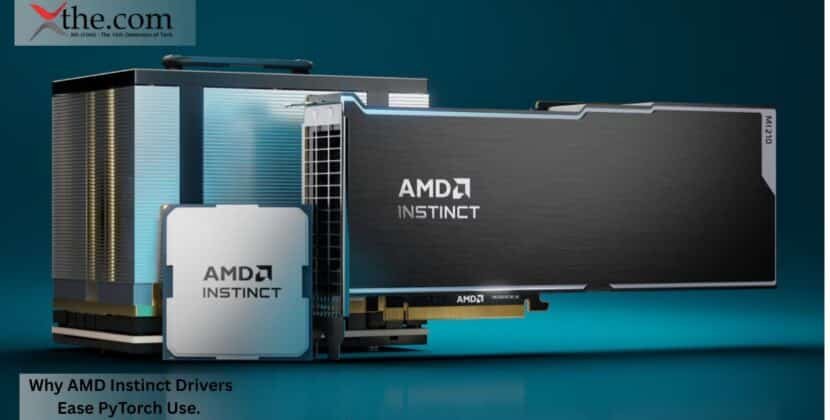
AMD Instinct hardware and ROCm 6.1 software are changing the focus. Rather than just aiming for faster accelerators, AMD is working to make deployment easier for developers using PyTorch distributed inference and large-scale training setups.
This strategy is important because AI infrastructure choices now depend more on software stability than on benchmark results alone.
Why Software Compatibility Became a Competitive Issue
For years, GPU computation was all about compute power and memory speed. This approach made sense when AI workloads were mostly experimental. But enterprise deployment has changed things.
A financial institution training fraud detection models does not want its engineers to build dependencies every few months. A healthcare analytics provider running complex imaging systems cannot risk unstable inference pipelines during production updates.
This kind of operational pressure explains why open-source AI ecosystems are now central to enterprise AI adoption. Developers expect frameworks like PyTorch to work without needing complex driver changes or custom kernel patches.
In the past, some organizations found AMD GPU environments more difficult to set up than established CUDA systems. ROCm six point one aims to change that view by offering better framework optimization, easier package management, and stronger support for distributed training.
How ROCM 6.1 Improves The Developer Experience
The main improvement in ROCm 6.1 is greater consistency. AI teams can now deploy models on different systems with fewer manual compatibility fixes.
This is important for companies running large language models or recommendation engines in mixed environments. Software fragmentation can lead to hidden costs. Even one incompatible library can delay production for days.
Better Native Integration with PyTorch
The integration between AMD Instinct accelerators and PyTorch has improved significantly over the past two years. Developers now get more stable support for transformer models, mixed-precision workloads, and tensor operations commonly used in generative AI.
For example, a startup training, a computer customer support language model, and several MI300X accelerators are used to perform manual memory allocation or distributed synchronization with earlier ROCM versions; now, ROCN 6.1 improves many of these optimizations by default through updated runtime libraries and compiler improvements.
This simplification makes it easier for engineering teams to move from prototypes to production-scale AI deployment.
The Role Of GPU Networking In AI Scaling
Training large AI models is no longer about the speed of each accelerator; now, how beta moves between GPUs plays a bigger role in system efficiency.
This is why GPU networking architecture is so important. Large distributed training jobs constantly exchange gradients, parameters, and inference data across clusters. Any spikes in latency or communication bottlenecks can sharply lower overall efficiency.
AMD has put a lot of effort into making the MI300X platforms more efficient through ROCM 6.1 optimization. The network stack now supports distributed PyTorch training across multiple nodes more efficiently.
For example, a company training a multilingual chatbot across eight GPU servers might process billions of parameters simultaneously. Faster GPU synchronization reduces training time and costs. Even a 10% cut in communication overhead can go a long way toward improving infrastructure over time.
Why Enterprises Care About Open AI Ecosystems
Many CIOs no longer want to tie their AI roadmap entirely to proprietary software stacks. That reference explains the growing importance of open-source AI frameworks.
Open ecosystems help companies adapt quickly as model architectures change. They also reduce the risk of being tied to a single vendor over the long term.
AMD Instinct products are becoming more attractive to organizations seeking alternative accelerators that still work well with popular frameworks such as PyTorch. The software layer is now just as important as the hardware.
This trend is even more evident in public-sector projects and academic labs, where tight budgets often mean choosing flexible infrastructure over exclusive vendor deals.
Understanding the Impact of AMD ROCm 6.1 Performance Improvements for PyTorch AI Models
The ongoing industry discussion about AMD ROCm 6.1’s performance improvements for PyTorch AI models signals a broader shift in AI infrastructure priorities. Enterprises are no longer judging accelerators only by synthetic benchmarks.
Now they look at deployment speed, stability, ecosystem maturity, support for distributed inference, and compatibility with their current AI pipelines.
For example, a retail analytics company might need to retrain its models weekly with real-time data, and faster deployment and support for the AGF framework are more valuable than small benchmark gains.
This practical need is making AMD increasingly relevant in discussions of enterprise AI infrastructure.
The Strategic Position Of AMD Instinct In Enterprise AI
The AI accelerator market remains highly competitive, but software maturity is a bigger factor in buying decisions. Hardware power alone is no longer enough to win over enterprises.
By improving framework integration, expanding GPU networking support, and enhancing the developer experience with PyTorch, ROCm 6.1 is helping AMD Instinct gain wider acceptance in enterprises.
The next stage of AI infrastructure competition will likely favor vendors who make deployment smoother, not just those who offer more compute power. Enterprises want accelerators that engineers can set up quickly, scale easily, and maintain without constant troubleshooting. This shift may prove more important than the latest benchmark results.
Enterprise Procurement Checklist
- Procurement Risk: Despite software improvements, the ecosystem for AMD-specific AI optimization remains smaller than NVIDIA’s CUDA.
- Infrastructure Consequence: Implementing ROCm 6.1 requires specific Linux kernel versions to support the new infinity fabric drivers.
- Deployment Bottleneck: Existing AI pipelines built on CUDA must undergo a “translation” phase using AMD’s HIPIFY tools.
- ROI Implications: Lower hardware acquisition costs for MI300X are balanced against the internal engineering labor required for software porting.
- Operational Action: Perform a pilot run of large-batch inference to validate memory bandwidth claims under the 6.1 stack.
Source: AMD Newsroom