SANTA CLARA, CA —
Atomic Answer: AMD (AMD) has introduced the Instinct MI350P PCIe, a dual-slot accelerator designed to bring high-performance AI inference to standard air-cooled data centers. This “drop-in” hardware allows enterprises to deploy advanced agentic AI models using their existing power and cooling footprints, bypassing the need for expensive liquid-cooling retrofits.
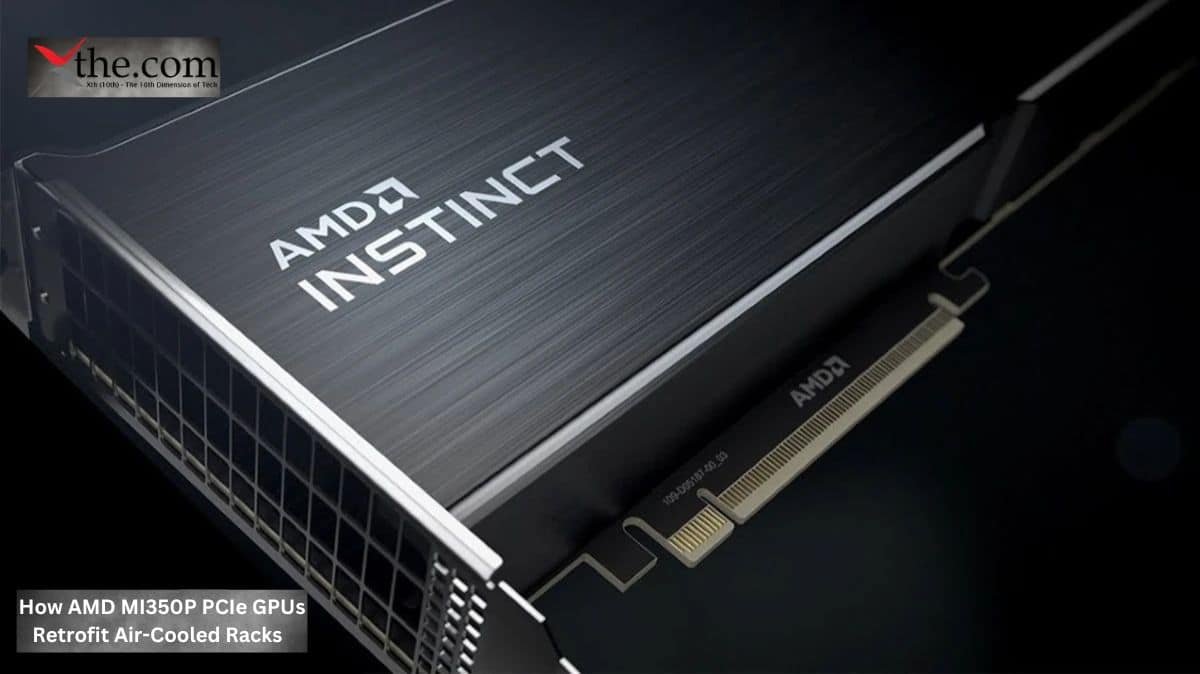
The upcoming 2026 release of the AMD Instinct MI350P PCIe air-cooled GPU directly addresses the infrastructure ceiling issue, which has prevented most companies from deploying advanced AI inference systems in their local facilities. Organizations without liquid-cooling systems will treat existing server compatibility with drop-in AI inference accelerator systems as their primary purchasing requirement, since the MI350P will shift the GPU upgrade discussion from facility redesign projects to straightforward hardware installation.
The Infrastructure Barrier MI350P Was Designed to Remove
Enterprise AI inference deployment has split into two factions operating along a shared infrastructure fault line. Organizations with liquid-cooled data centers that handle high-density GPU workloads operate as one group, while the other group includes organizations that lack this capability. The second group, which represents the majority of enterprise data center operators, has been effectively locked out of on-premises advanced AI inference by the facility requirements of the GPU platforms currently dominating the market.
On-premises AI inference with no liquid cooling retrofit capability is not a niche requirement. It is the deployment condition that most enterprise IT environments actually operate under. Organizations need to maintain their existing raised floor facilities, legacy server chassis, and air-cooled rack configurations because their current financial situation prevents them from funding liquid-cooling infrastructure.
The AMD Instinct MI350P PCIe air-cooled GPU 2026 functions as a designed operational system, serving as its main deployment environment.
What Drop-In Compatibility Actually Means
The “drop-in” designation requires procurement teams to evaluate its architectural effects, which contain specific architectural requirements. The MI350P system is a drop-in AI inference accelerator that operates within existing server power requirements and standard server chassis dimensions, requiring no chassis replacement, additional cooling systems, or rack modifications.
How does the AMD Instinct MI350P PCIe dual-slot design allow enterprises to deploy advanced agentic AI inference without expensive liquid-cooling facility retrofits? The card’s thermal architecture answers this question. The MI350P’s dual-slot form factor dissipates heat through conventional airflow the same rack-level cooling that existing server infrastructure already provides. There is no secondary cooling loop, no coolant distribution unit, and no facility plumbing requirement.
The deployment teams need to conduct a dual-slot PCIe headroom server audit, which tests 300W and 400W power usage to verify the infrastructure, before they can proceed with their equipment acquisition process. The MI350P consumes 300W to 400W, which modern server power supply units can handle, but exceeds the limits of older power supply units that lack GPU acceleration support. The deployment process will experience delays when hardware arrives unless a power supply unit audit takes place before the organization purchases equipment in bulk.
MI350P vs NVIDIA: The TCO Argument
The procurement comparison between AMD MI350P and NVIDIA enterprise inference TCO determines MI350P’s market position. The advanced NVIDIA inference platforms, which currently operate at high performance, require liquid-cooled environments for their high-density rack systems, and have facility upgrade expenses that exceed their GPU hardware costs for organizations without liquid-cooling systems.
The MI350P eliminates that facility cost component entirely. The TCO calculations between AMD MI350P and NVIDIA enterprise inference systems for air-cooled enterprise environments require organizations to evaluate the cost savings from avoiding liquid-cooling system installations, as this cost typically exceeds the expense of GPU hardware in mid-market enterprise facilities.
Why is AMD MI350P the highest-value alternative to NVIDIA for enterprises locked out of liquid-cooled data center upgrades in 2026? It’s a total cost question, not a raw performance question. Organizations that compare GPU platforms solely on inference-throughput benchmarks are omitting the dominant cost variable in their procurement environment.
ROCm Software and MXFP4 Precision
The process of deploying hardware via drop-in compatibility fails to provide full inference capabilities because it requires additional software components. AMD ROCm open-source MXFP4 precision MI350P provides the software layer that translates MI350P’s hardware capabilities into production inference performance across enterprise AI model deployments.
Enterprises can use ROCm’s open software architecture, which allows them to choose their own deployment and optimization tools without being forced to use specific proprietary systems. The MI350P uses MXFP4 precision support to execute quantized inference tasks at levels that closed-format precision systems cannot achieve under equivalent thermal conditions this feature enables more agentic AI models to operate on air-cooled systems.
The compatibility of AMD ROCm open-source MXFP4 precision MI350P with major inference frameworks enables organizations to deploy MI350P with slight adjustments to their existing model pipelines, including PyTorch, TensorFlow, and ONNX Runtime.
Scaling On-Premises AI Without Architectural Redesign
The MI350P deployment system enables air-cooled systems to reach their performance limits, while liquid-cooled systems must upgrade their entire infrastructure to increase GPU density.
The existing server chassis of MI350P units allows organizations to expand their inference capacity by adding additional units, keeping the rack’s thermal and power requirements at the same level as the units’ 300W-400W power consumption. The same infrastructure can support organizations at two different stages of their deployment process, from single-card pilots to multi-card production.
The use of drop-in AI inference accelerators for existing server systems at this incremental scale protects organizations from procurement uncertainties. Organizations can validate MI350P inference performance in production environments before committing to fleet-wide deployment a validation step that major facility infrastructure investments do not accommodate.
Conclusion
The AMD Instinct MI350P PCIe air-cooled GPU 2026 platform resolves the infrastructure access problem that has defined enterprise AI inference procurement for the past two years. The existing server framework for drop-in AI inference accelerators enables enterprise data center operators to deploy advanced inference systems without redesigning their facilities, which previously made such systems too expensive for most operators to implement.
The total cost of ownership calculations for AMD MI350P and NVIDIA enterprise inference show MI350P advantages in air-cooled enterprise environments, as they include avoided costs from liquid-cooling retrofits. The operational requirements for production inference deployment are met by the AMD ROCm software ecosystem and the open-source MXFP4 precision MI350P. The infrastructure verification process needs one server audit of 300W 400W dual-slot PCIe headroom before the MI350P deployment process can begin.
On-premises AI inference with no liquid-cooling retrofit capability at the MI350P’s performance level redefines what air-cooled enterprise infrastructure can support. As how does AMD Instinct MI350P PCIe dual-slot design allow enterprises to deploy advanced agentic AI inference without expensive liquid-cooling facility retrofits becomes the standard evaluation question for facility-constrained procurement teams, and why is AMD MI350P the highest-value alternative to NVIDIA for enterprises locked out of liquid-cooled data center upgrades in 2026 drives competitive GPU selection decisions, the infrastructure ceiling that separated enterprise AI inference haves from have-nots has a definitive hardware solution.
Enterprise Procurement Checklist
- Procurement Effect: High-value alternative to NVIDIA for firms locked out of liquid-cooled facility upgrades.
- Infrastructure Risk: Still requires dual-slot PCIe clearance and sufficient power headroom (approx. 300W-400W per card).
- Deployment Impact: Rapid scaling of on-premises AI inference without architectural redesigns.
- ROI Implications: Lower Total Cost of Ownership (TCO) by leveraging existing server chassis and racks.
- Operational Action: Verify server power supply unit (PSU) capacity before bulk-ordering MI350P units.
Primary Source Link: AMD Instinct MI350P PCIe GPUs: Run Enterprise AI on Your Existing Infrastructure