






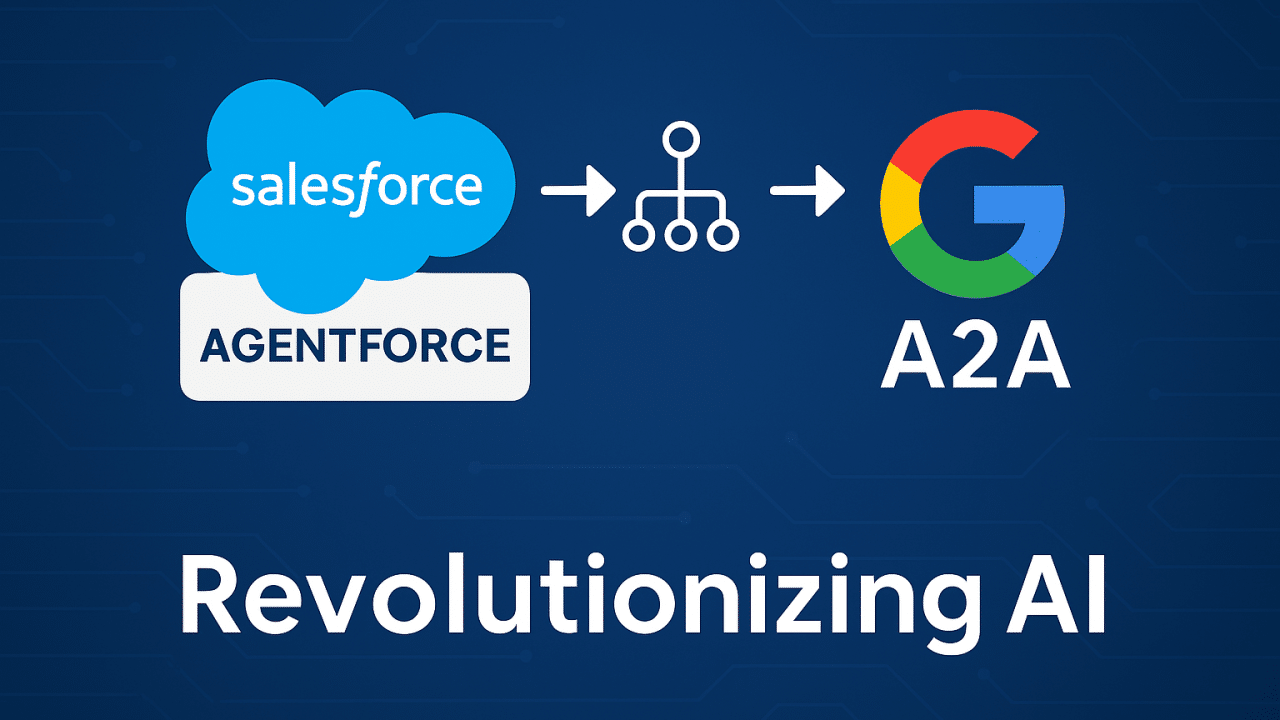
Mountain View, Calif.: A procurement manager at a Fortune 500 company recently shared a problem that seems minor at first, but quickly became serious: their AI agents couldn’t communicate with each other. One managed vendor discovery, another handled pricing negotiations, and a third processed contract. Each worked well on its own, but together they failed. This kind of fragmentation is exactly what the A2A protocol is designed to address, which is why its launch is prompting Salesforce AI to reconsider its strategy.
The Real Stakes Behind A2A Protocol And Agentic Workflows.
The launch of the A2A protocol denotes a move away from isolated AI tools toward coordinated task-focused systems called agentic workflows. These workflows rely on agents sharing structured information in real time, not just passing outputs. If there isn’t a shared way to communicate, the whole process falls apart.
This is where Google Cloud has made a smart move by placing Gemini Pro within a broader interoperability framework. Google is not just releasing another model. It is determining how models and agents work together across multiple systems. This affects more than just developer convenience. It directly influences how companies choose their technology.
For executives, this problem is easy to measure. An internal estimate, similar to what McKinsey might use, could show that integration gaps cause 20 to 30 percent inefficiency in AI-powered processes. When you add that up across procurement, customer service, and logistics, the costs grow substantially.
Why Salesforce AI Can’t Ignore Interoperability
Salesforce became dominant by controlling customer data pipelines. Its AI layer follows that tradition: it is deeply integrated, highly optimized, and mostly limited to its own system. The introduction of the A2A protocol challenges this approach by prioritizing interoperability over ecosystem control.
If Google Cloud AI agents can easily work with third-party tools, Salesforce could end up as a closed system in a world that is becoming more open. This isn’t a technical problem. It is a tactical one.
Take autonomous procurement as an example. A buyer’s agent finds suppliers using outside data, negotiates terms with a different service, and completes contracts in the company’s CRM. If these agents use cross-platform AI agent communication standards 2026, the system needs smooth data exchange between vendors. Any platform that doesn’t allow this openness becomes a bottleneck.
Salesforce has a decision to make: stick with its integrated approach or move towards greater compatibility. The market is already moving toward greater openness.
The Google Play: Gemini Pro as a Coordination Engine
Google’s strategy with Gemini Pro isn’t just about beating competitors on performance tests. It’s about adding intelligence to a network of agents. Gemini Pro acts as a coordinator, understanding intent, managing context, and ensuring each agent operates within a shared system.
This setup aligns well with agentic workflows, where tasks span multiple systems rather than having a single AI handle everything from start to finish. A group of specialized agents works together. The real value comes from how they coordinate.
By integrating the A2A protocol with Google Cloud, Google ensures that companies using its infrastructure get this coordination feature right away. It’s a quiet but strong incentive. Once a company builds its workflows around this protocol, it becomes harder to switch to something else.
The Pressure On Salesforce’s Architecture
Salesforce’s current AI strategy focuses on built-in intelligence, improving CRM features rather than managing external systems. This approach works well for customer information or sales forecasting, but it struggles when cross-platform co-coordination is required.
The arrival of cross-platform AI agent communication standards in 2026 sets a higher standard. Companies will expect their AI systems to work across multiple vendors’ ecosystems. They will want a smooth integration between procurement platforms, financial systems, and external data sources.
If Salesforce adapts, it could become a key player inside these networks. If it doesn’t, it risks being left off as more workflows avoid closed systems.
Autonomous Procurement as the Canary in the Coal Mine
Autonomous procurement is one of the best examples of what’s at stake. This isn’t just theory. Companies are already testing systems in which AI agents choose suppliers, negotiate contracts, and fulfill orders with little human involvement.
In these situations, interoperability is a must. A procurement agent needs to obtain data from external marketplaces, use negotiation tools, and connect with internal financial systems. Every step needs clear, consistent communication.
In this context, the A2A protocol is more than simply a technical detail. It forms the basis for trust between systems. Without it, companies end up with broken workflows and heightened operational risks.
Salesforce’s current products can handle some parts of this process, but they struggle to manage the entire chain when outside agents are involved. This gap will only get bigger as agentic workflows become the norm.
Strategic Implications for Executives
For decision makers, the main question isn’t whether to use AI agents, but how to ensure they work well together. Google Cloud’s new role as a coordination layer brings up new things to consider:
Organizations need to assess whether their current platforms can support large-scale interoperability. They should see how easily their systems can connect to protocols like A2A. They also need to think about the long-term effects of choosing open ecosystems over controlled ones.
A real-world example shows what is at stake. Picture a global company using AI in procurement, logistics, and customer service. If each area uses different vendors, coordinating agents becomes essential. A single protocol makes processes smoother, speeds up decisions, and leads to better results.
In this situation, Gemini Pro is far more than a model. It’s part of a bigger plan that might change how companies build and grow their AI systems.
The Way Forward for Salesforce
Salesforce still has choices. It can add the A2A protocol to its platform, letting its AI agents join wider ecosystems. It can form partnerships to improve interoperability or create its own standards that could lead to further fragmentation.
The most likely path is selective openness: keeping control over key data, but allowing outside collaboration. Striking this balance will determine whether Salesforce remains at the center of enterprise AI strategies or becomes just one part among many.
A Shift That Won’t Reverse
The shift toward agentic workflows and standardized communication protocols reflects a broader trend. Companies no longer see AI as just a set of tools. They now view it as a connected system.
The launch of the A2A protocol speeds up this change. It makes vendors think, leading them to rethink their system designs and encouraging organizations to prioritize compatibility over convenience.
How Salesforce responds will shape its place in this new environment. At the same time, Google Cloud is working to become the main link for enterprise AI.
The companies that move quickly will lead to the next stage of AI adoption. Those who wait may still be included, but they won’t be essential anymore.
Source: 5 ways AI agents will transform the way we work in 2026








