






Santa Clara, CA
Atomic Answer: NVIDIA has launched the Cosmos platform, designed to process millions of hours of video data for “physical AI” development in weeks rather than years. Leveraging the Blackwell architecture and NeMo curator, developers can build world models for robotics with a 100x efficiency gain over CPU-only pipelines.
Just one hour of autonomous driving footage can produce over 100 gigabytes of raw sensor data. For a warehouse robotics company testing 500 robots across three continents, compute costs can reach millions before a model is reliable enough for commercial use. The economics of machine learning change significantly when AI moves from the cloud into the real world. The challenge is why the NVIDIA Cosmos platform is attracting interest from robotics companies, automotive suppliers, and industrial automation leaders who want to accelerate physical AI development.
The main question is no longer if physical AI works. Now, the question is whether companies can train, test, and deploy models quickly enough to make the investment worthwhile.
The Infrastructure Bottleneck In Physical AI Development
Traditional AI systems operate in stable digital environments, but physical AI systems face more challenges. Robots deal with changing light, reflective surfaces, moving obstacles, and unpredictable people. Autonomous systems must handle video, sensor data, mapping, and decision-making simultaneously.
This complexity leads to big infrastructure problems. Teams often put together separate tools for simulation, labeling, training, and running models. One team might manage perception models while another works on simulation. Data engineers can spend months fixing bad video streams instead of making models more accurate.
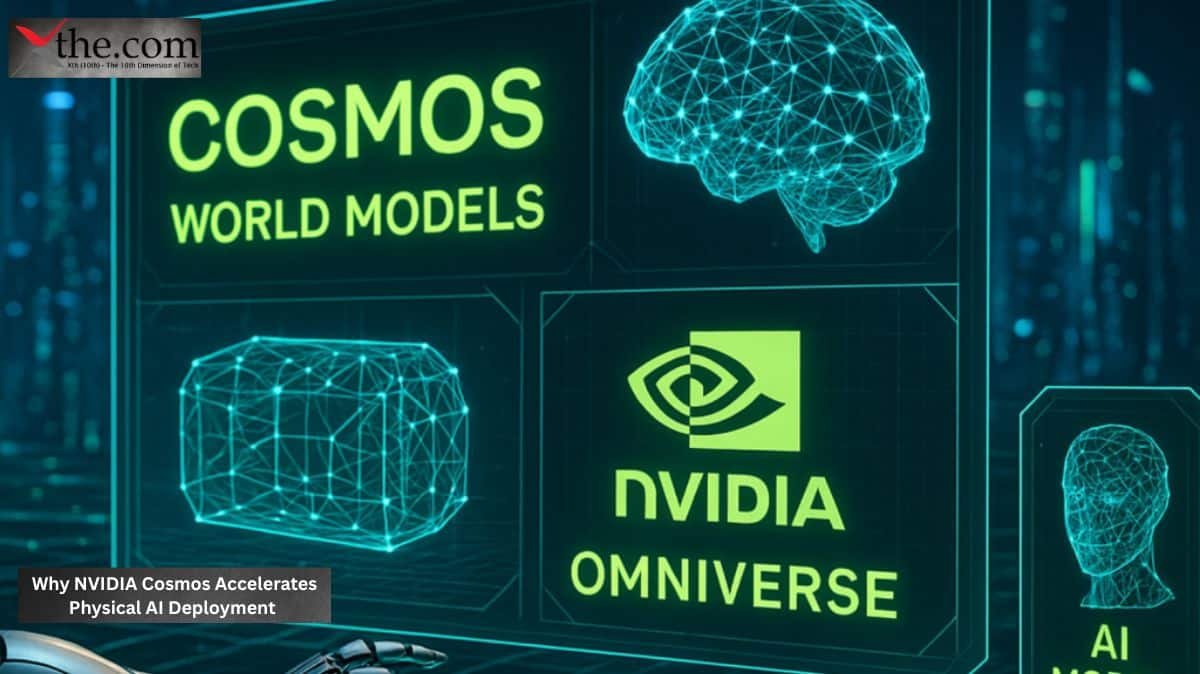
The NVIDIA Cosmos platform solves this problem by bringing together simulation tools, high-performance computing, and scalable model training into a single system for physical AI development.
The business benefits are clear when companies look at how much time delays cost. For example, a robotics setup startup testing warehouse navigation might spend six weeks just preparing data before training starts. With tools like Nemo Curator, companies can automate filtering and labeling and optimize large datasets, reducing manual work.
Why Compute Efficiency Matters More Than Ever
As robotics and autonomous systems grow, there is a huge need for faster training hardware. Video-heavy tasks put significant pressure on regular GPU clusters because physical AI models process long sequences of images rather than single images.
This is where Blackwell GPU training makes a big difference.
The Blackwell architecture boosts memory performance and enables parallel execution for large AI workloads, especially in environments that rely heavily on simulation. For example, a robotics company training robots to handle objects might use thousands of simulated scenarios. Older systems could take days to complete a single training cycle. But with Blackwell GPU training, teams can train much faster and improve robot behavior more quickly.
Faster training is important because robotics companies compete on how quickly they can deploy. If training takes too long, customer pilots, manufacturing, and revenue all get delayed.
As a result, the focus shifts from performance alone to overall cost and value.
Understanding the Cost-Benefit Analysis of NVIDIA Blackwell for Physical AI Video Pipelines.
The cost-benefit analysis of NVIDIA Blackwell in physical AI video pipelines is strong when companies compare computing efficiency to their operating costs.
A logistics automation company that processes nonstop warehouse video has three main costs: preparing data, training models, and scaling up for real-time use. Older systems often force companies to choose between model quality and cost. Using higher-resolution video makes models more accurate, but also much more expensive to process.
The NVIDIA Cosmos platform helps solve this problem by streamlining AI video processing and speeding up training. Companies can develop faster while still keeping high-quality simulations.
For example, a company making autonomous forklifts can use synthetic data generation to create thousands of rare collision scenarios that are hard to find in real life. Instead of waiting months to collect these cases, engineers can simulate them right away and use them to train models faster with Blackwell GPUs.
This approach changes the financial picture. Faster training means lower engineering costs. Better simulations mean less need for costly real-world testing. More accurate models also lower deployment risk.
The end result is a lower total cost for each deployment cycle.
The Growing Role Of Robotics World Models
Physical AI systems now depend more on predicting their environments instead of just reacting to them. This is why interest in robotics world models is growing.
These models help robots predict what will happen before they act. For example, a warehouse robot can plan its path before moving through a crowded aisle. Industrial robots can also predict how they will interact with objects before touching them.
The NVIDIA Cosmos platform helps with this shift by bringing together simulation tools and scalable training systems. Developers can now build systems that understand and reason about changing environments, not just train separate perception models.
This ability is especially important in fields where safety and accuracy matter most. Manufacturing, healthcare robotics, self-driving vehicles, and smart infrastructure all need systems that can predict uncertainty before making decisions.
Why Data Quality Defines Deployment Success
Many physical AI projects fail because companies do not understand how complex the data is. A model trained on unbalanced data might work well in tests but fail in real-life situations.
This is why tools like NeMo Curator are important. Smart data curation makes models more reliable by removing duplicates, identifying bad samples, and improving the quality of training data. With scalable AI video processing, companies can better control model quality across large projects.
Adding that synthetic data set generation makes deployment even easier. Developers do not have to rely on extensive, expensive real-world data collection. They can simulate weather, factory issues, lighting changes, and other visual events at scale.
This flexibility speeds up physical AI development and lowers the risk of problems during operation.
The future of enterprise AI will be about more than just chatbots. Success will depend on whether machines can understand, predict, and work safely in the real world. Companies that speed up training, improve simulations, and manage costs will lead the way. The NVIDIA Cosmos platform aims to be at the center of this shift, helping turn physical AI into a real business tool.
Enterprise Procurement Checklist
- Procurement Effect: Massive CapEx shift toward NVIDIA (NVDA) Blackwell-ready AI factories for robotics.
- Infrastructure Risk: Thermal scaling pressures; Cosmos-scale workloads require liquid-to-chip cooling.
- Deployment Impact: Drastic reduction in the time-to-market for autonomous warehouse and humanoid robots.
- ROI Implications: 80% reduction in data labeling and curation costs for visual AI models.
- Operational Action: Evaluate rack-scale cooling capacity before committing to Blackwell-based physical AI training.
Source: NVIDIA Launches Cosmos World Foundation Model Platform to Accelerate Physical AI Development








