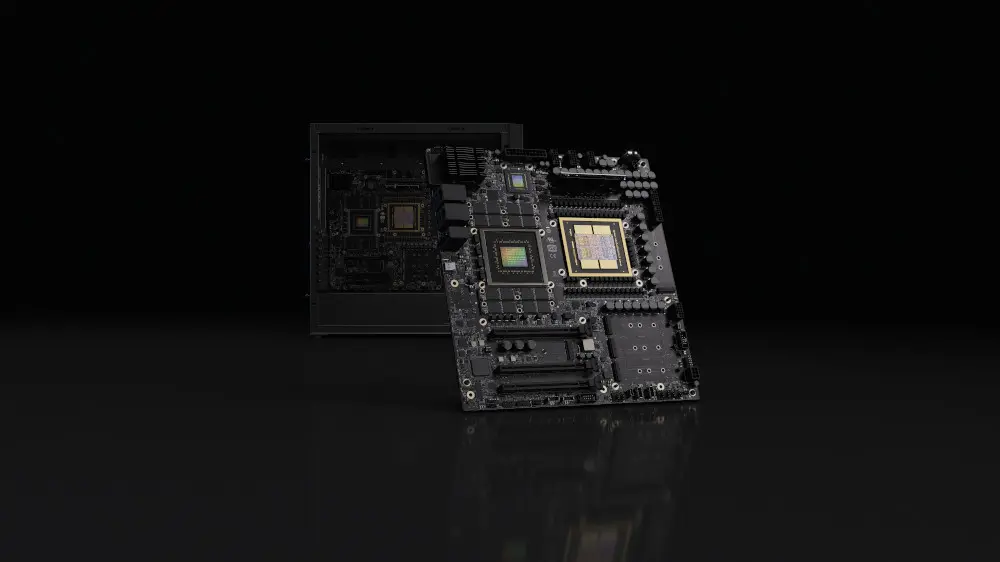
SANTA CLARA, Calif. — NVIDIA’s new product is not simply another hardware upgrade; it represents a revolution in the development and training of artificial intelligence models and ownership. Launching the NVIDIA Blackwell Ultra-powered DGX Station marks a major milestone, making possible a desktop machine that provides unparalleled compute density and brings the same level of hyperscale AI training capabilities to businesses and labs. DGX Station, based on the GB300 Superchip architecture, is the key to this revolution. The impressive amount of memory (up to 748GB), made possible by HBM3e technology, in addition to very fast NVLink-C2C interconnectivity, allows achieving outstanding AI performance of up to 20 Petaflops. It effectively breaks the dependence on distributed cloud clusters for training purposes.
The End of Cloud Dependence
AI research has always been dependent on cloud services from companies such as Microsoft Azure. For model training, there was a need for powerful GPU clusters, expensive bandwidth, and high operating costs. The arrival of NVIDIA Blackwell Ultra has disrupted this scenario.
There are three key benefits associated with this new paradigm:
- Decrease in Latency: Training and inference will occur in-house with no latency.
- Cost Management: There will be no recurring cloud egress or compute charges
- Data Security: Confidential data can stay within corporate premises
This is especially important for start-ups and research facilities that wish to maintain proprietary information. Instead of using third-party services, these facilities can now utilize DGX Stations as their local AI supercomputers.
Architectural Leap: Its Unique Features
As far as the technical leap, this NVIDIA product has one more crucial feature – it is designed for system coherence, combining the HBM3e memory’s high bandwidth and low latency with an NVLink-C2C connection that eliminates the need to synchronize different compute parts.
Some highlights include:
- Memory pool: unified and 748GB large
- Interconnects: scalable and NVLink-C2C powered
- Software stack: deeply integrated and Ubuntu-based
This architecture provides all the necessary prerequisites for scaling 1-trillion-parameter models on NVIDIA Blackwell Ultra desktop supercomputers, a task previously considered a hyperscale data center task.
Impact on the Hardware Ecosystem
The introduction of the NVIDIA Blackwell Ultra immediately puts pressure on hardware providers like Supermicro, as they have traditionally offered enterprise-class AI systems. The first-party solution from NVIDIA, in turn, shrinks the time to innovation in cooling, density, and performance.
Possible outcomes are:
- Faster introduction of liquid-cooled enterprise towers
- More competition regarding high-density packaging
- Focus on vertically integrated AI hardware solutions.
The game is no longer about putting together various hardware components – it is about creating ready-for-use AI computing systems.
Financial Implication: Transition to CapExFinancial Implication: Transition to CapEx
Another important implication is the shift towards financial optimization. The AI stack is moving from being an operational expenditure in the cloud to a capital expenditure system based on ownership.
What will change for business?
- High Initial Costs: Systems over $100,000 become a long-term investment
- Asset Depreciation: Allow hardware accounting in installments
- Fixed Cost: Removes unpredictable costs from cloud bills
The capital expenditure model is suitable for high-growth AI companies that seek stable finances and data privacy. Thus, the DGX Station is not only a product but a key asset in the AI development pipeline.
Competition for Cloud Service Providers
The emergence of such technology puts cloud service providers under stress. The “inference moat,” which refers to their capacity to bind clients to proprietary hardware, is becoming weaker. If enterprises can achieve the same level of efficiency in-house using NVIDIA Blackwell Ultra, their solutions lose their competitive advantage.
Therefore, companies like Amazon Web Services and Google must now consider:
- Decreasing GPU computing prices
- Hybrid cloud deployment options
- Enhancing security guarantees
Benefits for Developers and Researchers
For developers, the DGX Station opens up the following opportunities:
- Increased Iteration Cycle Speed: Instant access to computing capabilities
- Model Prototyping: The ability to experiment with larger architectures
- Confidentiality Guarantee: No need to expose proprietary models externally
With such a solution integrated with an Ubuntu AI environment, developers have access to premium AI training solutions without the need for complex infrastructure management.
Strategic Vision
In light of the new NVIDIA Blackwell Ultra solution, the approach to building AI infrastructures undergoes fundamental changes. Scaling outward, into large cloud networks, is no longer required; one can build their own systems instead.
This trend is part of a wider pattern:
- Growing awareness of privacy issues
- Increasing prices for cloud computing services
- Real-time AI requirements
It is within this context that the DGX Station is placed.
Conclusion
The introduction of NVIDIA Blackwell Ultra via the DGX Station is no ordinary product; it is an AI infrastructure gamechanger. This technology is breaking free from reliance on cloud providers by enabling on-site training of trillion-parameter models. Enterprises, start-ups, and academic research institutes now have a fundamental choice to make: do you continue renting your computing power or own it? The potential for performance up to 20 PetaFLOPS, and technological developments such as HBM3e and NVLink-C2C, could change the game in favor of owning AI. This shift is not only about building great models; it is about who owns the infrastructure behind them.
Source– NVIDIA DGX Station