




CUPERTINO, CA —
Atomic Answer: OpenAI is reportedly preparing a notice of “breach of contract” against Apple due to strained partnership terms. This legal pivot threatens the integration of advanced multimodal AI within the Vision Pro and iOS 2026 roadmaps, potentially forcing Apple to rely more on internal LLM projects.
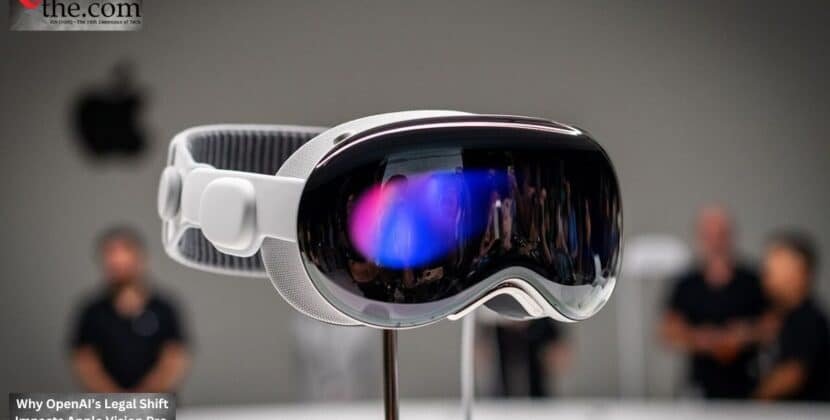
The Apple OpenAI Breach dispute arrives at the worst possible moment for the momentum of Vision Pro AI deployment. As $AAPL prepares its most AI-dependent product roadmap in company history, the contract dispute with OpenAI introduces integration uncertainty that enterprise spatial computing buyers and federal procurement teams cannot plan around making the multimodal AI partnership on which VisionOS depends suddenly contingent on litigation outcomes rather than engineering timelines.
What the Breach Notice Actually Threatens
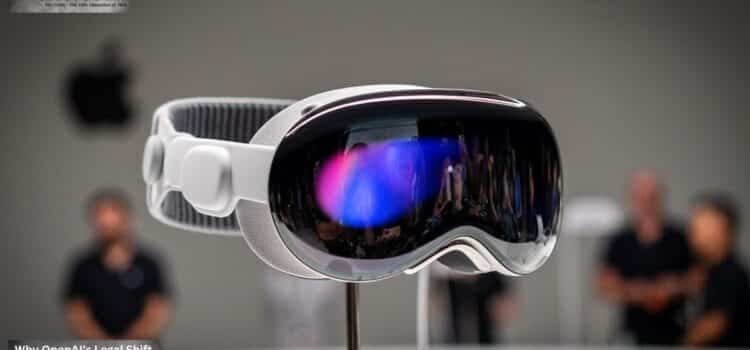
Vision Pro AI’s current form is architecturally dependent on OpenAI’s multimodal AI integration. The ChatGPT layer embedded in VisionOS handles the natural language, image interpretation, and contextual reasoning that enterprise spatial computing pilots depend on capabilities that $AAPL’s internal LLM projects cannot replicate at equivalent quality on the timelines that 2026 deployment roadmaps require.
OpenAI vs Apple legal breach impact on Vision Pro 2026 is not a branding dispute it is a capability dependency crisis. If the breach notice escalates to integration termination, VisionOS loses its primary multimodal reasoning layer mid-cycle, forcing enterprise buyers who have built spatial training pilots around ChatGPT-native workflows to rebuild their application architecture around replacement models that have not yet been validated in spatial computing environments.
The Internal LLM Fallback Problem
$AAPL’s internal model development Apple Intelligence has demonstrated competence in on-device inference for bounded tasks. It has not demonstrated equivalence to GPT-4-class multimodal reasoning for the complex, context-rich spatial computing interactions required by Vision Pro AI enterprise use cases.
Transitioning the reliance on AI models for the Vision Pro from OpenAI to a proprietary in-house model will increase heat generation and power consumption on the physical wearable hardware. The weight of on-device multimodal AI inference at a quality equivalent to GPT will be accommodated within the Vision Pro hardware’s thermal envelope via the use of cloud offload as a design assumption, which will no longer be valid if the only Replacement option is on-device. Enterprises implementing spatial computing will be better off treating ‘on-device’ model substitution as a downgrade of capability/endurance rather than as a like-for-like solution.
Federal Procurement and Enterprise Deployment Risk
As Federal procurement groups assess Vision Pro’s compliance for spatial training, field operations, and secure facility applications, the risk profile is compounded. Federal procurement evaluation frameworks do not account for the uncertainty associated with contract dispute resolution between $AAPL and OpenAI over the features of Vision Pro. For federal government procurements, the basis for acquiring products is validated capabilities, whereas the partnership is contingent on a future roadmap.
Enterprise IT teams planning 1,000-unit-plus rollouts of the Vision Pro AI assistant should treat the breach notice as a signal to pause deployment. The capability baseline that justified the procurement decision may not be the capability baseline available at delivery a gap that spatial computing deployments built around ChatGPT-native workflow assumptions cannot absorb without significant remediation cost.
The Google-First and Llama-Native Alternatives
$AAPL’s reported consideration of Google Gemini as an OpenAI replacement introduces its own procurement implications. Gemini integration would shift multimodal AI dependency from one external partner to another resolving the immediate breach risk without eliminating the partnership dependency that created it. Federal procurement environments with restrictions on Google infrastructure would face the same deployment constraint under a Gemini-first VisionOS as they face under the current OpenAI integration uncertainty.
Llama-native vision workflows represent the architecturally independent alternative open-weight models that enterprises deploy and control without external partnership dependency. OpenAI vs Apple legal breach impact on Vision Pro 2026 accelerates the enterprise evaluation of Llama-based spatial computing stacks that were previously positioned as alternatives to the premium ChatGPT integration rather than its replacement.
Conclusion
The vision of AI from Apple and OpenAI’s partners in this lawsuit creates a new layer of risk for purchases made on behalf of their partner organizations, as the pace of enterprise adoption of spatial computing has not slowed. For Apple Incorporated ($AAPL), they have reached a critical point in the evolution of their roadmap, which means they must decide whether to pursue litigation to resolve the disagreement, find a new AI partner and pivot to an impaired multimodal delivery, or hasten the development of their internal modeling capabilities. No matter which option Apple chooses, none of them maps to any of the required timelines for enterprise users to deploy in 2026.
Because enterprise IT teams will not have predictable outcomes from contract disputes to use as anchors for their deployment decisions (and therefore cannot back out of them), the continued hosting of large-scale Vision Pro AI assistants by federal procurement teams will serve as a de facto example for the rest of the enterprise IT community. Enterprises that have previously been piloting spatial computing deployments should re-evaluate their AI strategy and implement dual-track approaches for Google’s Gemini and Meta’s Llama-enabled vision workflows now before Apple vs OpenAI creates a scheduling crisis impacting Vision Pro and requiring an unplanned architecture change due to timeline constraints.
Enterprise Procurement Checklist
- Deployment Risk: Potential loss of native ChatGPT features in VisionOS could impact enterprise “spatial training” pilots.
- Procurement Intelligence: Apple’s pivot to “Google-first” or internal models may change the required NPU specifications for 2027.
- Infrastructure Constraint: Relying on on-device models for Vision Pro increases thermal loads on the wearable’s battery.
- Operational Consequence: IT teams should delay 1,000+ unit “AI Assistant” rollouts until partnership clarity emerges.
- Action Step: Dual-track your AI strategy to include “Google Gemini” or “Llama-native” vision workflows.
Primary Source Link: The Economic Times