




New York, NY. A single AI query uses almost 10 times more network traffic than a typical cloud search. Many executives may not realize how important this is. As GPU arrays grow across the US, the main challenge is shifting from computing power to physical infrastructure that connects these systems. The partnership between Corning and Nvidia is a direct response to this issue and could change how AI infrastructure is built in the US.
The main issue is not only about making cables faster, but it is also about energy efficiency, control over manufacturing, and the costs of scaling up new AI systems. The impact of the Nvidia and Corning fiber optic partnership on US AI infrastructure goes well beyond buying hardware. It affects national competitiveness, energy use, and the future of American leadership in cloud technology.
The Hidden Bottleneck Inside AI Infrastructure
For years, large-scale operators focused on adding more computing power, GPUs, racks, and cooling. But data traffic congestion has quietly become the weak point in big AI training setups.
Modern language models need thousands of GPUs to share huge datasets. At the same time, even tiny delays can lower training efficiency across these distributed systems. This is when networking latency becomes a financial issue, not only a technical one.
If synchronization is delayed in a 100,000-GPU cluster, it can waste millions of dollars in computing each year. This is why fiber optic manufacturing is now a key topic in infrastructure planning.
Optical fiber, unlike traditional copper connections, offers higher bandwidth and requires less power per bit. For those running dense AI clusters, this difference directly affects operating costs.
The NVIDIA and Corning partnership is designed to tackle this exact challenge.
Why Corning Matters More Than Most Investors Assume
Most people know Corning for making smartphone glass, but in the tech industry, Corning has spent decades developing expertise in optical networking components and sophisticated cables.
This manufacturing background has suddenly become strategically very important.
The US is under increasing pressure to strengthen its domestic semiconductor and networking supply chains. Recent global political tensions have shown how much American tech companies still rely on overseas factories.
Optical networking equipment is a key part of this vulnerability.
By expanding US-based fiber optic manufacturing, Corning gives cloud providers and AI operators a stronger sourcing strategy. This matters to companies building multi-billion-dollar campuses, where supply disruptions might delay deployment schedules by months.
The financial effect is substantial. A large AI facility might need hundreds of thousands of fiber connections. If transceivers or cables are delayed, the entire project can be put on hold.
This is one reason why the NVIDIA and Corning fiber optic partnership has effects that go far beyond a typical vendor deal for US AI infrastructure.
AI Infrastructure Is Becoming a Power Management Problem
Most public conversations about AI focus on chips, but energy use is another important part of the story.
Large AI clusters now use as much electricity as small cities. Moving data between GPUs significantly increases power consumption. Operators now have two main challenges: speeding up communication and cutting energy costs.
Optical networking helps address both of these problems.
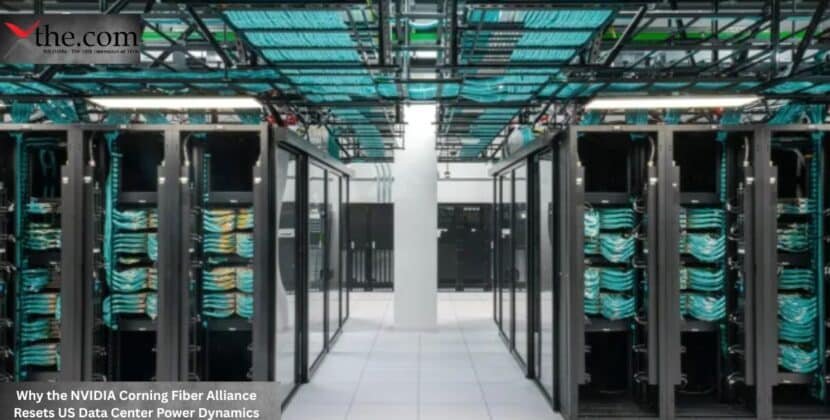
Compared to copper-based systems, advanced fiber-optic systems reduce heat and improve data transmission over long distances. This effectiveness is especially important in large data centers, where rack density continues to increase.
Microsoft, Amazon, and Meta are already under greater scrutiny from utilities and regulators over how much power they consume. Every watt saved in networking adds up across millions of tasks running at once.
This is why AI infrastructure and fiber optic manufacturing are now closely linked to energy strategies.
The Competitive Race Behind Domestic Supply Chain Expansion
The US is not the only country investing in AI networking. China is expanding its state-backed optical manufacturing, and Saudi Middle Eastern countries are heavily funding their own AI infrastructure projects.
This competition is a strategic concern for both Washington and Silicon Valley.
A stronger domestic supply chain helps protect against geopolitical interruptions and allows American companies to deploy faster. It also gives the US more leverage in future trade talks about semiconductors and telecom infrastructure.
For Nvidia, working with Corning brings benefits beyond just logistics. It lets them better connect GPU systems with optical networking technologies designed for AI workloads.
This merging could reduce network latency in distributed AI clusters, especially as models continue to grow to trillions of parameters and beyond.
The advantages are evident. Faster connections can cut model training times by days or even weeks for companies competing in generative AI. This time savings can directly lead to more revenue.
Hyperscale Data Centers Confront a New Infrastructure Hierarchy
For the past 20 years, expanding data centers followed a set pattern: get land, secure power, install servers, and then grow outward.
AI changes that hierarchy.
Now, network design is a key factor in whether a facility can efficiently handle advanced AI workloads. Operators can no longer see connectivity as a minor purchase.
Inside modern hyperscale data centers, optical interconnect density now rivals power delivery as a design priority. The shift elevates companies involved in fiber-optic manufacturing from component suppliers to strategic infrastructure partners.
This shift explains why the Nvidia and Corning partnership is getting so much focus from investors and tech companies.
The partnership addresses three main challenges simultaneously. They are the rising demand for AI bandwidth, growing concerns about domestic supply chain resilience, and rising energy costs for AI infrastructure. Very few infrastructure deals affect all three of these areas simultaneously.
NVIDIA’s Expanding Infrastructure Strategy
For NVIDIA, this cooperation is part of a bigger strategic change.
NVIDIA is not simply a GPU vendor. The company is now presenting itself as a full AI infrastructure provider, covering computing, networking, cooling, and systems integration.
This change is important because future enterprise AI spending will likely focus on comprehensive infrastructure solutions rather than buying separate hardware components.
By partnering with Corning, NVIDIA gains more control over a key part of AI deployment. This move also puts pressure on networking suppliers who still rely on scattered international supply chains.
The wider impact of the NVIDIA and Corning fiber-optic partnership could change how the cloud industry sets its purchasing priorities. Companies planning future AI projects may start to value US-made networking systems that are closely linked to GPU performance.
This would be a major shift in how tech companies evaluate infrastructure investments.
The Next Phase of AI Infrastructure Will Be Physical
Software has gotten most of the attention, and hardware has gotten the profits, but physical connectivity might end up deciding which companies come out on top.
As AI systems continue to grow, companies that reduce network latency, manage energy use, and maintain a stable supply chain will have an edge. These abilities now depend more on advances in fiber-optic manufacturing than on computing power alone.
The Corning and Nvidia partnership shows this new reality. It suggests that the future of American AI leadership could rely as much on glass, cables, and optical engineering as on silicon chips.