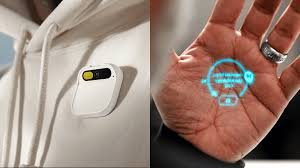
SAN FRANCISCO, Calif. The rapid disappearance of independent AI pin devices has opened a new path for consumer technology development, as Meta and Apple had to redirect their research efforts toward advanced eyewear computing systems after encountering serious hardware development issues.
The transition marks a major turning point for both Smart Frames and the broader Wearable AI market, as companies rethink how they use artificial intelligence in commercial products that rely on small electronic devices.
What initially appeared to be the next breakthrough category in personal AI devices is increasingly being viewed as an unsustainable hardware form factor.
Why AI Pins Struggled Technically
The AI pin devices attracted public interest because they offered users access to artificial intelligence via voice commands and a lightweight design that did not require a screen.
The actual implementation revealed significant engineering issues that affected battery performance, processing capacity, and continuous temperature control.
The main difficulty that needed resolution was Thermal Throttling, which reduced device performance to protect against overheating during heavy AI processing.
The practical functionality of several wearable AI pin systems was affected by this restriction.
Smart Frames Offer More Hardware Flexibility
The transition to Smart Frames demonstrates how glasses-based systems provide a more efficient distribution of processing units, sensors, audio equipment, and battery components.
Manufacturers can use eyewear platforms to create more effective heat-dissipation and power-management systems than they can with small wearable pins.
Smart Frames deliver superior performance as a permanent solution for sophisticated AI interaction.
The category has now emerged as a critical element for upcoming consumer AI hardware development plans.
Wearable AI Moves Toward Spatial Computing
The broader development of Wearable AI technology now emphasizes multimodal interaction systems rather than basic voice-driven virtual assistants.
Future systems will use audio, visual overlays, contextual sensing, and real-time AI assistance to create ongoing user experiences.
The transition leads companies to develop more advanced wearable systems with multiple functions rather than basic devices, creating complete user experiences through their eyewear products.
The growth of Wearable AI technology now depends on advances in spatial computing.
Meta Ray-Ban Gains Strategic Importance
The increasing popularity of Meta Ray-Ban smart glasses shows that wearable AI devices will evolve from existing consumer product designs rather than requiring new types of devices.
Glasses enable users to wear AI assistants while they use their built-in microphones, cameras, and speakers for daily activities.
The performance limitations affecting AI pins have therefore increased confidence in smart glasses as a more scalable consumer adoption pathway.
Meta Ray-Ban’s strategic value in the wearable technology market has increased.
Apple Glass Development Accelerates
The current industry trend is driving greater focus on Apple Glass projects that Apple has been developing for many years.
The future development of computing platforms will increase the importance of wearable displays and contextual assistance systems, as AI capabilities become embedded in consumer products.
The existing restrictions on AI pins will drive companies to invest in glasses-based systems that can deliver advanced AI capabilities.
The emergence of Apple Glass as a significant hardware category for future development.
Thermal Throttling Limits AI Processing
The successful operation of large language models and contextual AI systems requires massive computing resources, generating substantial thermal energy during active inference. Pins that are worn in a small size do not have sufficient thermal capacity to withstand those workloads for an extended period.
The hardware limitation directly led the industry to adopt Smart Frames as its new standard.
AI Hardware Strategy Is Changing
The decline of interest in AI pins has led companies to reconsider their complete approach to AI hardware development.
Manufacturers now design products that balance portability with essential thermal protection, power capacity, and multiple user modes.
The consumer AI device market has reached a new stage of development, which shows increasing maturity.
The next generation of AI Hardware will focus on developing practical user functions that solve real-world problems rather than creating new technological methods.
Consumer Tech Competition Intensifies
The developing wearable market is driving increased competition across the entire Consumer Technology sector.
Companies are competing to build superior ecosystems for their AI-based wearable devices, which they need to establish before mainstream users start adopting their products.
Smart glasses will become the primary interface, connecting smartphones to cloud AI systems, augmented reality tools, and personal digital assistants.
The future of Smart Frames is strategically significant because its value extends beyond hardware sales.
The Death of the AI Pin Concept
The broader death of the “AI Pin” and the rise of spatial audio-visual wearables reflect the reality that successful consumer devices must integrate naturally into existing user behavior patterns.
AI pins failed to function properly because their design required users to learn new ways of interacting with the system, while the system provided unpredictable results.
The smart glasses market builds upon existing social acceptance of smart glasses, which users already know as a familiar form of wearable technology.
This factor provides them with a significant edge, enabling customers to adopt their products for an extended period.
Wearable AI Expands Into Daily Computing
The future of Wearable AI will develop systems that provide ongoing user support through voice interaction, contextual awareness, translation, navigation, messaging, and real-time information retrieval.
The vision requires hardware that can perform AI inference without generating excessive heat or depleting battery capacity.
The industry is increasingly unifying its operations around Smart Frame architectures because they meet its needs.
The Future of Spatial Wearables
Future wearable systems will combine spatial audio with lightweight visual overlays, environmental awareness, and AI-generated contextual assistance, creating single-consumer platforms.
The speed of technology adoption will depend on advances in processor performance, improvements in battery efficiency, and developments in thermal management.
The current market trend indicates that glasses-based devices have become the primary option for future development.
Conclusion: Smart Frames Become the New AI Frontier
The first major shift in consumer artificial intelligence hardware development occurred through the reduction of AI pin devices.
The current state of Wearable AI development shows a trend toward Smart Frames and immersive glasses-based systems, as companies seek to overcome three major challenges: Thermal Throttling, battery limitations, and processing power constraints in small devices.
The growing importance of products such as Meta Ray-Ban and potential future platforms like Apple Glass highlights how the next generation of AI Hardware may center around continuous spatial interaction rather than standalone AI gadgets.
The future trajectory of the global Consumer Tech industry faces a potential transformation driven by developments from Meta and Apple, which signal the decline of AI pin technology and the emergence of spatial audio-visual wearables.
Source: Meta Newsroom