






Washington, DC.
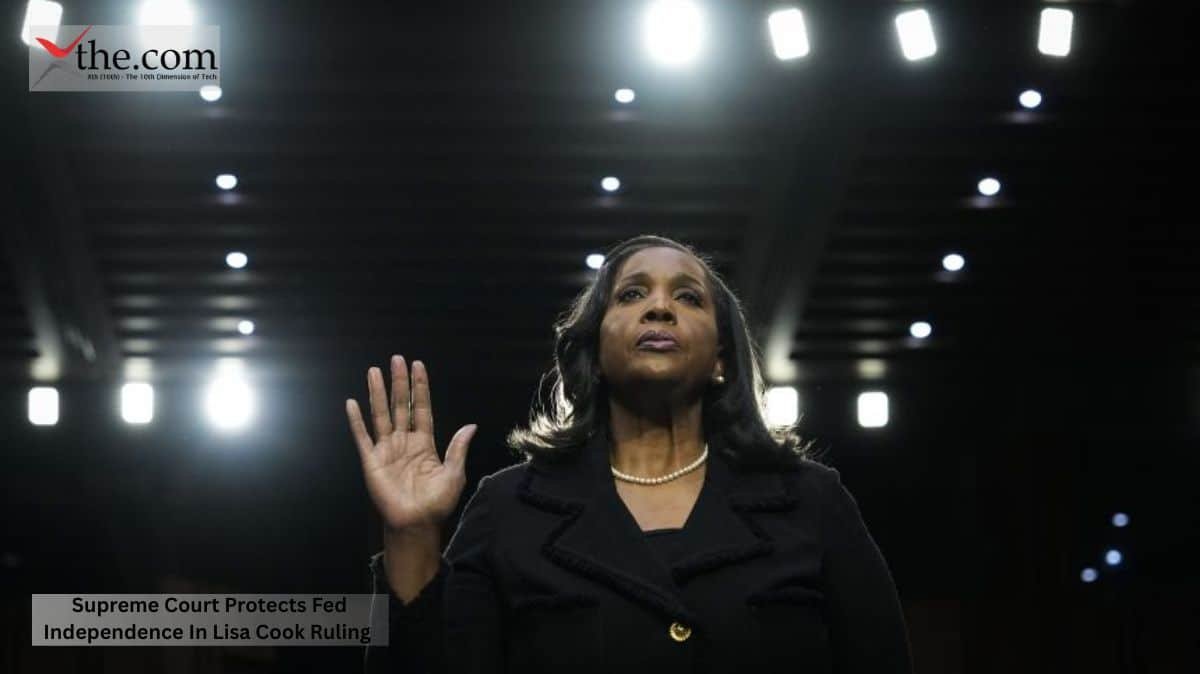
Nine months. That is how long Lisa Cook worked under the shadow of a presidential firing letter posted not to her inbox, but to a social media feed. On Monday, the wait ended, at least for now. The Supreme Court Lisa Cook ruling landed as a narrow but consequential check on presidential power, and it did something almost no one expected from this bench a year ago: it drew a hard line around the nation’s central bank and dared the executive branch to cross it.
By a slim majority, the justices decided President Trump could not remove Cook from the Federal Reserve Board of Governors while her lawsuit is still moving through the lower courts. The decision is being read across Wall Street trading desks and law school seminar rooms alike as the clearest signal yet on Federal Reserve independence 2026, a phrase that a year ago would have sounded like an abstraction and now describes a live constitutional battle.
What the SCOTUS Fed Governor Firing Case Actually Decided
The SCOTUS Fed governor firing dispute, formally Trump v. Cook, never asked the justices to decide whether Cook committed the mortgage fraud Trump accused her of. It asked something narrower and, in some ways, more important: does a president get to fire a Federal Reserve governor unilaterally, without notice, without a hearing, and without judicial review?
The Court said no. Federal Reserve governors serve fourteen-year terms and can only be removed “for cause,” a rule set by Congress in 1913 and confirmed again in 1935. Cook, whose term runs until 2038, argued she never got the notice or chance to respond that the law requires. Chief Justice John Roberts agreed, saying Cook deserved to know the charges against her and to defend herself before being removed. He called the decision narrow and sent the main dispute back to the district court, allowing Cook to stay on the Board for now.
This difference is important. The Court did not say Trump can never remove Cook. It said he cannot remove her the way he tried—by posting a termination letter on Truth Social and acting as if no judge could review the decision.
Humphrey’s Executor Supreme Court Precedent, Reworked Rather Than Repealed
Anyone who has followed administrative law for the past five years has watched Humphrey’s Executor Supreme Courtprecedent take one hit after another. The 1935 decision shielded multimember independent agencies from at-will presidential firing, and this Court has spent recent terms chipping away at that shield, agency by agency. The same day it ruled for Cook, the Court ruled against Federal Trade Commission member Rebecca Slaughter, allowing her removal and confirming that Trump has broad power to fire leaders of most other independent agencies without cause.
Why did the Fed get different treatment than the FTC? Roberts focused on the nature of the institution, not the person. He suggested that Humphrey’s Executor applies most strongly to agencies that lack significant executive power, such as today’s regulatory bodies. The Fed’s special structure, its role in monetary policy, and its long tradition of being separate from White House influence made it different. Some critics said this was an inconsistent standard, whereas supporters argued it was the only way to protect central bank independence with a Court that has otherwise given the president broad firing power.
The SCOTUS 5-4 Fed Ruling and Its Immediate Fallout
The SCOTUS 5-4 Fed ruling split the bench along familiar lines: six conservative-appointed justices decided the FTC case, but only a smaller group supported Cook in the Fed case. Legal experts noticed how close the decision was. Just one vote kept the Federal Reserve from facing the same outcome as the FTC and the National Labor Relations Board, whose leaders can now be removed by the president at any time.
Federal Reserve Chair Jerome Powell, who was present at the oral arguments in January, called the Cook case the most important legal issue in the Fed’s 113-year history. He was not exaggerating. Every living former Fed chair and Treasury secretary from both parties, along with many top economists, signed a brief asking the Court to protect the central bank’s independence. Their strong concern came from a simple fear: if a president could fire a governor over a policy disagreement disguised as a fraud claim, there would be nothing to stop him from firing enough governors to control the Federal Open Market Committee, and interest rate decisions could become political promises.
Trump Fed Governor Removal Blocked, But Not Forever
It is important to be clear about what happened. The Trump Fed governor removal was blocked for now, but this is not a final decision. Cook keeps her job today because the government did not prove it would likely win, and because the Court said removed governors can stay in office while the trial proceeds. This is a temporary ruling, not a final answer. The case now returns to Judge Jia Cobb in Washington, DC, where the details of the mortgage fraud claims, first raised by Federal Housing Finance Agency Director Bill Pulte, will be fully examined.
Pulte has not changed his position and, after the ruling, told reporters that he still expects Cook to be indicted. Cook’s lawyer, Abbe Lowell, said the decision brought some relief but is part of a larger effort to expand presidential power. Both sides agree on one thing: the fight is not over, and the district court’s decision on whether Trump had a valid reason will be just as important as Monday’s ruling.
Searches for phrases such as “Supreme Court rules Lisa Cook can stay Federal Reserve job Trump removal blocked” jumped within hours of the decision. This shows that both markets and everyday savers quickly understood what was at stake. Mortgage rates, Treasury yields, and stock futures all depend on the idea that the Fed sets policy based on economic data, not politics. If that trust is lost, all these financial assets would start to reflect new risks.
If you want a simple explanation of the “SCOTUS protects Fed independence 5-4 ruling explained 2026,” here it is: the central bank passed its first big test against presidential removal power, but only by a single vote, on a legal argument the Court itself called narrow, and the case is not over yet.
What Comes Next for the Fed’s Independence
The lower courts will now spend months, or maybe longer, working through the facts about Cook’s alleged actions before she joined the Board. Whatever they decide will likely be appealed to the Supreme Court, giving the justices another chance to determine how much protection the Federal Reserve really has from presidential control.rol. People inside boardrooms, on trading floors, and central bank watchers around the world will be paying close attention, because the main question goes beyond any one governor: can a president treat the Fed like any other agency, or does the institution that sets interest rates for 340 million Americans still have some independence from the White House?