






Washington, DC
The federal government has given itself sixty days to decide which artificial intelligence systems could pose a national security threat. Now, federal agencies are working quickly to figure out what happens next before the deadline arrives.
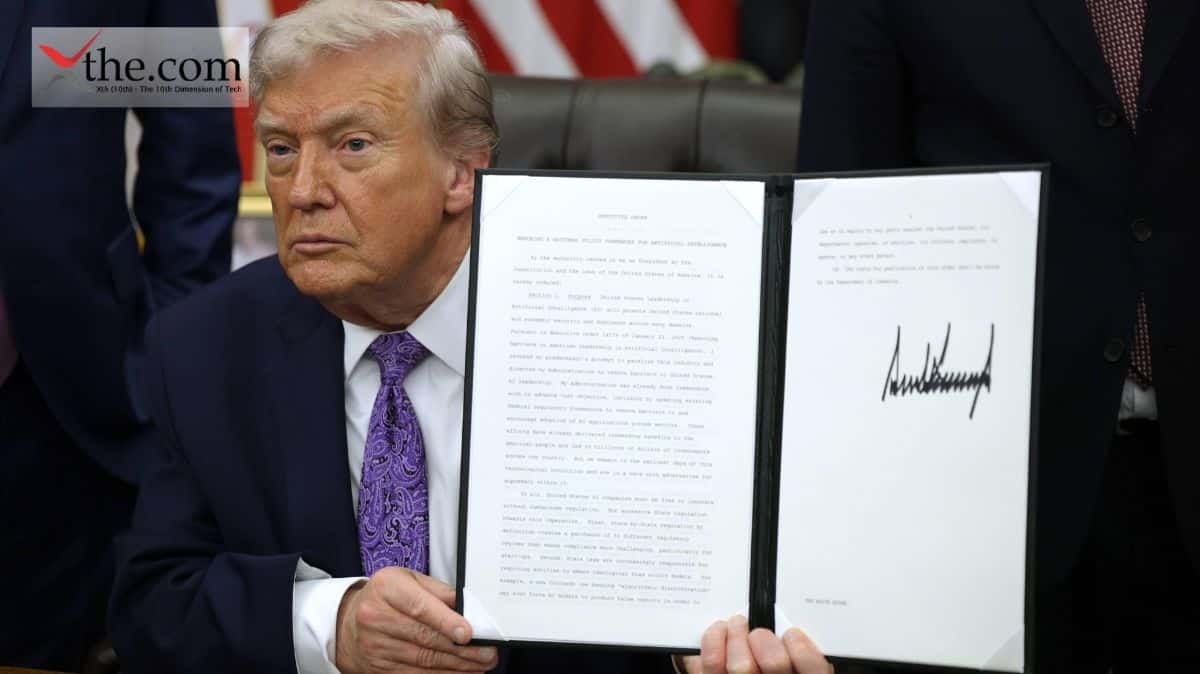
On June 2, 2026, President Trump signed the Trump AI executive order, officially called “Promoting Advanced Artificial Intelligence Innovation and Security.” For the first time, this order gives the National Security Agency a formal role in reviewing commercial AI systems before they are released to the public. This constitutes a notable change for an administration that spent its first year reducing AI oversight, and it is a shift worth examining.
Why the NSA Now Sits at the Center of AI Policy
The order’s most consequential provision establishes NSA frontier model review as a coordinated function shared among the NSA, the Treasury Department, and the Cybersecurity and Infrastructure Security Agency. These three bodies must jointly complete a classified benchmarking process that determines whether a given AI system meets the threshold for a covered frontier model designation. That designation is not cosmetic. Models that clear the bar become subject to a government review window before they ship to customers.
This is a major change. In the past, CISA and the National Institute of Standards and Technology led federal AI cybersecurity efforts. Now, putting the NSA—an agency known for intelligence and code-breaking, not consumer software—at the center shows the White House sees advanced AI as a national security asset, similar to weapons technology. A senior policy attorney at a Washington law firm said this alteration could change which agencies have long-term authority over AI, even if the current framework is described as voluntary.
What the AI Voluntary Pre-Release Framework Actually Requires
The order tells agencies to design an AI voluntary pre-release framework within 60 days of signing, placing the deadline for early August 2026. With this system, developers can work with the government to see if their model qualifies as a covered frontier model. If it does, the developer may give the government access to the model for up to 30 days before releasing it to partners.
Earlier drafts suggested a 90-day access window, but the final order reduced this to 30 days after debates among national security advocates and those concerned about slowing US AI progress. The order does not require mandatory licensing or preclearance, a point the White House has emphasized to avoid appearing too restrictive. However, once the government selects “trusted partners” for early access to a covered model, it still has major influence over when the model is released, even without formal veto power.
For readers tracking the mechanics closely, this is the Trump AI executive order NSA cybersecurity review frontier models July 2026 deadline explained in its simplest form: benchmarking criteria first, frontier designation second, voluntary access window third, and a functioning clearinghouse running in parallel.
Building the AI Cybersecurity Clearinghouse
In addition to the review process, the order requires an AI cybersecurity clearinghouse to be up and running within 60 days. This clearinghouse will serve as a central place for sharing AI vulnerability data, threat intelligence, and defensive tools between government and industry. It is designed specifically for AI-related risks, unlike older cyber-threat-sharing programs that were not designed for generative models or autonomous agents.
The CISA AI clearinghouse is key to this effort, coordinating submissions and sending useful threat data to critical infrastructure operators. Utilities, banks, and hospitals—sectors already facing AI-driven phishing and automated attacks—could benefit the most if the clearinghouse works as planned. Its success depends on having enough staff, and the order also tells the Office of Personnel Management to expand cybersecurity hiring through the U.S. Tech Force program. This suggests that finding skilled people, not just writing policy, may be the biggest challenge.
What This Means for OpenAI, Anthropic, and Google
The executive order does not refer to any companies by name. However, people in Silicon Valley know the frontier model rules are aimed at OpenAI, Anthropic, and Google. These companies now have a new, though voluntary, process to follow before releasing their most advanced systems to commercial partners. This makes AI model cybersecurity in 2026 a real compliance issue, not simply a policy discussion. Engineering teams working on large-scale models must now plan for a possible 30-day government review before launch.
Some in the industry will see this as a manageable delay. For companies used to months of internal safety testing, a 30-day wait before launching a major model is inconvenient but not critical. Others are more cautious about the “trusted associate” selection, since the order does not explain how the government will decide who gets early access. This lack of clarity may be the order’s biggest risk. Several law firms following the rollout have pointed out that this part is most likely to cause disputes once the framework is in place.
Anyone advising a frontier lab right now is effectively answering what OpenAI, Anthropic, and Google must do by July 31, 2026, as a practical checklist: monitor forthcoming CISA guidance, draft technical documents for the classified benchmarking process, and make sure product roadmaps are flexible in case a model is labeled as covered.
The Bigger Shift Nobody Is Naming Directly
If you look beyond the deadlines and specialized terms, a bigger trend appears. In its first term, this White House was known for cutting rules, speeding up deployment, and keeping government involvement low. The June 2026 order does not completely change that approach, but it does make things more complex. Now, innovation and national security are being combined under one oversight system, with the NSA playing a new and important role.
Whether this system becomes a lasting system or just another little-used compliance step will depend on what happens after the 60-day deadline. If the benchmarking process yields a clear definition of a covered frontier model, other agencies may use this approach to evaluate future technologies beyond AI. But if it gets stuck because of classification issues or industry resistance, the order might be seen as more symbolic than practical. Either way, the outcome will affect how the next wave of powerful AI models is released, and every major lab is paying close attention.
Source: PROMOTING ADVANCED ARTIFICIAL INTELLIGENCE INNOVATION AND SECURITY