



OpenAI, Anthropic, Google and Meta Executives Testify Under Oath at NYC Council AI Hearing
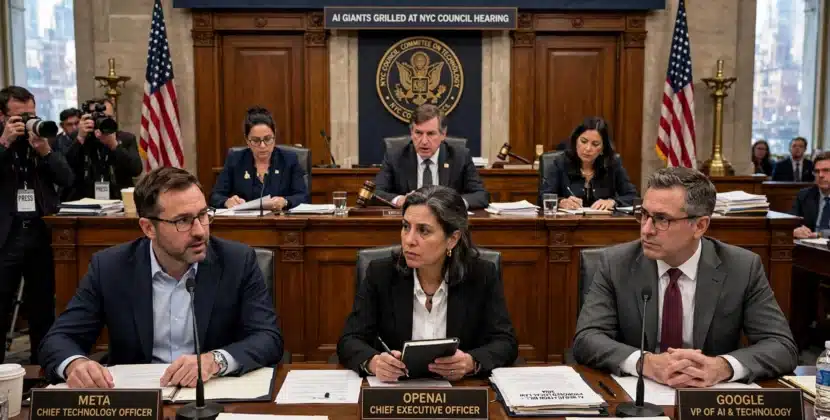
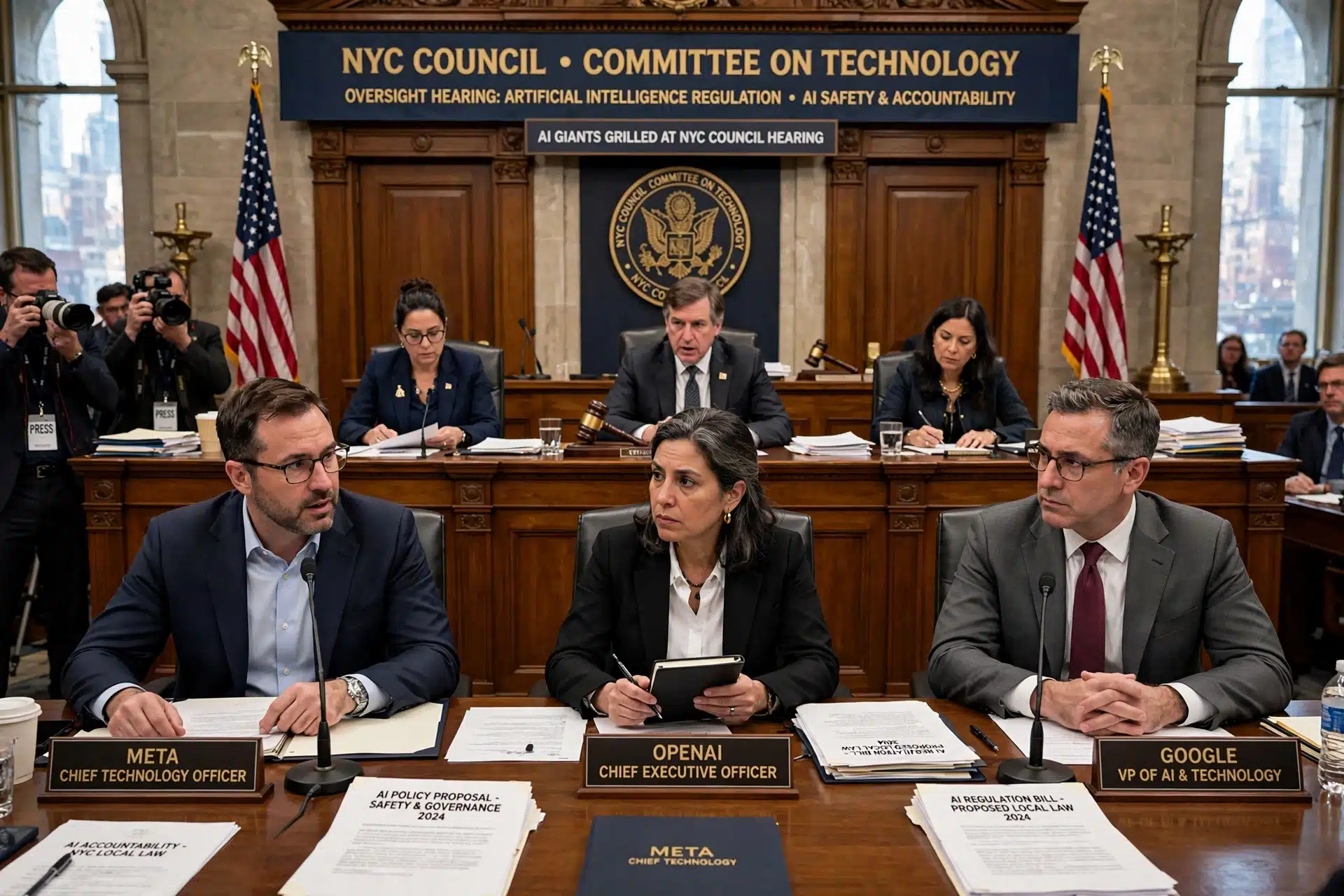
The four most powerful names in artificial intelligence filed into New York City Hall on Monday to answer questions from all 51 members of the City Council, in a rare full-council hearing that put the risks of AI in the spotlight and showed how quickly local government is stepping into the void left by federal inaction. Senior leaders from OpenAI, Anthropic, Google and Meta testified under oath, and they did not arrive voluntarily: the companies agreed to appear only after the council threatened to issue subpoenas.
The hearing, formally a Committee of the Whole session, convened every council member at once, an unusual procedure reserved for matters the body considers too important for a single committee. Alongside company executives, the witness list included AI whistleblowers, researchers who have left the industry to sound alarms about its practices. One of them, Jacob Coxon, a researcher who previously worked at OpenAI and recently at Anthropic, drew attention for testimony about internal safety concerns. The event is being watched far beyond New York because what the council does next could become a template for cities and states across the country.
A Rare Full-Council Hearing
The council announced the session on September 28, scheduling it for the following Monday and describing a hearing on AI safeguards that would convene all 51 members. That format signals how the council views the issue: not as a niche technology question for a small committee, but as a matter touching housing, jobs, public safety, education and consumer protection, all of which New York City regulates directly.
The stakes were visible in the guest list. Representatives of the biggest AI companies, outside researchers, labor voices and former insiders all received invitations, and the council’s leadership made clear that attendance was not optional in their view. The threat of subpoenas did the work: Meta confirmed its participation without pressure, while OpenAI, Anthropic and Google agreed to send executives only under the shadow of compulsory process. It is a posture more common in congressional fights than city hall hearings, and it set the tone before a single question was asked.
What Lawmakers Wanted to Know
Council members pressed the companies on the safeguards that govern their most advanced models, how they handle user data, what protections exist for children and tenants facing AI-generated decisions, and how the firms police misuse of their tools. New York is a natural laboratory for those questions. The city runs huge systems in housing and social services, its residents are among the most photographed and data-profiled people in the world, and its workers are already encountering AI in hiring, customer service and the creative industries.
Lawmakers also asked how the companies decide when a model is safe enough to release, and what happens when they get it wrong. Executives described layered review processes, red-teaming exercises and partnerships with outside experts, answers that skeptics on the panel repeatedly challenged as insufficient. Several members returned to a theme that has defined the year’s AI debate: the companies are asking the public to trust that their internal standards are enough, while declining to commit to independent verification.
Whistleblowers Take the Mic
The most charged moments came from former insiders. Whistleblowers joined the hearing to describe what they said happens inside the labs when commercial pressure collides with safety review. Coxon, the ex-OpenAI and ex-Anthropic researcher, testified about his experience of the research process, and other critics echoed concerns about deployment speed, disclosure practices and the treatment of staff who raise objections.
Whistleblower testimony has become a recurring feature of the national AI conversation. Former employees of leading labs have previously described racing release schedules and disagreements over risk to federal and state audiences, and protection for those speakers is now a legislative topic in its own right. At City Hall, the presence of these witnesses changed the texture of the hearing: executives described what their companies do, while former employees described what it feels like from inside, and the contrast was not lost on the council.
Why the Companies Showed Up
The subpoena threat explains part of it, but the industry’s calculus runs deeper. National AI regulation has stalled in Congress, federal rules remain patchwork, and states are advancing their own bills at a pace Washington cannot match. In that environment, tech companies have concluded that engagement is cheaper than resistance, particularly in a city as visible as New York. A cooperative posture before the council costs less than a fight that produces the first aggressive municipal AI law in the country.
There is also the talent angle. New York has become the second major hub for AI employment in the United States, with labs opening large offices and hiring thousands of researchers and engineers. The companies that testified have real stakes in how the city regulates AI in hiring tools, tenant screening and public-facing services. Showing up, answering questions and shaping early standards may be the smartest way to keep any future rules workable.
Local Governments Move While Washington Waits
The NYC Council AI hearing is the clearest sign yet that the center of gravity in AI oversight is shifting to statehouses and city halls. Congress has held its own sessions on artificial intelligence this year, including deliberations over a new super-intelligence task force, but major legislation has not landed. Meanwhile, California, Colorado and a dozen other states have enacted or advanced rules covering algorithmic accountability, deepfakes and automated decisions.
Cities have unique power in this fight because they are buyers, employers and regulators at once. New York can set conditions on AI used in city contracts, licensing and services, requirements that ripple through the market the same way state privacy rules changed websites nationwide. Lawmakers at Monday’s hearing made clear they see the council as a pioneer, with members referencing the possibility of legislation emerging from the testimony.
What Comes Next for AI Oversight in New York
The immediate question is what the council does with the record it built. Options include introducing bills on AI safeguards, creating a permanent oversight body, or using the hearing to pressure the companies into voluntary commitments with real reporting requirements. The subpoena threat proved effective once, and council leaders have indicated they are prepared to use it again if documents or follow-up answers are not forthcoming.
For the AI industry, the hearing is a warning that the era of self-governance alone is ending. Executives spent Monday insisting that they welcome sensible rules, but the details of those rules will be negotiated in rooms like the one they just left, with council members, whistleblowers and the public in the conversation. The companies that treated the session as a checkbox may find that the real dialogue starts with the legislation it produces.
Frequently Asked Questions
Why did OpenAI, Anthropic, Google and Meta testify in New York?
The City Council called a rare full hearing of all 51 members on AI safeguards and threatened subpoenas, which prompted the companies to send senior executives to testify under oath on October 5, 2026.
Did AI whistleblowers speak at the hearing?
Yes. Researchers who left leading labs, including former OpenAI and Anthropic employee Jacob Coxon, testified alongside company executives about internal practices and safety concerns.
Can New York City regulate artificial intelligence?
The city can regulate AI used in hiring, housing, consumer services and municipal contracts, and council members signaled that legislation could follow the hearing.
Was this hearing connected to federal AI policy?
It came as Congress debates national AI rules, but the hearing was local. Council members framed New York as a testing ground that could influence state and federal action.