




Shadow Surge Pushes ICE Arrests Toward Records as 287(g) Expands to 2,617 Local Deals
Immigration arrests in the United States are running at heights not seen in years, and a large share of them is not happening where the public expects. A quieter enforcement strategy that advocates call the shadow surge has shifted the work of picking up immigrants away from marquee raids and toward routine encounters handled by local police officers operating under federal agreements. The result is a deportation machine that is bigger than the headlines suggest and more distributed than the debates in Washington acknowledge.
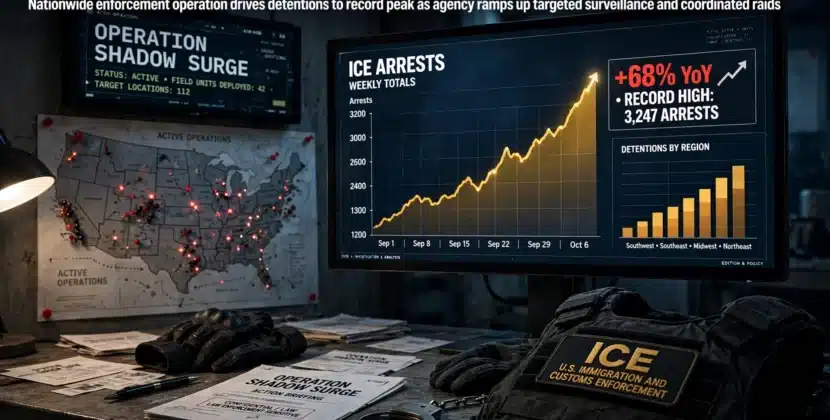
The numbers tell the story. Immigration arrests hit roughly 50,000 in July, a pace that has officials celebrating and communities bracing. Underpinning the surge is the 287(g) program, which deputizes local law enforcement to enforce federal immigration law, and it has grown sharply: Immigration and Customs Enforcement lists 2,617 active agreements covering 39 states and two territories as of this month. The expansion gives federal agents reach into thousands of small departments that once limited their role to criminal work.
How the Shadow Surge Works
The term shadow surge describes a tactic change rather than a new law. After the high-profile operations of earlier in the administration, officials leaned into quieter channels: jailhouse screenings, traffic stops that end in immigration holds, and compliance checks at workplaces. Because each individual stop is small, it rarely makes national news, but the cumulative effect has driven arrest totals to new highs while attracting far less attention than the blitzes that dominated the first year.
PBS reported that the approach has allowed enforcement to expand even as some of the more aggressive operations paused, with advocates arguing the tactic obscures the true scale of the campaign. Local departments that join 287(g) receive federal training and reimbursement for costs, and their officers can initiate immigration detainers that keep people in local custody beyond their release dates. Supporters call it efficient use of existing infrastructure; critics call it the federalization of local police.
What the 287(g) Program Actually Does
Created by Congress in the 1990s, 287(g) allows the federal government to contract with state and local agencies for immigration enforcement duties. There are two common models: jail officers screen inmates for immigration status, and task force models let local officers enforce immigration law in the field. ICE’s public figures show the program’s scale, with thousands of agreements now covering a broad slice of the country, including every county in Florida, the state with the most local partners.
Federal funding laws juice the expansion. Agreements allow departments to be reimbursed for officer salaries, vehicles and technology used in immigration work, a structure that gives cash-strapped rural agencies a reason to sign. The Migration Policy Institute documented how the escalation has emboldened state and local lawmakers on both sides, with some jurisdictions passing laws to cooperate fully and others constraining their police from asking about status at all.
Florida and the Leading States
Florida illustrates the model’s reach. All 67 of its counties have partnered with ICE through 287(g) agreements, helping the state lead the nation in local enforcement capacity, according to NPR reporting. Texas and several southeastern states have followed with their own expansions, while states like California and New York have moved in the opposite direction, limiting local cooperation and pushing back through legislation and court challenges.
The patchwork means the experience of an immigrant in America now depends heavily on geography. In cooperative counties, a routine stop can trigger an immigration hold and a fast track to federal custody. In limiting states, the same stop generally ends with a ticket. That divergence is shaping court arguments about federalism, since the federal government holds supreme authority over immigration while states control the police forces that encounter most immigrants daily.
Pushback and the Legal Fight
Opposition has organized around several fronts. Immigrant advocates publish know-your-rights guides and monitor complaints about worksite raids, while city councils pass sanctuary policies that restrict local officers from asking about status. Civil liberties groups have challenged detainer practices in court, arguing that holding people without a warrant violates the Fourth Amendment, and some sheriffs have declined agreements on principle, saying they erode community trust needed to solve crimes.
Congressional Democrats have targeted the funding stream, and reports like the one from Amnesty International calling for the abolition of ICE have energized the activist base. Supporters of the program counter that voters asked for enforcement and that local chiefs know their communities best. With arrests running this high, both arguments are live, and the courts will keep sorting the boundaries as the enforcement apparatus keeps growing.
What Comes Next
The trajectory points upward. ICE has said it intends to keep expanding local partnerships and detention capacity, and appropriations flowing from last year’s enforcement law give departments money to sign. Unless the courts narrow the detainer power or Congress rewrites the rules, analysts expect the shadow surge to stay effective precisely because it is quiet: enforcement that happens one stop at a time rarely produces the moments that build political resistance.
For immigrant communities, the practical advice from advocates is unchanged: know your rights, carry documentation of status at all times, ask for a lawyer if detained, and understand that a routine local stop can now carry serious federal consequences in most states across the country. For the debate in Washington, the numbers are the headline. Arrests near record levels and 2,617 local agreements describe an enforcement system that has moved well beyond the border and deep into the everyday machinery of local government.
Frequently Asked Questions
What is the ICE 287(g) program?
287(g) is a federal agreement that lets state and local law enforcement perform immigration duties, from screening jail inmates to making field arrests, with ICE training and reimbursement.
How many 287(g) agreements exist now?
ICE lists 2,617 active agreements covering 39 states and two territories as of October 2026, a major expansion that spreads enforcement into thousands of local departments.
What does shadow surge mean for immigrants?
It describes quieter enforcement through jail screenings, traffic stops and workplace checks, meaning a routine local encounter can now lead to an immigration hold and detention.
Can local police enforce immigration everywhere?
No. Cooperation varies by state. Some states have all counties partnered with ICE, while others bar local officers from asking about immigration status during routine duties.