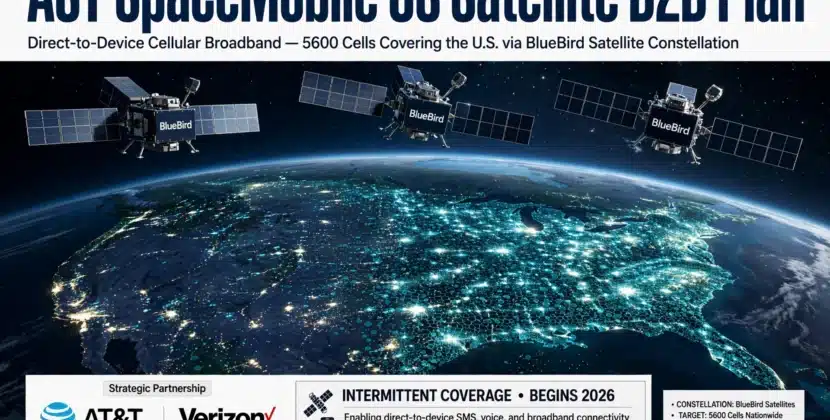





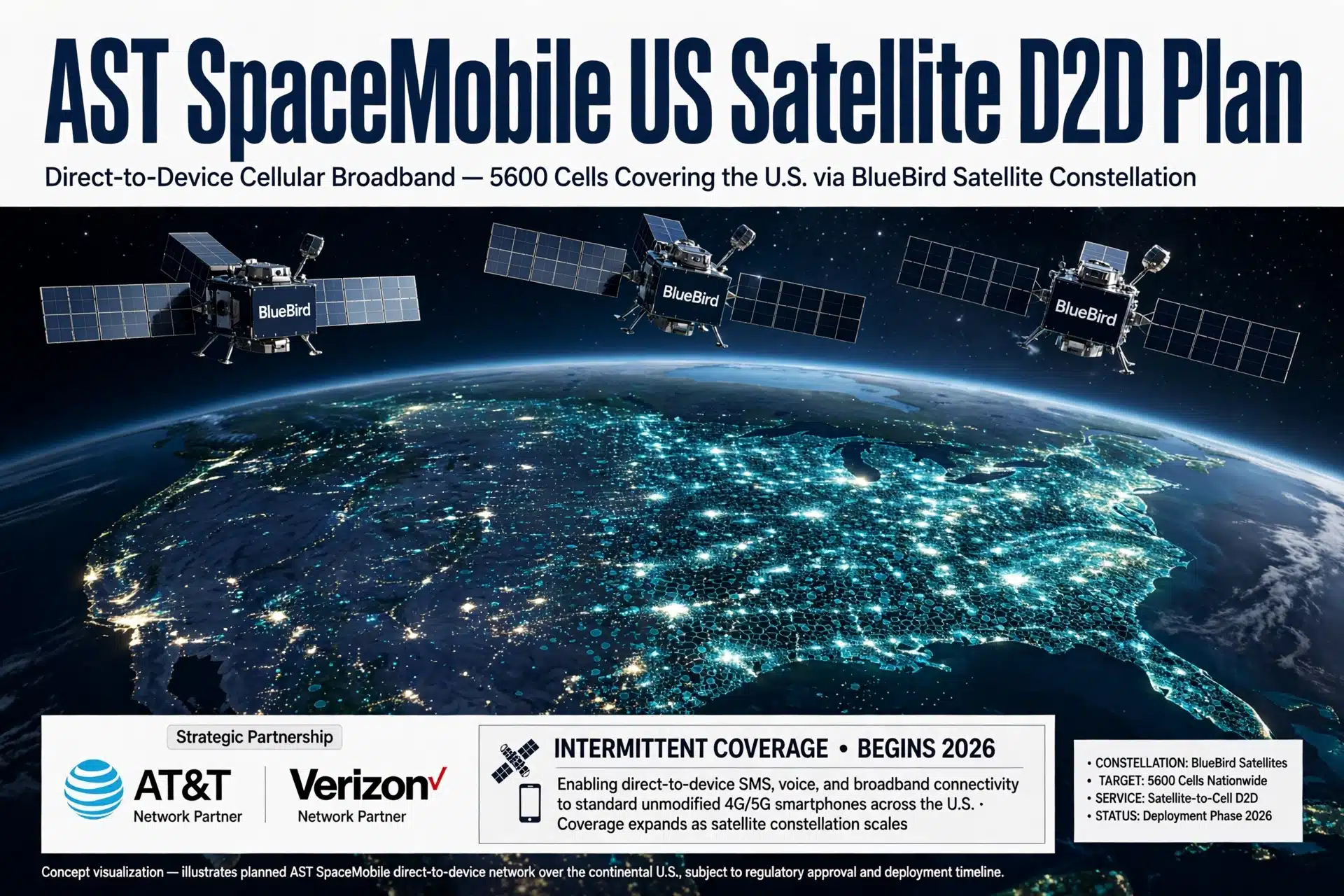
In an update impacting the future of mobile connectivity, satellite communications developer AST SpaceMobile announced on October 21, 2026, that it is targeting initial, intermittent direct-to-device (D2D) broadband coverage across the United States and international markets before the close of the year [cite: 2.1.5]. Designed to bridge dead zones and eliminate terrestrial cellular gaps, the company’s space-based cellular broadband network aims to connect unmodified, everyday smartphones directly to low-earth orbit (LEO) satellites without requiring specialized hardware.
The Technical Mechanics of Direct-to-Cell Satellite Broadband
Direct-to-device satellite communication represents one of the most ambitious engineering challenges in modern telecommunications. Traditional satellite phones require bulky, dedicated transceiver dishes and specialized antennas. In contrast, AST SpaceMobile’s architecture deploys massive phased-array antennas in low-earth orbit capable of communicating directly with standard cellular handsets operating on commercial frequencies.
Industry analysts following the rollout note that initial service will be characterized by intermittent connectivity windows as satellites pass overhead [cite: 2.1.5]. Because the current constellation size is still expanding toward full commercial density, users will experience coverage in targeted geographic cells during orbital transit passes rather than continuous 24/7 connectivity. Nevertheless, establishing functional D2D data and voice links marks a pivotal milestone for emergency communications and remote rural coverage.
Carrier Ecosystem: AT&T, Verizon, and Global Partners
AST SpaceMobile’s commercial strategy relies heavily on deep integration with Mobile Network Operators (MNOs) rather than operating as an independent retail carrier. In the United States, the company maintains high-profile strategic partnerships with AT&T and Verizon [cite: 2.1.5], alongside international alliances with Vodafone, Rakuten Mobile, and Bell Canada [cite: 2.1.5].
These partnerships allow partner carriers to offer satellite roaming directly to existing subscribers when terrestrial towers are out of reach. Recent FCC regulatory approvals clearing low-earth orbit satellite operations across specific low-band spectrum frequencies [cite: 2.1.5] have positioned the company to conduct rigorous live network testing in coordination with AT&T and FirstNet infrastructure [cite: 2.1.5].
Competitive Landscape: SpaceX Starlink and Spectrum Battles
The race to dominate space-based cellular broadband is intensifying across the US technology sector. SpaceX continues to advance its Starlink direct-to-cell initiatives, recently pursuing strategic low-band spectrum acquisitions to bolster its carrier ambitions [cite: 2.1.5]. Simultaneously, major global telecom consortia are evaluating joint bids for upcoming satellite spectrum allocations [cite: 2.1.5].
Industry experts emphasize that regulatory approvals, spectrum availability, and launch cadence will dictate market leadership over the next several years. While SpaceX boasts an established rocket launch infrastructure, AST SpaceMobile’s large-aperture satellite design has earned praise from carrier partners for delivering high-bandwidth cellular signals directly to standard phones.
What US Consumers Can Expect by Year-End
As AST SpaceMobile approaches its year-end target for initial US deployment [cite: 2.1.5], subscribers on partner networks like AT&T and Verizon should anticipate phased rollouts focusing on emergency text messaging and basic data services in designated test regions.
As additional LEO satellites launch into orbit throughout 2027, intermittent coverage windows will transition into seamless, continuous connectivity, effectively eliminating cellular dead zones across national highways, national parks, and rural communities.
Frequently Asked Questions
Q: What is satellite D2D connectivity? Direct-to-device (D2D) technology allows standard, unmodified mobile phones to connect directly to satellites in orbit for voice and data services [cite: 2.1.5].
Q: When will US users see coverage? AST SpaceMobile announced plans for initial, intermittent coverage in the US, Canada, Japan, and other regions by the end of 2026 [cite: 2.1.5].
Q: Which carriers support the network? The company partners with major tier-one operators including AT&T, Verizon, and Vodafone [cite: 2.1.5].
Conclusion
AST SpaceMobile’s progress toward initial US satellite D2D coverage highlights the rapid convergence of space exploration and telecommunications. By partnering with major US carriers to connect standard smartphones via orbit, the industry is poised to eradicate cellular dead zones once and for all.
Sources
Reference 1: • Light Reading (October 21, 2026): ‘AST SpaceMobile limited coverage coming soon in US and beyond’ – https://www.lightreading.com/satellite/ast-spacemobile-says-limited-coverage-coming-soon-in-us-and-beyond [cite: 2.1.5]