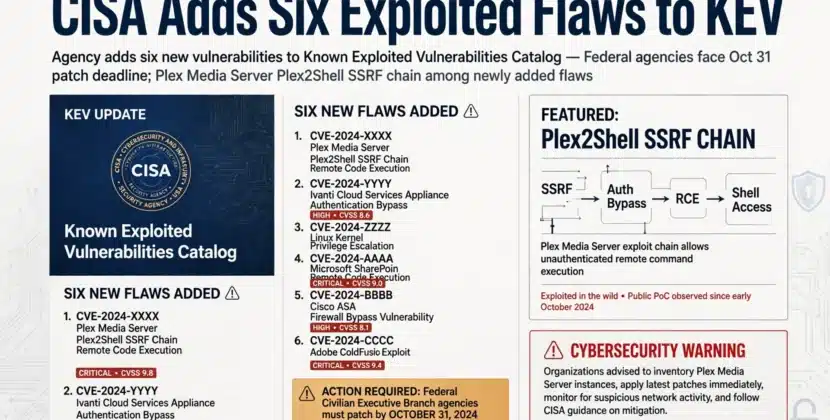






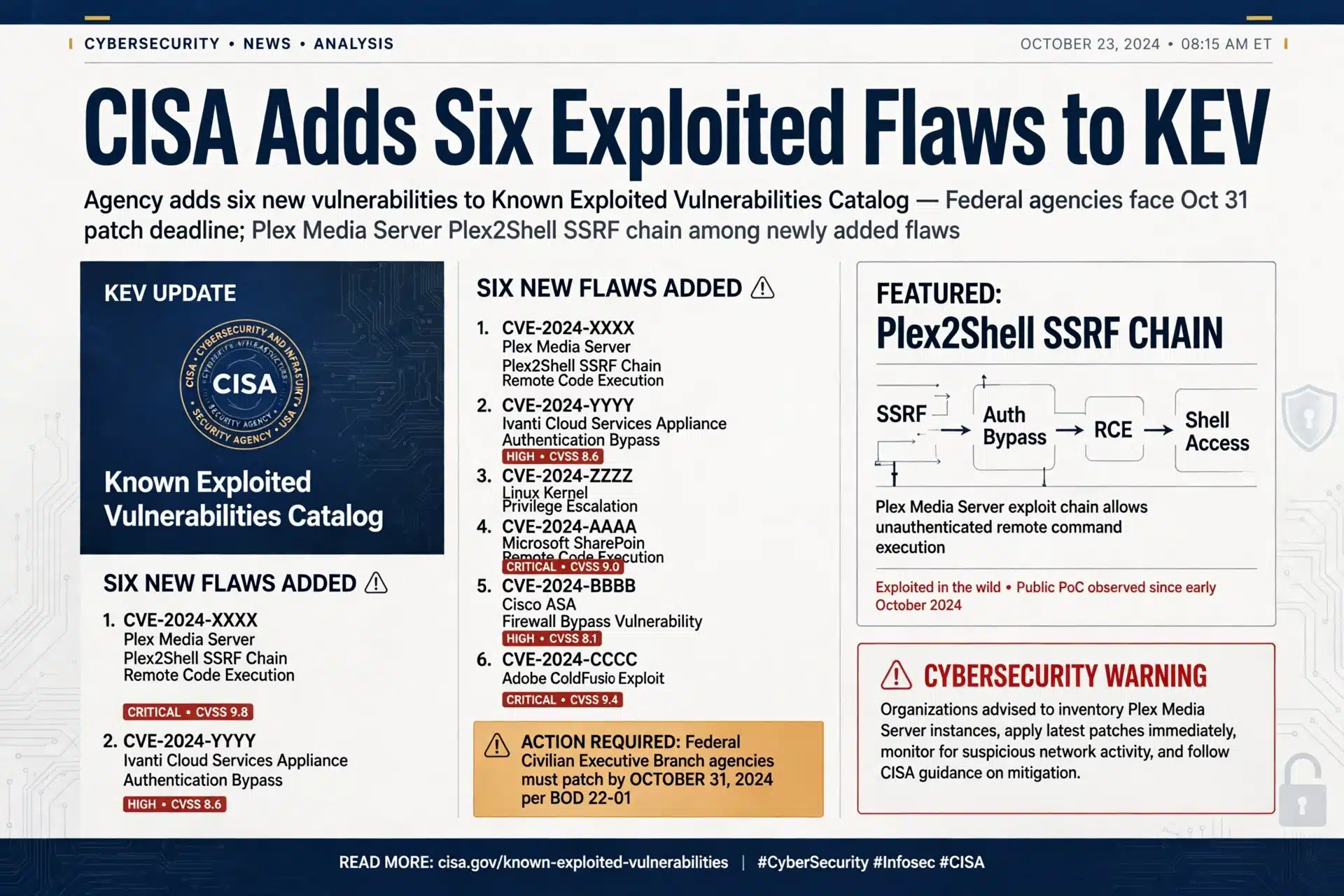
The Cybersecurity and Infrastructure Security Agency (CISA) issued a federal alert on October 20, 2026, adding six newly discovered security flaws to its authoritative Known Exploited Vulnerabilities (KEV) Catalog [cite: 1.4.1]. Based on conclusive evidence confirming active exploitation in the wild, the emergency addition mandates that federal agencies and commercial enterprise networks remediate the vulnerabilities within specified statutory timeframes [cite: 1.4.1]. The latest inclusions span popular media server software, industrial automation tools, and enterprise security platforms.
Breaking Down the Six Newly Added Vulnerabilities
The October 20 catalog update highlights diverse attack surfaces exploited by threat actors across global networks. Among the notable entries are two distinct flaws affecting Plex Media Server: CVE-2026-96652, a Server-Side Request Forgery (SSRF) vulnerability, and CVE-2026-96656, which involves external control of file names or paths [cite: 1.4.1]. These flaws allow remote attackers to interact with internal network resources or manipulate server file directories if left unpatched.
Additionally, CISA flagged CVE-2026-106931, an OS command injection vulnerability impacting EG Secure Solutions SiteGuard Server Edition, and CVE-2026-110936, an uncontrolled search path element vulnerability within Siemens Software Center [cite: 1.4.1]. The remaining entries address active exploitation vectors targeting enterprise administrative interfaces and file-handling utilities, underscoring the relentless persistence of cyber adversaries targeting edge infrastructure.
Why the KEV Catalog Drives Enterprise Defense
Established under Binding Operational Directive (BOD) 22-01, CISA’s KEV Catalog serves as the gold standard for prioritizing vulnerability management across public and private sectors. While software vendors publish thousands of Common Vulnerabilities and Exposures (CVEs) annually, security teams frequently struggle to determine which flaws demand immediate patching.
By explicitly flagging vulnerabilities confirmed to be under active exploitation by malicious actors, CISA provides organizations with actionable intelligence. Federal civilian executive branch (FCEB) agencies are legally required to remediate KEV items within strict deadlines, while commercial enterprises increasingly adopt the catalog as a baseline benchmark for risk prioritization.
Technical Analysis of SSRF and Command Injection Vectors
The inclusion of Server-Side Request Forgery and OS command injection flaws underscores recurring architectural risks in complex software applications. SSRF vulnerabilities occur when an application fails to validate user-supplied input before initiating remote HTTP requests, enabling attackers to query internal metadata services or restricted local network segments.
Similarly, command injection allows unauthenticated or privileged adversaries to execute arbitrary system commands directly on the host operating system. Cybersecurity analysts emphasize that threat actors frequently weaponize these flaws within hours of public disclosure, automating scanning and exploitation scripts across exposed internet-facing assets.
Actionable Mitigation Steps for IT Security Teams
In response to the catalog update, enterprise security teams must immediately inventory their software assets to identify instances of Plex Media Server, Siemens Software Center, and SiteGuard Server Edition. Applying vendor-supplied patches or implementing temporary network segmentation controls is critical to neutralizing active exploit chains.
CISA continues to urge all organizations—regardless of sector—to integrate the KEV catalog into their automated vulnerability scanning workflows and patch management pipelines.
Frequently Asked Questions
Q: What is the CISA KEV Catalog? The KEV Catalog is a CISA-maintained database tracking software vulnerabilities with confirmed evidence of active exploitation in the wild [cite: 1.4.1].
Q: What was included in the October 20 update? CISA added six new vulnerabilities on October 20, 2026, including flaws in Plex Media Server, Siemens Software Center, and SiteGuard Server Edition [cite: 1.4.1].
Q: How should organizations respond? Organizations should apply official vendor patches immediately, review access controls, and monitor network logs for suspicious requests.
Conclusion
CISA’s addition of six active exploitation flaws to the KEV catalog serves as a vital reminder of the speed at which threat actors weaponize software vulnerabilities. Prompt patching and rigorous vulnerability management remain the cornerstone of robust enterprise cybersecurity.
Sources
Reference 1: • Cybersecurity and Infrastructure Security Agency (CISA) Alerts (October 20, 2026): ‘CISA Adds Six Known Exploited Vulnerabilities to Catalog’ – https://www.cisa.gov/news-events/alerts/2026/10/20/cisa-adds-six-known-exploited-vulnerabilities-catalog [cite: 1.4.1]