



B-21 Weapons Test Moves the Raider From Flight to Firepower
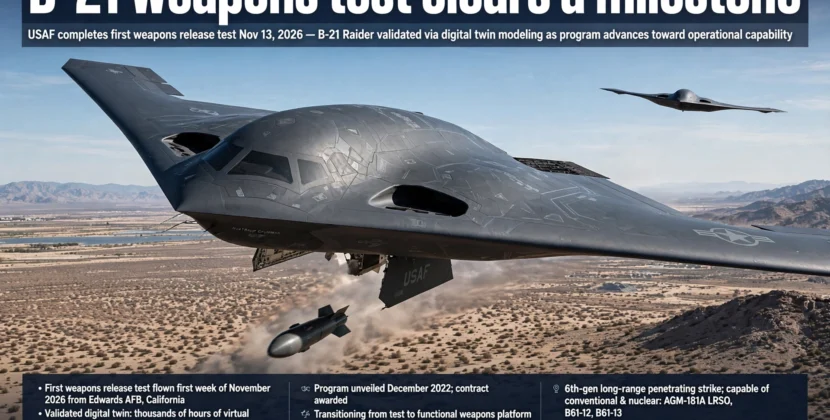
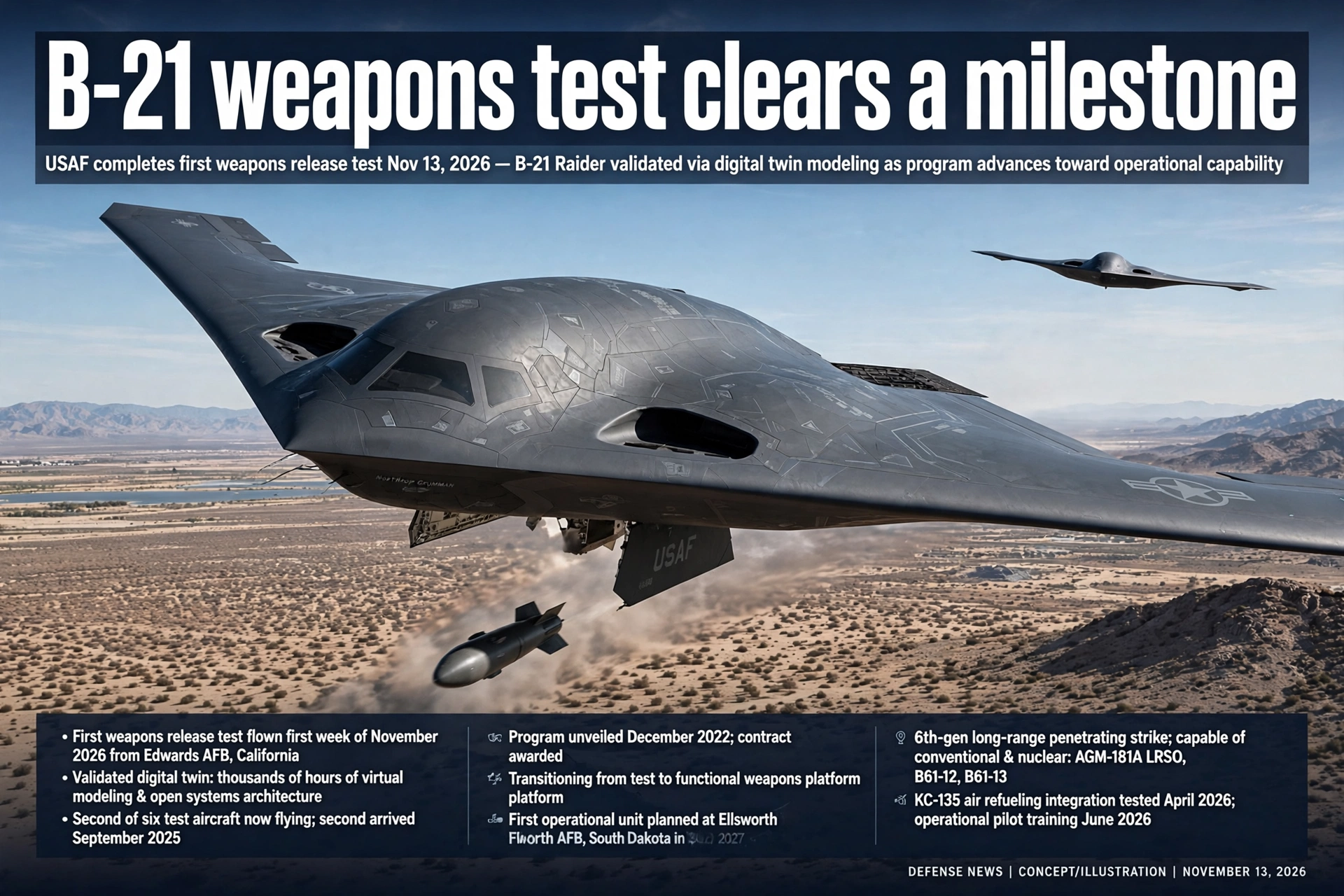
A B-21 Raider released a conventional weapon during a test at Edwards Air Force Base, the Air Force announced on November 13, 2026, transitioning the bomber from a flight test article into a functional weapons platform. The test took place the previous week, according to the service.
Key Takeaways:
- – The Air Force announced the weapons release test on November 13, 2026, and said it occurred the prior week.
- – A B-21 test aircraft flying from Edwards Air Force Base released a conventional weapon.
- – The service says the test validated its digital models and the maturity of the aircraft’s open systems architecture.
- – Northrop Grumman is accelerating production and testing ahead of the B-21’s arrival at Ellsworth Air Force Base in 2027.
- – The B-21 is the first sixth-generation long-range penetrating strike aircraft and the planned backbone of the future bomber force.
What actually happened
A B-21 test aircraft took off from Edwards Air Force Base in California and released a conventional weapon. That sentence is short, and it represents a boundary crossing in a flight test program.
Until a combat aircraft releases a weapon, it is proving that it can fly, not that it can fight. The release validates the interfaces between the aircraft, the weapon and the software that decides when and how to employ it, and it exposes the airframe to the loads and separations that only a live drop produces.
The Air Force says the test validated the bomber’s digital models and the maturity of its open systems architecture. The first claim is about prediction: the service builds detailed simulations of how a weapon separates from a bay, and the flight test checks whether the model matched reality. The second is about adaptability, which is the design idea behind the whole program.
Why the open systems architecture matters
The B-21 was designed with an open systems architecture, meaning its software and hardware interfaces are documented so new weapons, sensors and communications gear can be integrated without redesigning the aircraft. That is a procurement strategy as much as an engineering one.
Older bombers were built around specific weapons and required expensive modifications to carry new ones. An open architecture lets the Air Force plug in a new missile or a new electronic warfare pod and validate it quickly, which matters when adversaries field new defenses on their own timelines.
The claim that this test validated that maturity is therefore more consequential than a single bomb. If the interfaces behave as designed, the aircraft’s combat relevance can be extended over decades without rebuilding the airframe.
Production and basing
Northrop Grumman said the demonstration proves the B-21 can carry and employ combat power, and that the company is accelerating production and testing ahead of the aircraft’s arrival on the ramp at Ellsworth Air Force Base in 2027.
Ellsworth, in South Dakota, is the first operational main operating base for the bomber. The Air Force has also named Whiteman Air Force Base in Missouri as a second base and Dyess Air Force Base in Texas as a third, with the fleet to be supported at each location.
The B-21 replaces the B-1B Lancer and B-2 Spirit in the penetrating strike role, and it is described by the service as the backbone of the future bomber force. That language matters for budget purposes: the program is funded as a long-term modernization priority, not a technology demonstration.
What the test does and does not prove
It does not prove the bomber is ready for combat, and the service did not claim that it is. A single release test validates one weapon type from one aircraft configuration. Weapons integration typically requires multiple releases, different release conditions, and testing with the actual weapons the aircraft will carry.
It does not prove the aircraft can survive contested airspace, which is the core claim for a stealth bomber. Survivability testing happens in different venues and is rarely described in public releases.
It does prove that the program is following a normal path from flight test to weapons test, and that the schedule the Air Force is advertising, with operational aircraft arriving at Ellsworth in 2027, remains plausible. For a program that has been watched closely for cost and schedule, that is the signal worth reading.
What happens next
The next milestones to watch are additional weapon releases, integration of the specific munitions the bomber will carry in service, and the first aircraft arriving at Ellsworth. Each is a public event if the service chooses to announce it, and each is a chance to check the schedule claims. That distinction is worth keeping in view as the program moves toward operational testing.
There is also the question of how the B-21 fits with uncrewed systems. The Air Force’s Force Design 2026 emphasizes autonomy and interconnected systems, and a bomber that can act as a node for other aircraft is a different asset than a standalone strike platform. The open architecture is what makes that possible, and the weapons test is the first public evidence that the interfaces work.
Why a stealth bomber still drops bombs
Stealth shapes how a bomber survives the trip, not what it does at the target. The B-21’s job is to penetrate air defenses, find a target and release a weapon, and the last step requires the most integration work because it links the aircraft, the store and the mission software.
A bomb bay on a stealth aircraft is an engineering compromise. Doors open, the radar signature changes, and the weapon separates in turbulent airflow that simulations approximate rather than reproduce. Each of those effects has to be measured in flight, which is what a release test provides.
The Air Force’s public account emphasizes validated models and open architecture rather than weapon performance, which fits a program that wants credit for schedule progress without revealing operational detail. Public milestones in classified programs are chosen for what they signal, not for what they disclose, and the signal here is that the aircraft’s interfaces behave as designed.
Frequently Asked Questions
Did the B-21 drop a real bomb?
Yes. The Air Force said a B-21 test aircraft released a conventional weapon at Edwards Air Force Base, and that the test validated digital models and the aircraft’s open systems architecture.
When will the B-21 be operational?
Northrop Grumman says it is accelerating production and testing ahead of the aircraft’s arrival at Ellsworth Air Force Base in 2027. The Air Force has not announced an initial operational capability date in this release.
How many B-21s is the Air Force buying?
The service has described the B-21 as the backbone of the future bomber force, and it plans to base the fleet at Ellsworth, Whiteman and Dyess. Specific production quantities are set through the budget process and have not been restated in this announcement.
Bottom line
The B-21 weapons test is the milestone that turns a stealth bomber from an aircraft in flight test into a platform that can employ combat power. A single conventional release at Edwards does not make the Raider combat-ready, but it validates the interfaces that the program’s open architecture depends on, and it keeps the 2027 arrival at Ellsworth on schedule. For a program whose critics focus on cost and delay, the useful signal is that the plane released a weapon on the timeline the service implied it would.
Sources: