




Upper C-Band Auction 115 Set for April 27 With 3,248 Licenses
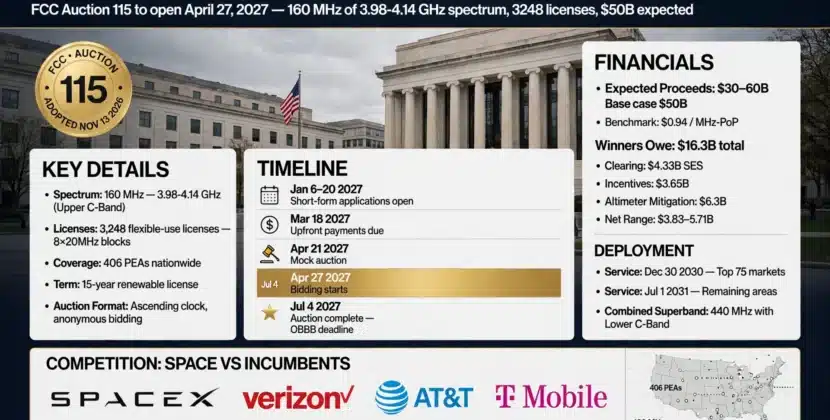
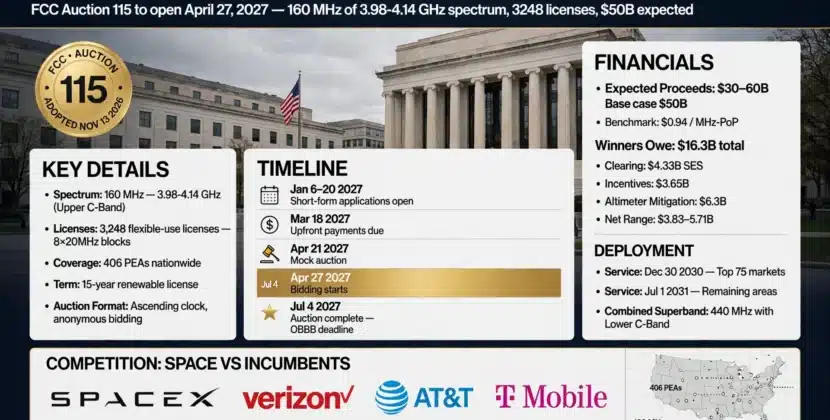
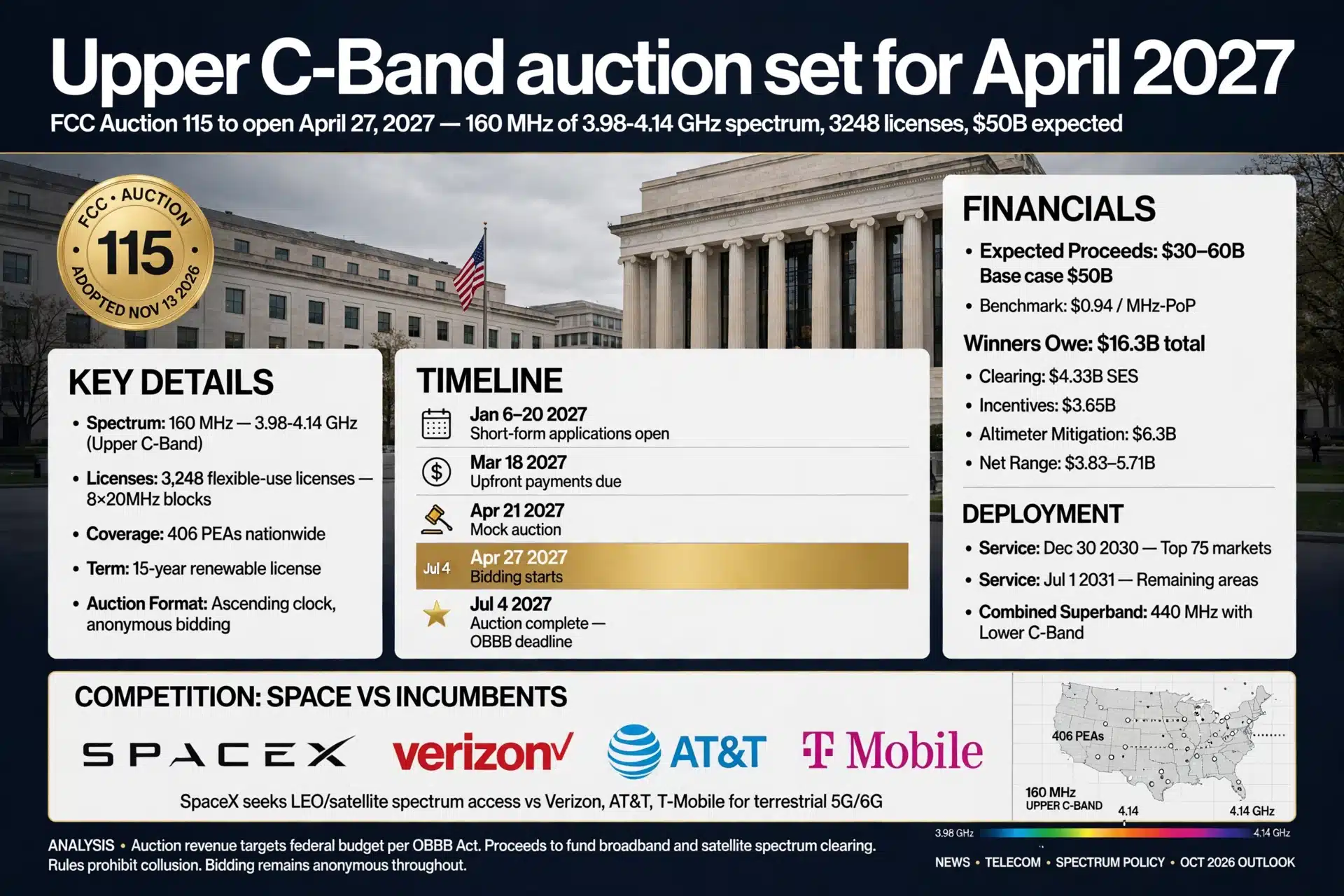
The Federal Communications Commission adopted the final schedule and procedures for its Upper C-Band auction on November 13, 2026, with bidding set to begin April 27, 2027. Auction 115 offers 3,248 flexible-use licenses across 160 MHz of spectrum in the 3.98 to 4.14 GHz range.
Key Takeaways:
- – The FCC released the Auction 115 procedures and minimum opening bids on November 13, 2026.
- – Bidding starts April 27, 2027, in AU Docket No. 26-191.
- – The auction covers 160 MHz of Upper C-band spectrum and 3,248 licenses.
- – Combined with the 2020 Lower C-band auction, the FCC says it will create a 440 MHz contiguous block from 3.70 to 4.14 GHz.
- – Congress set a July 4, 2027 deadline to complete the auction.
What the FCC adopted
The public notice does two jobs. It sets the calendar for Auction 115 and locks in the mechanics: minimum opening bids, upfront payment amounts, the bidding format and the post-auction payment process. Those details decide how much money the Treasury collects and which companies can compete.
The format is a two-phase ascending clock auction. Bidders first compete for generic license blocks, then move to an assignment phase that determines which specific frequencies each winner receives. That structure is designed to let bidders express how much they want spectrum generally before fighting over particular channels.
Chairman Brendan Carr framed the timeline as a speed record, saying the commission is poised to complete one of the most significant spectrum auctions in US history on time and on budget. The schedule does leave room: bidding opens in April 2027, and the legislative deadline is July 4, 2027.
Why 160 MHz matters
Mid-band spectrum is the workhorse of 5G. It carries more data than low-band frequencies and travels farther than millimeter wave, which is why carriers have built most of their capacity on it. The Upper C-band sits directly above the airwaves sold in 2020, and the FCC’s goal is to make the two blocks behave as one.
The commission is offering 160 MHz in this auction, which it says exceeds the 100 MHz required by the One Big Beautiful Bill Act by more than 150 percent. That overdelivery matters for capacity: more contiguous mid-band means fewer guard bands, simpler radios and higher throughput per site.
For US mobile users, the effect is not immediate. Spectrum won at auction in 2027 has to be cleared, licensed, built out and tuned, a process that typically takes years. The benefit shows up as network capacity in dense areas and as a competitive check on pricing, not as a coverage map on announcement day.
The super band promise
The headline number is 440 MHz. Combining 280 MHz of Lower C-band sold in 2020 with the 160 MHz on offer here would create a contiguous block from 3.70 to 4.14 GHz, which the FCC calls a harmonized super band.
Contiguity is an engineering advantage, not a marketing phrase. A carrier holding adjacent channels can deploy wider channels, which raises peak speeds and reduces interference between its own sectors. It also simplifies coordination with neighbors, because the edges of the band are fewer.
The 2020 auction drew Verizon, AT&T and T-Mobile as major winners, and those carriers have already built Lower C-band into their 5G networks. Whether they consolidate the upper block, or a new entrant uses it to build a fourth network, is the competitive question the auction will answer.
Who bids and what it buys
Auction 115 is open to mobile carriers, and the notice’s rules on eligibility and payments determine participation. Satellite and cable operators have also shown interest in mid-band spectrum as they build fixed wireless and hybrid networks, though the FCC’s auction design and the capital required narrow the field.
The practical constraint is price. C-band spectrum has sold for high per-megahertz prices in prior auctions, and 160 MHz nationwide is a large commitment. Companies that bid aggressively will have less capital for network construction in the same period, which is why auction outcomes shape deployment schedules for years.
Smaller operators and rural carriers typically depend on the assignment phase and on partitioning rules to acquire usable slices. The notice sets out the procedures for those bids, and the details are worth reading for any company that cannot compete for a nationwide block.
The deadline and the risks
Congress gave the commission until July 4, 2027 to finish the auction. Starting in late April leaves roughly two months of bidding, which is tight but not unprecedented for a large auction with a clock format.
The bigger risk is legal. Spectrum auctions attract petitions, and any challenge to the procedures can delay the start. The commission has already taken comment on the framework, which reduces but does not eliminate the chance of a last-minute dispute.
There is also an international dimension. The Upper C-band sits near frequencies used for aviation altimeters and satellite services, and coexistence questions have delayed deployments before. The FCC’s rules address those issues in the band plan, but operators will still need to coordinate with incumbents as they build.
What the auction means for prices
The immediate effect of a spectrum auction is a transfer from carriers to the Treasury, and the secondary effect is what carriers do with the bill. Companies that spend heavily often slow network investment or raise prices to protect margins, which is why auction outcomes show up in consumer costs years later.
The 2020 C-band auction raised tens of billions of dollars and produced a version of that pattern: winners built aggressively, then trimmed capital spending as the buildout matured. This auction is smaller, but the same trade-off applies to any carrier stretching for nationwide coverage.
There is also a competitive argument for over-supplying mid-band. When spectrum is scarce, incumbents hold capacity advantages that new entrants cannot match. Offering 160 MHz rather than the 100 MHz required gives challengers a path to usable blocks, if they can afford them, and whether that happens depends on the reserve prices in the notice and on how many bidders show up.
Frequently Asked Questions
When does the Upper C-Band auction start?
Bidding in Auction 115 is scheduled to begin April 27, 2027, according to the FCC’s November 13, 2026 public notice. Congress set a deadline of July 4, 2027 to complete the auction.
How much spectrum is being sold?
The FCC is offering 160 MHz of spectrum in the 3.98 to 4.14 GHz portion of the Upper C-band, across 3,248 flexible-use licenses. Combined with the Lower C-band, the commission describes a 440 MHz contiguous block.
Who can bid?
Mobile carriers, and potentially other qualified applicants such as cable or satellite operators, subject to the eligibility and payment rules in the public notice. Bidders must submit upfront payments before the auction begins.
Bottom line
The Upper C-Band auction is the last big piece of the mid-band puzzle the FCC has been assembling since 2020. Starting April 27, 2027, carriers will spend billions for 160 MHz that, combined with what they already own, could give the United States a contiguous 440 MHz block for 5G and whatever comes next. The winners will not be known until summer, and consumers will not feel the capacity for years. But the auction decides which companies can build the densest networks of the next decade, and the July 4 deadline leaves little room for error.
Sources: