




Durvalumab Bladder Cancer Approval Adds a Pre-Surgery Option
The Food and Drug Administration approved durvalumab with enfortumab vedotin-ejfv on November 13, 2026, as pre-surgery treatment followed by durvalumab alone after surgery for adults with muscle invasive bladder cancer who cannot receive or decline cisplatin chemotherapy. In the VOLGA trial, the combination cut the risk of event or death roughly in half compared with surgery alone.
Key Takeaways:
- – The FDA approved the regimen on November 13, 2026, for adults with muscle invasive bladder cancer who are ineligible for or refuse cisplatin-based chemotherapy.
- – Treatment runs before radical cystectomy and continues as single-agent durvalumab afterward.
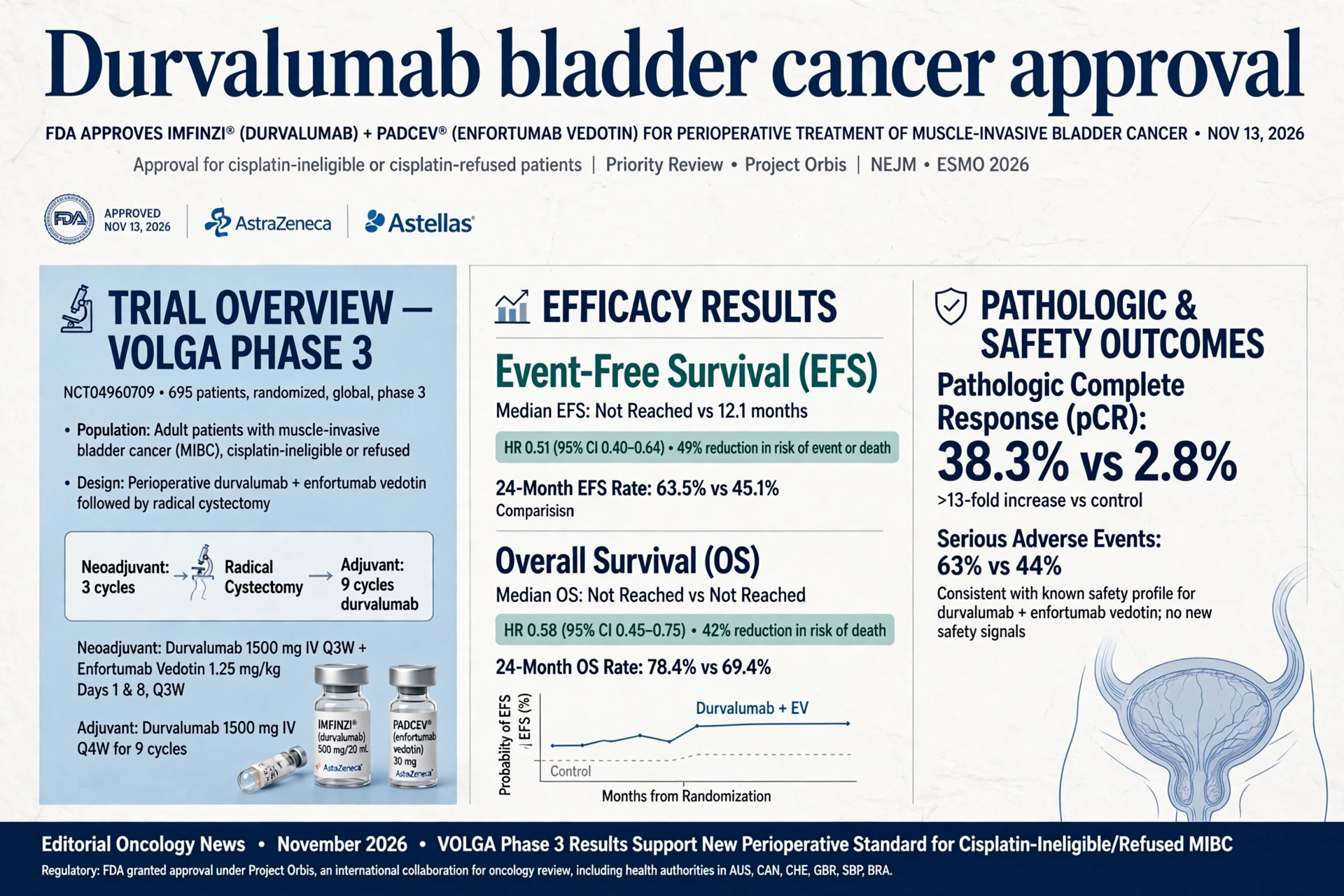
- – Median event-free survival was not reached on the combination versus 12.1 months with surgery alone, with a hazard ratio of 0.51.
- – Overall survival also improved, with a hazard ratio of 0.58.
- – The label carries warnings for immune-mediated reactions, infusion reactions and embryo-fetal toxicity.
This article is general information about a regulatory decision and is not medical advice. Patients should discuss treatment options, risks and eligibility with their oncologist.
What the FDA approved
The approval covers durvalumab, sold as Imfinzi by AstraZeneca, in combination with enfortumab vedotin-ejfv as neoadjuvant treatment, meaning before surgery. After radical cystectomy, patients continue on durvalumab alone as adjuvant treatment.
The eligible population is specific: adults with muscle invasive bladder cancer who are ineligible for cisplatin-based chemotherapy or who have refused it. Cisplatin eligibility has long been the dividing line in bladder cancer treatment, and patients who cannot tolerate it have had fewer options before surgery.
Muscle invasive bladder cancer is the form that has grown into the muscle wall of the bladder, which is where the disease becomes life-threatening and where surgery is the standard of care. The new regimen does not replace surgery; it wraps around it.
The VOLGA results
The evidence comes from VOLGA, a randomized, open-label trial that assigned 695 patients 1 to 1 to 1. One arm received neoadjuvant durvalumab and enfortumab vedotin followed by adjuvant durvalumab, one received radical cystectomy alone, and one received an additional investigational combination.
The primary measure was event-free survival, assessed by blinded independent central review. Median event-free survival was not reached in the combination arm, with a confidence interval spanning 33.2 months to not estimable, versus 12.1 months for surgery alone. The hazard ratio was 0.51, with a 95 percent confidence interval of 0.38 to 0.67 and a p-value below 0.0001.
Overall survival was a secondary measure, and it also improved. Median overall survival was not reached in either arm, with a hazard ratio of 0.58 and a confidence interval of 0.40 to 0.83. When both arms have not reached the median, the hazard ratio is doing the work, and it indicates a meaningful reduction in the risk of death over the follow-up period.
Who is eligible
Eligibility turns on two things: the cancer must be muscle invasive and the patient must not be a candidate for cisplatin, either because of kidney function, hearing, neuropathy, heart function or overall fitness, or because the patient declines it.
That group is larger than it sounds. A significant share of bladder cancer patients are older adults with other conditions that make cisplatin risky, which is why trials have focused on cisplatin-ineligible populations in recent years.
Patients who are candidates for cisplatin still have cisplatin-based neoadjuvant chemotherapy as a standard option, and this approval does not change that. The decision between regimens belongs with a multidisciplinary team, usually including a urologic oncologist and a medical oncologist.
Dosing and safety
For patients weighing 30 kg or more, the regimen is durvalumab 1,500 mg every three weeks with enfortumab vedotin 1.25 mg/kg on days 1 and 8 of each cycle for three cycles before surgery. After surgery, durvalumab continues at 1,500 mg every four weeks for up to nine cycles. Patients under 30 kg receive weight-based dosing at 20 mg/kg.
The label carries warnings for immune-mediated adverse reactions, infusion-related reactions, complications of allogeneic hematopoietic stem cell transplantation and embryo-fetal toxicity. Reported adverse reactions include increased alkaline phosphatase, dysgeusia, nausea, peripheral neuropathy, musculoskeletal pain and alopecia.
Peripheral neuropathy is worth flagging for patients, because enfortumab vedotin is associated with nerve damage that can affect hands and feet and may persist. The FDA advises health professionals to report serious adverse events through MedWatch.
What it means for patients
For a disease where the pre-surgery window has been limited to chemotherapy that many patients cannot tolerate, a targeted combination that improves event-free and overall survival is a real change in the treatment map. It also adds a conversation patients can have with their surgeon and oncologist before cystectomy.
The open questions are practical. Cost and coverage will determine access, and specialty regimens with two branded drugs typically require prior authorization. The duration of benefit beyond the trial’s follow-up is not yet known, and longer-term data will show whether the improvement holds.
This article is not medical advice. Anyone facing cystectomy should ask their care team whether they are cisplatin eligible, whether the VOLGA regimen applies to their stage, and what monitoring the treatment requires.
The cisplatin problem
Cisplatin is an effective chemotherapy for bladder cancer and a difficult drug for many patients. It demands kidney function that many older adults do not have, and it can cause hearing loss, nerve damage and kidney injury. Some patients cannot take it at all, and others choose not to.
That gap has driven a decade of trial design. Researchers have tested immunotherapy, antibody-drug conjugates and combinations in the neoadjuvant setting specifically to give cisplatin-ineligible patients a path that does not require a drug they cannot tolerate.
The VOLGA result matters because it compares the regimen with surgery alone, which was the realistic alternative for that group, rather than with chemotherapy. A hazard ratio of 0.51 against that baseline is a large effect, and it explains why the approval changes practice quickly instead of adding one more option to a list. The trade-off is that the regimen adds months of treatment before and after an operation that already carries a long recovery, so patients and families should plan for that schedule when weighing surgery timing.
Frequently Asked Questions
What exactly did the FDA approve?
Durvalumab with enfortumab vedotin-ejfv before surgery, followed by durvalumab alone after radical cystectomy, for adults with muscle invasive bladder cancer who are ineligible for or refuse cisplatin-based chemotherapy.
How much did the regimen improve outcomes?
Median event-free survival was not reached versus 12.1 months with surgery alone, with a hazard ratio of 0.51. Overall survival also improved with a hazard ratio of 0.58, according to the FDA’s summary of the VOLGA trial.
What are the main risks?
The label lists immune-mediated adverse reactions, infusion-related reactions, complications of stem cell transplantation and embryo-fetal toxicity, along with side effects including peripheral neuropathy, nausea, rash-like skin reactions and fatigue.
Bottom line
The durvalumab bladder cancer approval gives cisplatin-ineligible patients a pre-surgery option that meaningfully improved event-free and overall survival in a 695-patient randomized trial. The regimen is not simple: three cycles before surgery, then up to nine after, with monitoring for immune reactions and nerve damage. But for a group that has historically gone straight to cystectomy because chemotherapy was too risky, the approval changes the standard conversation. Access will depend on coverage, and the long-term durability of the benefit is still being measured.
Sources: