





Jensen Huang Resignation Hands Nvidia to Colette Kress as Interim CEO
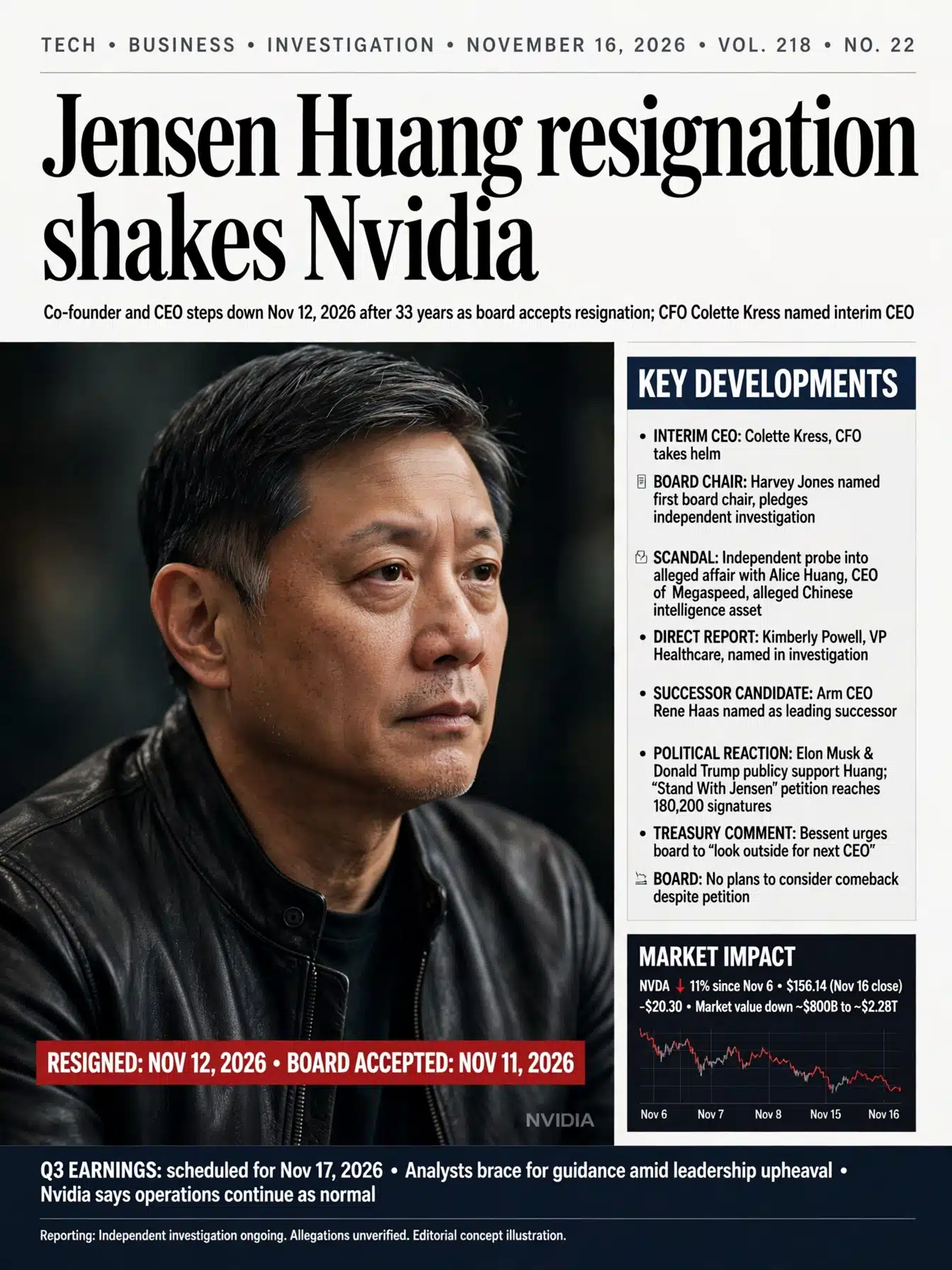
Jensen Huang resigned as Nvidia’s president, chief executive and board member on November 12, 2026, effective immediately. The board named chief financial officer Colette Kress as interim CEO and appointed Harvey C. Jones as its first-ever chair, with a search underway for a permanent chief executive.
Key Takeaways:
- – Nvidia announced the transition on November 12, 2026, and Huang’s departure was effective immediately.
- – Colette Kress, CFO since 2013, is interim CEO while keeping her finance role.
- – Harvey C. Jones, former Synopsys chief executive, became the board’s first chair.
- – Nvidia reports third-quarter fiscal 2027 results on November 17, as previously scheduled.
- – Huang has agreed to testify before Congress before Thanksgiving, CNBC reported.
What Nvidia actually announced
The press release is short and unusually final. Huang resigned as president, chief executive officer and a member of the board, effective immediately, according to the company’s November 12 statement. There is no transition period, no advisory role and no consulting arrangement described.
Kress, who has been executive vice president and chief financial officer since September 2013, agreed to serve as interim CEO while keeping the CFO job until a permanent successor is named. The board said it will consider both internal and external candidates.
The governance change is just as significant. Nvidia had no independent board chair before this announcement; Jones becomes the first. He spent more than 30 years as an entrepreneur, technology executive and venture investor, including as chief executive and executive chairman of Synopsys.
Who is running the company now
Kress is not a caretaker from outside. She has run Nvidia’s finance organization through the period when the company became the central supplier of AI accelerators, and the board’s statement leans on that continuity. Jones said Kress has a deep understanding of the business, customers, operations and financial position.
Her background fits the moment. Before Nvidia, she spent nearly 25 years in finance roles at technology companies including Cisco and Microsoft, which means she has seen a large hardware business navigate a platform shift before.
The open question is authority. An interim CEO who is also CFO controls the numbers and the narrative, but strategic decisions such as capital allocation, capacity commitments and acquisitions usually require a permanent chief executive. Until the search concludes, Nvidia is being run by a board chair and a finance leader, not by a founder.
Why the board moved fast
The resignation followed reporting on Huang’s personal conduct. The Associated Press reported that the departure came after revelations of extramarital affairs, including with a woman US officials had identified as a suspected Chinese intelligence asset, and a separate relationship with an Nvidia executive who reported to him.
Nvidia’s release does not mention the reason. It thanks Huang for 33 years and describes his contributions as profound, which is the standard language for a board that wants the operational story to be about continuity rather than cause.
The timing was not chosen by the company. CNBC reported that Huang agreed to testify before Congress before Thanksgiving, which means the governance question and the Washington question will now run on separate tracks. A board can replace a chief executive in an afternoon; a congressional appearance cannot be delegated to a CFO in the same way.
What it means for the AI trade
Nvidia is the most important single stock in the AI buildout, and its chief executive was the public face of the thesis. Wall Street Journal coverage on November 13 described shares falling again as investors weighed the fallout, with earnings and Anthropic’s initial public offering both due the following week.
The fundamental case does not change on a resignation. Nvidia’s chips are still the reference design for AI training, its order backlog is still enormous, and the November 17 earnings call will still report the same demand. What changes is the discount investors apply to uncertainty about succession, strategy and political risk.
The comparison that matters is Apple after Steve Jobs and Microsoft after Bill Gates: both companies survived founder departures because the product pipeline and the customer relationships were institutional. Nvidia’s test is harder because its advantage runs through one person’s relationships with hyperscale customers and suppliers, and those relationships have to be transferred, not just announced.
The political dimension
The scandal has an international component that no board statement addresses. The woman identified in reporting as a suspected Chinese intelligence asset has been linked to Megaspeed, a Singapore-based company named in the coverage. CBS News reported on November 15 that Megaspeed said the person left the company in 2025 and denied wrongdoing, saying it conducts legitimate and lawful business.
Those are allegations and denials, not findings, and no court has resolved them. But the political context is real: Nvidia’s China business has been under congressional and export-control scrutiny for two years, and a spy allegation involving the chief executive gives lawmakers a reason to escalate.
Reuters reported separately that the leadership change and US scrutiny are complicating billions of dollars of Chinese AI projects that depend on Nvidia hardware. That is the channel through which a personnel story becomes a revenue story.
What to watch this week
Three dates matter. November 17 is the earnings report, the first under Kress, and the call will be judged on whether guidance is unchanged. Huang’s congressional testimony before Thanksgiving is the second, and it will be the first time he speaks publicly since resigning. The third is the pace of the CEO search, because a fast internal appointment signals continuity while a prolonged external search invites speculation about deeper problems.
For US investors and buyers of AI infrastructure, the practical question is whether Nvidia’s product roadmap slips. The board says it expects operations, customer commitments and the roadmap to continue without interruption. That sentence is now the thing the next two quarters have to prove.
The board’s choice will also signal strategy. An internal promotion suggests continuity with the current roadmap of annual chip releases and heavy capital commitments, while an outside hire would invite a review of how aggressively Nvidia spends on capacity and on the companies it backs.
Frequently Asked Questions
Who is Nvidia’s CEO now?
Colette Kress is interim chief executive. She remains executive vice president and chief financial officer while the board searches for a permanent CEO, and Harvey C. Jones serves as the board’s first chair.
Why did Jensen Huang resign?
Nvidia’s announcement did not give a reason beyond his resignation from all three roles. The Associated Press reported that the departure followed disclosures about extramarital affairs, including one with a woman US officials identified as a suspected Chinese intelligence asset.
When does Nvidia report earnings?
Nvidia said it will report third-quarter fiscal 2027 results on Tuesday, November 17, 2026, at approximately 1:20 p.m. Pacific, with an earnings call at 2 p.m. Pacific, as previously scheduled.
Bottom line
The Jensen Huang resignation ends a 33-year run at the company he co-founded and hands day-to-day control to a finance chief who knows the numbers better than anyone. The board moved to install an independent chair and keep the earnings date, which is what a company trying to look stable does. Nvidia’s demand has not changed, but its risk premium has, and the market now has to price a founderless Nvidia while a congressional appearance and a CEO search run in parallel. The next real data point is November 17, not the press release.
Sources:
- https://investor.nvidia.com/news/press-release-details/2026/NVIDIA-Announces-CEO-Transition
- https://apnews.com/article/nvidia-jensen-huang-resigns-ceo-affairs-314714d463cf578cbb0dbd49de903107
- https://www.cnbc.com/2026/11/12/nvidia-jensen-huang-ceo-live-updates.html
- https://www.cbsnews.com/news/nvidia-alice-huang-jensen-ai-china-singapore-megaspeed/