






Beijing, China | July 17, 202611
On Friday, Nvidia briefly lost its spot as the world’s most valuable company. Meta shares slid more than 2%. The Nasdaq Composite closed down 1.4%, and the Nasdaq 100 fell. AI China headlines were suddenly everywhere on trading desks from New York to Palo Alto. This shift wasn’t caused by a Federal Reserve decision or weak earnings. Instead, it was sparked by a product launch from a four-year-old Beijing lab that most American investors hadn’t even heard of the week before.
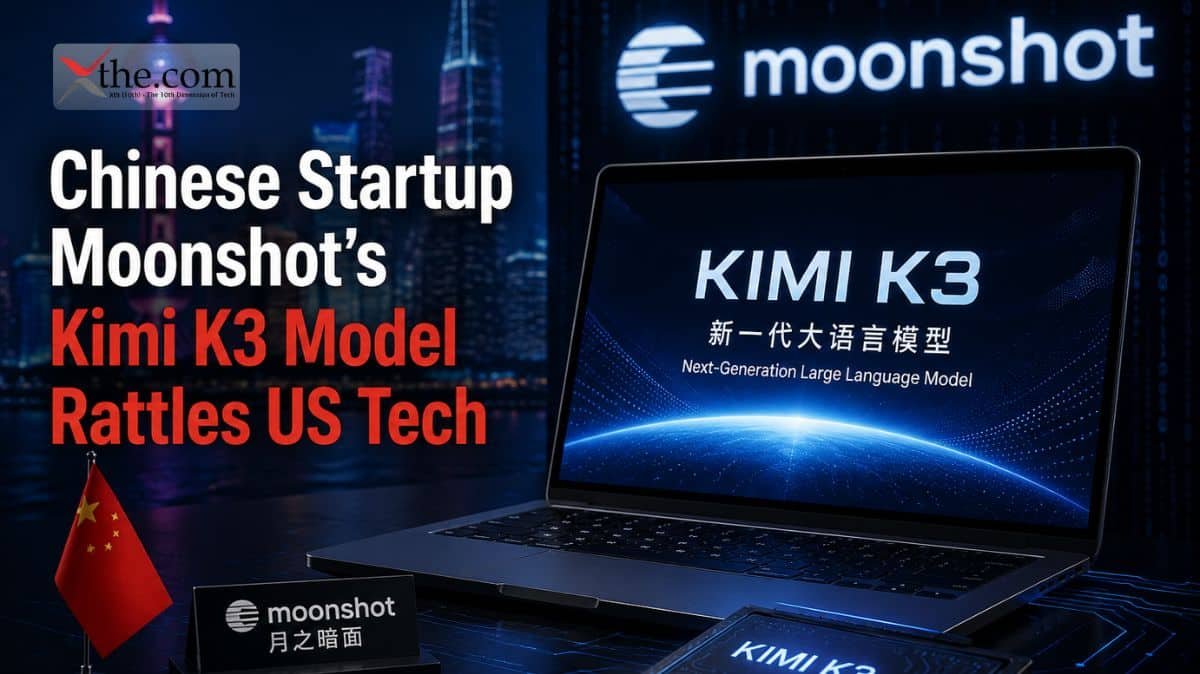
The Moonshot Kimi K3 model launched on Friday, and within hours, it did something rare: it moved the stock prices of Nvidia, Meta, and several semiconductor companies across the globe. Moonshot AI, the company behind K3, claims the model can compete with top systems from OpenAI and Anthropic. This, along with their open-weight release plan, was enough to revive a fear Wall Street thought it had already accounted for after the DeepSeek surprise in January 2025: that China’s AI labs are catching up faster and at a lower cost than US investors expected.
What Kimi K3 Actually Is
Kimi K3 is a mixture-of-experts model with about 2.8 trillion parameters and a one-million-token context window. Moonshot says it is the largest open-weight model released so far. There are two versions: K3 Max, designed for chat and general tasks, and K3 Swarm Max, made for large-scale parallel processing. According to the company, K3 outperforms Anthropic’s Claude Opus 4.8 and OpenAI’s GPT-5.5 on most of its own benchmarks, only falling behind the very latest models, Claude Fable 5 and GPT-5.6 Sol.
Early testers focused on one area: front-end coding. This is especially important for enterprise software teams to decide which AI vendor to use. Several engineers noted that K3’s output was hard to distinguish from leading closed models. This matters because OpenAI and Anthropic earn significant subscription revenue from their coding-assistant products.
An Open Model with a Catch
Calling this a Kimi K3 is an open-source model. Moonshot made it available right away through its API and consumer app, but the full model weights—the files’ developers need to run K3 on their own—won’t be released until July 27. Until then, anyone wanting to use K3 must go through Moonshot’s servers, just like OpenAI and Anthropic. K3 is also less affordable than the earlier Kimi K2 series. At $3 per million input tokens and $15 per million output tokens, its pricing is similar to Anthropic’s Claude Sonnet, not the lower-cost tier that made K2 popular with budget-minded developers.
Why Wall Street Reacted So Fast
The market’s reaction wasn’t just about this model. It was about what K3 represents: further evidence of a Chinese AI model 2026 wave that keeps arriving faster than US strategists had modeled into their forecasts. Moonshot raised $500 million in a Series C round in January 2026, reaching a $4.3 billion valuation. This money was set aside for the computing and research needed to build K3. The funding came together in about six months, showing how quickly China’s “Six Tigers” group of AI startups—including Moonshot, DeepSeek, and Zhipu AI—can turn research into real products.
Semiconductor stocks took the biggest hit. The VanEck Semiconductor ETF dropped over 4% that day, marking its third weekly loss in four weeks. Taiwan Semiconductor Manufacturing Company fell 7%, even though it reported a 77% jump in quarterly gains. This shows that investors weren’t reacting to TSMC’s results but to the idea that cheaper, more competitive open models could slow down the need for new AI infrastructure, which has driven chip demand for three years. Taiwan’s main index closed down more than 6%. Japan’s Nikkei dropped about 4%. Z.ai, a Chinese competitor to Moonshot, fell nearly 30% in Hong Kong trading on worries that K3 had overtaken its own product plans.
The DeepSeek Echo
On Friday, traders kept comparing the situation to January 2025, when DeepSeek released a model that matched top US systems at a much lower training cost and briefly wiped-out hundreds of billions from Nvidia’s market value. That event taught the market two things. First, a Moonshot AI startup in China with far fewer people and less money than OpenAI can still build a leading-edge system. Second, the initial shock usually fades. US stocks bounced back within weeks of the DeepSeek selloff, and AI infrastructure spending mostly continued as before. Some analysts on Friday were already saying the same about K3, seeing it as part of an ongoing trend rather than a true surprise.
Bank of America told clients on Friday that K3 raises the competitive bar within China as much as it does worldwide. It puts pressure on Alibaba’s Qwen ecosystem and additionally challenges US labs from the outside. For American investors, the situation is more complex: it’s not just one company moving ahead. It’s a crowded, well-funded field where China AI competes with OpenAI and Anthropic on many fronts at once—from consumer chatbots to enterprise coding tools to open-weight infrastructure that others can use for free.
What It Means for OpenAI and Anthropic
For OpenAI and Anthropic, the two leading US AI labs, the direct financial impact is indirect. Since neither company is publicly traded, Friday’s selloff affected their partners and public proxies instead. Microsoft, which has invested billions in OpenAI, fell up to 1.8% in early trading, and Nvidia briefly slipped below Apple in market capitalization. The deeper concern is that it is competitive. Every time a Chinese AI startup challenges OpenAI and Anthropic with a model that closes the performance gap and costs less, it makes the subscription-based business model of OpenAI and Anthropic harder to defend. If developers can get K3-level performance from an open-weight system, they can inspect, change, and eventually run themselves. It becomes tougher to justify paying high API prices in board meetings.
Moonshot has been clear about its reasons for this move. After DeepSeek’s breakout, Moonshot’s share of China’s busy chatbot market dropped from third to seventh place. The company shifted to open-weight models, starting with K2 in mid-2025, as a direct response. K3 is the strongest result of that strategy so far, and its launch occurred on a Friday, when chip stocks were already falling, which made the reaction even bigger than the model alone would have caused.
The Road Ahead
This doesn’t settle the bigger debate investors have had since early 2025: does AI leadership need huge, continuous infrastructure spending like Nvidia, Microsoft, and Meta have done, or can smaller, more efficient teams keep closing the gap at much lower cost? Moonshot’s answer, shown twice in eighteen months, is that the second approach works. Whether US labs respond by lowering prices, accelerating their own release schedules, or merely absorbing the volatility, the Moonshot Kimi K3 model rattles US tech stocks, and the topic will likely come up again whenever a Chinese lab hits a new milestone. The full-weight release on July 27 will be the next real test of how strong that pressure is.
Source: China’s Moonshot AI claims Kimi K3 can rival OpenAI and Anthropic








