





Atlanta, Georgia — July 10, 2026
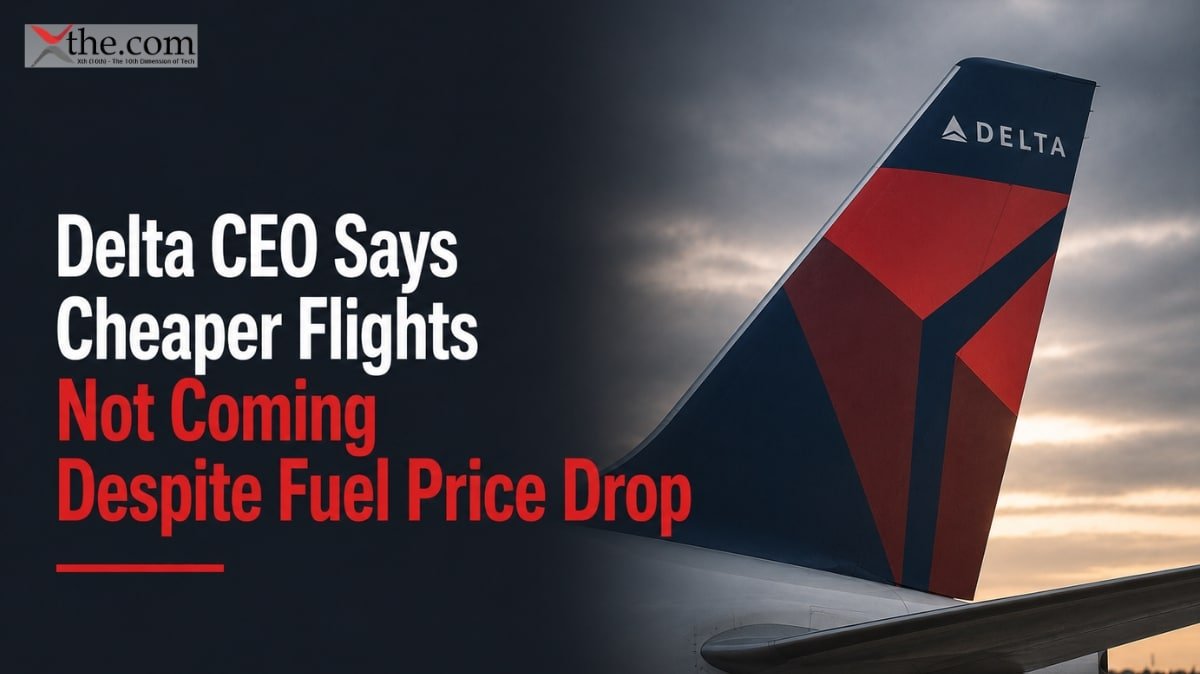
Jet fuel just got noticeably cheaper. Your next ticket to Cancun did not. That disconnect is not an accident, and Delta’s chief executive wants travelers to stop waiting for it to correct itself. In a CNBC interview Friday tied to the airline’s second-quarter earnings, Delta CEO Ed Bastian fares commentary made one thing explicit: Delta’s cheaper flights not coming is the reality for the rest of the summer and likely beyond. “I think it’s sustainable,” Bastian said of current pricing, a two-word verdict that hit hard on an industry accustomed to fuel costs and fares moving in tandem.
Why Delta Airfare Stays High in 2026
The math behind Delta airfare staying high in 2026 starts with a brutal spring. Fuel prices paid by Delta jumped roughly 75% year over year during the second quarter, driven by the US-Israeli conflict with Iran and the oil-market shock that followed. Fuel is the airline’s second-largest expense after labor, and the spike added close to $1.9 billion to Delta’s adjusted fuel bill for the quarter alone. Delta responded to the way any pricing-disciplined business would: it raised fares, but not enough to fully offset the hit. According to chief financial officer Erik Snell, ticket increases covered only about 60% of the cost to jump — an unusually strong recovery rate by historical standards, but still a gap the airline absorbed rather than passed entirely to flyers.
Now the equation has flipped. Oil prices have eased, and Delta itself projects fuel costs will fall roughly 20% this quarter. That is precisely the scenario Bastian addressed head-on: jet fuel costs plunged Delta fares stay at their current, elevated level anyway. “Airfares are a function of supply and demand,” he told CNBC. “The demand set is really strong.” In other words, the fare increases were never purely a fuel pass-through in the first place, and reversing the fuel spike does not obligate the airline to reverse the fares.
The K-Shaped Travel Economy
Bastian’s reasoning focuses on strong demand, similar to the “K-shaped” recovery economists use to describe post-pandemic spending. Wealthier travelers kept flying, upgrading, and paying higher prices, while those more sensitive to price cuts backed off or chose cheaper options. Delta’s numbers show this: premium passenger revenue rose 17% in the quarter, more than twice the 8% increase in main-cabin revenue. “Our consumer is financially very healthy, [with a] tremendous amount of wealth accumulation,” Bastian said, referring to Delta’s wealthy core customers and their willingness to pay for better seats, lounges, or direct flights.
That segment is the foundation of the airline’s broader Delta premium pricing strategy for summer 2026, which now extends beyond seat maps to include loyalty economics. Amex remuneration tied to Delta’s co-branded credit cards rose 16% to $2.4 billion in the quarter, while total loyalty revenue climbed 19%. Those are recurring dollars that arrive regardless of jet fuel volatility, giving Delta a cushion that competitors with weaker card partnerships cannot easily replicate. Add a newly segmented business-class cabin — rolled out this month to further separate top-dollar buyers from cost-conscious ones — and the picture is less “airline recovering from a fuel shock” and more “airline restructuring how it extracts revenue from its best customers.” Taken together, it’s the clearest evidence yet that Delta’s CEO fares are sustainable despite fuel being beyond a talking point and a strategy built into the airline’s revenue architecture.
What the Data Says About Airline Fares July 2026
The federal government’s own numbers support Bastian’s view on airline fares in July 2026. The latest Consumer Price Index shows airline fares rose 2.7% in May and are 26.7% higher than a year ago, which corresponds to the “nearly 27%” figure reported elsewhere. Bastian says this jump is just catching up, not overreaching. He points out that even with these increases, airfares remain at 10 to 15 percentage points below overall inflation since the pandemic. According to his calculations, the industry’s lower end still needs about a 5% fare increase just to break even at current fuel prices. This is an important statement from the CEO of the most profitable US airline: even after a year of big price increases, he says the industry is still trying to catch up.
Consumer Backlash and the Competitive Wildcard
None of these guarantees Delta gets to hold the line unchallenged. A near-27% year-over-year jump in airfares is the kind of statistic that shows up in political speeches and congressional hearings, not just earnings calls, and Delta’s stock traded lower after the report despite beating Wall Street’s estimates — a sign investors are already weighing how much pricing power is durable versus borrowed. The bigger swing factor is competitive behavior. Southwest Airlines has drifted away from its low-fare identity in recent quarters, adapting pricing to reflect higher costs rather than undercutting rivals. United’s own management has signaled that it expects to recover all of its added fuel expense, essentially through pricing, by year-end, and American is widely expected to move in step rather than break ranks. If any of the big three decides market share matters more than margin, Delta’s “sustainable” framing gets tested fast. For now, Bastian’s own words sum up the industry’s calculus: “There’s nothing to be gained by trying to grow in that environment.” Full-service carriers appear more interested in defending revenue per seat than in restarting a price war — a dynamic captured in the phrase “Delta CEO says cheaper flights not coming despite jet fuel cost drop” from July 2026.
Whether this pricing discipline lasts through the rest of 2026 will reflect both the economy and Delta’s strategy. If wealthy travelers keep spending and budget airlines keep raising fares to survive, premium airlines have little reason to lower prices. This explains why Delta ticket prices are staying high despite falling fuel costs in 2026. United and American will share their second-quarter results later this month, and their comments on fuel and loyalty revenue will show if Delta’s approach is the norm or an exception. For now, Delta’s message is clear: book your ticket now, because a discount based on lower fuel prices is not coming.
Source: Jet fuel costs have plunged. Here’s why Delta says cheaper flights aren’t on the way