




Washington, D.C. | July 17, 2026
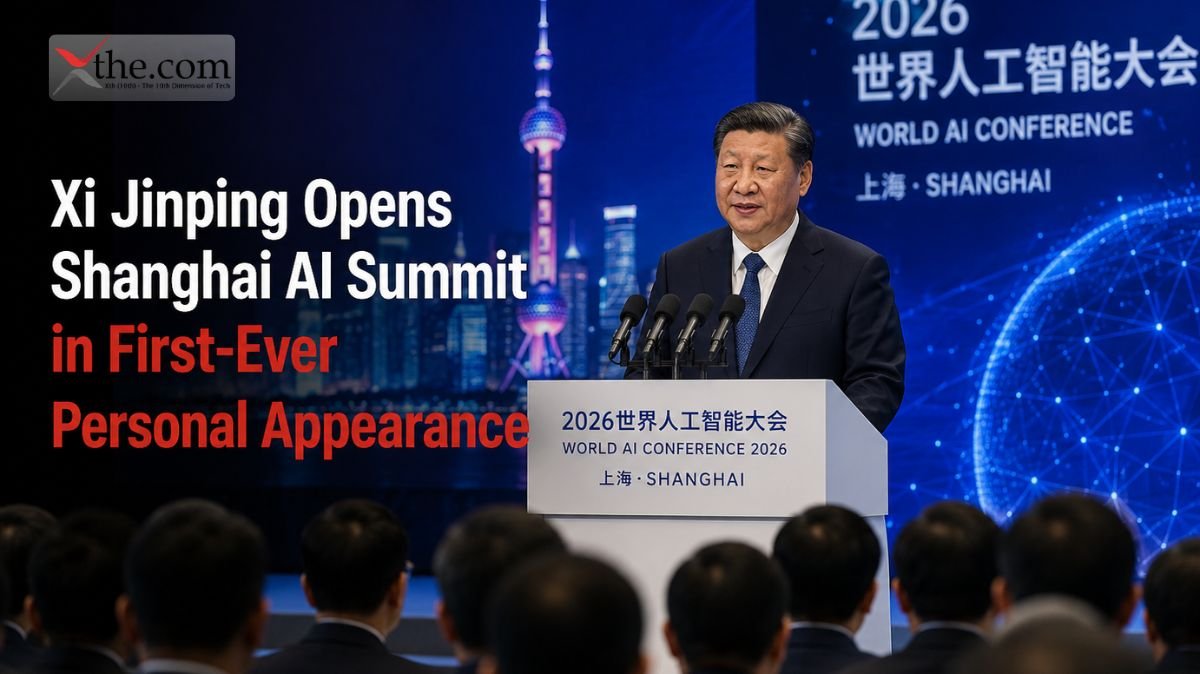
One appearance can change the direction of a global technology discussion. That is what happened when Chinese President Xi Jinping took the stage at Shanghai’s World AI Conference on July 17. For the first time since the event began in 2018, China’s top leader personally opened the country’s main artificial intelligence summit. His presence turned the conference from a regular industry event into a clear geopolitical message.
The Xi Jinping World AI Conference 2026 became one of the year’s most closely watched technology events. The Shanghai WAIC on July 17 also marked the start of China’s largest international push in AI diplomacy to date. At the heart of Xi’s speech was the China AI Governance Summit 2026, which Beijing hopes will shape global rules for artificial intelligence.
The timing was highly symbolic. On the same day Beijing shared its vision for AI governance, Google was set to launch Gemini 3.5 Pro. This illustrated the growing gap between Western focus on advanced AI models and China’s push for international governance standards.
Xi Jinping World AI Conference 2026 Signals a New Phase
President Xi’s presence meant more than just ceremony. Earlier WAIC events included senior officials and tech leaders, but Xi’s choice to open the conference himself showed how important artificial intelligence is to China’s long-term economic and national plans.
The WAIC 2026 opening ceremony in Shanghai brought together policymakers, scientists, investors, and business leaders from around the world. With over 140 forums, about 1,100 exhibitors, and nearly 300 product launches, Shanghai became one of the biggest AI showcases ever.
Companies like Huawei, StepFun, and MiniMax showed new base models, enterprise AI systems, robotics, semiconductor devices, and autonomous applications. These are all aimed at strengthening China’s domestic AI ecosystem.
For global observers, the message was clear: Beijing wants to compete in both AI innovation and in setting the international rules for its development.
China AI Governance Summit 2026 Focuses on Global Rules.
The main focus of Xi’s speech was his vision for international AI governance. While the United States has mostly focused on innovation, private-sector leadership, and national security, China has described artificial intelligence as requiring joint global oversight.
The Xi Jinping keynote AI speech emphasized cooperation, responsible development, technological inclusion, and shared governance. Chinese officials said AI should remain accessible to developing countries while reducing risks such as misinformation, cybersecurity threats, and the risk of independent decision-making.
Beijing’s proposal goes beyond domestic regulation. Officials discussed establishing a China global AI governance body, an international framework that could coordinate standards and ethical guidelines and encourage cross-border cooperation on artificial intelligence.
These proposals seek to shape global regulations before international norms are set.
Beijing’s Definition of AI Governance Differs from Washington’s
The term “AI governance” means different things to policymakers in different countries.
For Washington, governance frequently focuses on managing innovation with national security. Policymakers focus on export controls, semiconductor restrictions, cybersecurity, responsible model deployment, and maintaining technological leadership against strategic competitors.
Beijing sees governance in wider diplomatic terms. Chinese leaders focus on working with other countries, setting international standards, and leading government coordination across borders.
This difference in thinking shows the bigger geopolitical priorities at play.
The United States usually sees AI leadership as a matter of market competition and technological strength. China, on the other hand, describes governance as a public good that should be managed together through international organizations.
These different views are now a key policy debate shaping artificial intelligence around the world.
The US-China AI race 2026 enters a New Phase.
The US-China AI race in 2026 now goes far beyond language models and computing power.
Earlier, the focus was on making semiconductors, building cloud computing, and leading AI research. Now, the competition also includes diplomacy, regulation, intellectual property, talent hiring, and international partnerships.
Xi’s personal appearance showed that China sees AI governance as part of its national strategy, not just a technology policy.
American officials have responded by strengthening export controls on advanced AI chips while increasing federal investments in domestic semiconductor manufacturing and AI research. U.S. technology firms continue releasing increasingly capable frontier models, but policymakers are cautious about allowing strategic technologies to reach geopolitical competitors.
These parallel strategies suggest that future AI leadership may rely as much on regulatory influence as on technical performance.
Google’s Gemini Launch Creates an Extraordinary Contrast
It is rare for technology to create such a strong symbol.
While world leaders in Shanghai discussed administrative frameworks, Google was getting ready to launch Gemini 3.5 Pro. This illustrated the commercial race to build more advanced AI systems.
These events, happening at the same time, presented two competing stories.
One story focuses on technological breakthroughs, model effectiveness, business adoption, and developer communities.
The other story highlights governance, international collaboration, policy coordination, and long-term influence over regulations.
These two stories are not separate. In fact, innovation and governance are growing together.
For multinational companies working in both markets, this creates new compliance challenges. They must deal with different rules while still reaching global customers.
Global Technology Companies Watch Closely
Executives across Silicon Valley followed Shanghai’s announcements with considerable interest.
The question, “China AI governance push WAIC 2026 what it means for US tech companies,” sums up the uncertainty that multinational tech firms face.
If China sets governance standards that developing countries adopt, American companies may have to change their products, compliance processes, and data practices to align with different regulatory systems.
Software developers could encounter different transparency requirements.
Cloud providers may face different data localization rules.
Foundation model developers could see diverging expectations regarding risk evaluations, algorithm disclosure, and cross-border deployment.
Instead of a single global AI framework, businesses may have to operate under several overlapping governance systems.
Why Xi’s Appearance Matters Beyond China
The search phrase “Xi Jinping attends World AI Conference Shanghai for first time July 17 2026” shows more than just historical interest.
It denotes a strategic milestone.
China has spent years investing in AI research, domestic semiconductors, robotics, industrial automation, and large language models. Xi’s participation shows that these investments are now a top priority in national policymaking.
It also signals to international partners that Beijing wants to lead in shaping the future rules for artificial intelligence.
Whether other nations will embrace China’s governance proposals remains unclear.
European regulators continue developing their own AI oversight models.
The United States places greater emphasis on innovation and competitive leadership.
Emerging economies may find parts of China’s governance model appealing, especially if it includes technology partnerships and infrastructure funding.
This international competition could shape how AI develops in the next decade.
Gazing Forward
The Xi Jinping World AI Conference 2026 may be remembered more for making artificial intelligence a diplomatic priority than for its product demos. The Shanghai WAIC on July 17 showed that the future of AI will be formed not just by engineers building better systems, but also by governments competing to set the rules. As the China AI governance summit 2026 continues through July 20, policymakers, investors, and tech leaders worldwide will watch closely, since the next phase of the global AI race will be decided as much in meetings and regulatory forums as in research labs.
Source: China’s Xi to outline AI diplomacy vision at key Shanghai forum