




FCC Approves Amazon Leo Globalstar Deal, Clearing a Starlink Rival
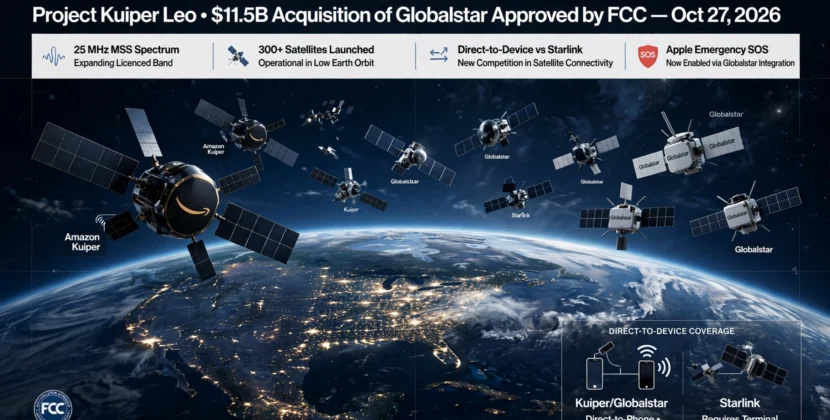
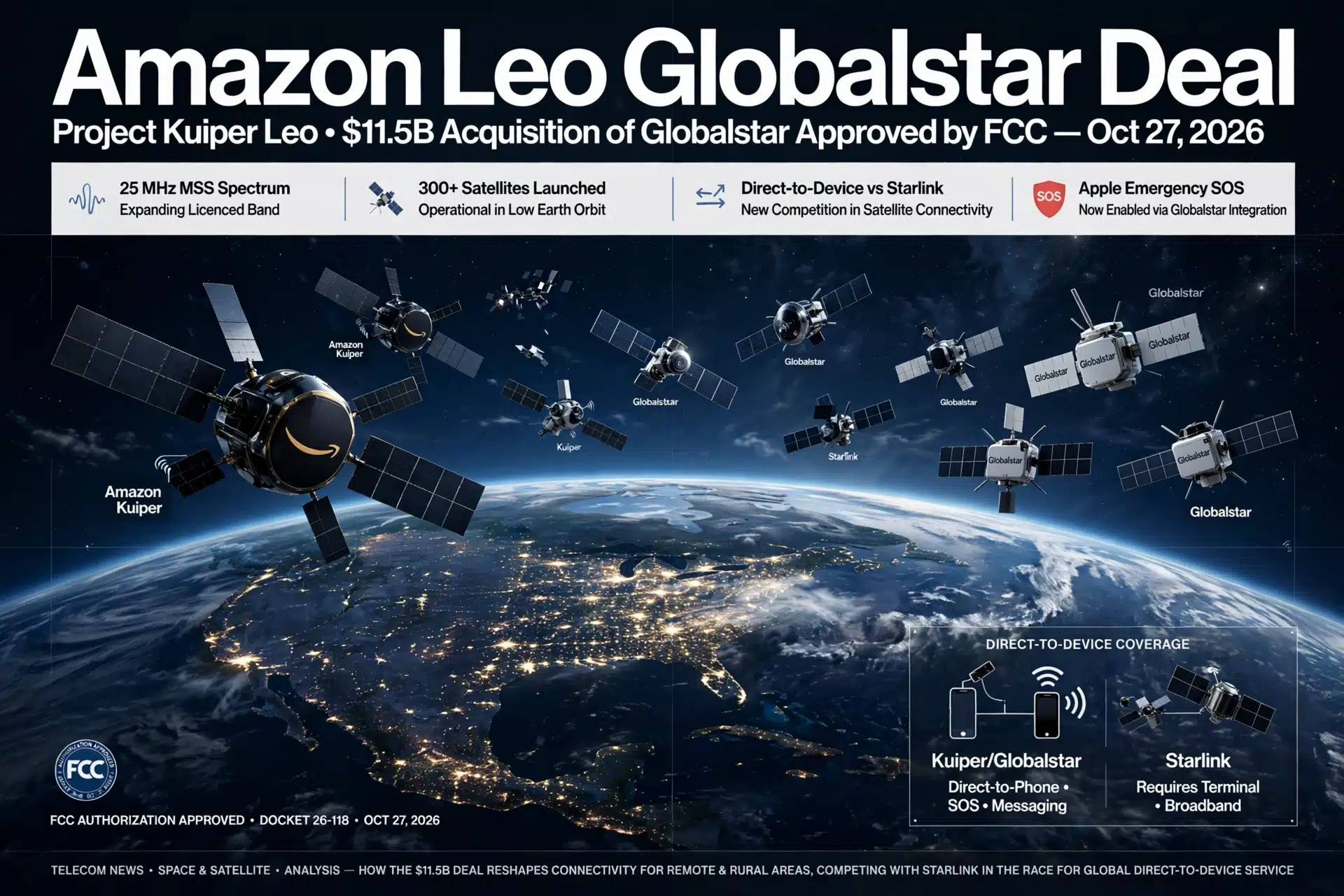
The Federal Communications Commission approved Amazon Leo’s acquisition of Globalstar on Tuesday, October 27, 2026, concluding its review of the roughly $11.5 billion deal and handing Amazon the mobile-satellite spectrum it needs to build a direct-to-device service that texts and connects ordinary phones. Here is what the Amazon Leo Globalstar approval actually grants, how it sets up a head-to-head with SpaceX’s Starlink, and when US users might see the service.
Key Takeaways:
- – The FCC’s Space Bureau approved the deal on October 27, 2026, concluding its review of Amazon’s purchase of Globalstar, announced in April at roughly $11.5 billion including spectrum.
- – Amazon gains control of about 25 MHz of Globalstar’s internationally harmonized mobile-satellite service spectrum.
- – The FCC found the deal likely to improve coverage in unserved areas, emergency communications, and enterprise data services, with no material public-interest harms.
- – Amazon has filed to launch a dedicated direct-to-device constellation of up to 5,105 satellites using the acquired L-band and S-band spectrum.
- – The deal was announced April 2026 with closing expected in 2027; Amazon declined to give an updated closing timeline.
What the FCC approval grants Amazon
The decisive asset is spectrum. Under the transaction, Amazon acquires 100% control of Globalstar, which becomes a wholly-owned subsidiary operating as an affiliate of Kuiper Systems LLC, the business now branded Amazon Leo, while retaining its corporate identity. With that control comes Globalstar’s license portfolio, including roughly 25 megahertz of mobile-satellite service spectrum that is internationally harmonized, meaning the same frequencies are recognized for satellite use across major markets, which lowers the cost of building a global constellation.
The FCC framed its public-interest findings on four benefits: enhanced data coverage in unserved or underserved areas, stronger emergency communications capabilities, growth in industrial and enterprise data services, and more intensive use of mobile-satellite spectrum. It also found no material public-interest harms, and its competitive analysis concluded that Amazon and Globalstar barely overlapped before the deal, with Globalstar focused on narrowband satellite connectivity, IoT, messaging, and tracking, and Amazon Leo focused on satellite broadband, so the transaction creates no horizontal or vertical harm.
How Amazon Leo competes with Starlink
The approval lands in a market where SpaceX has a years-long head start and a regulator-conceded scale advantage. Earlier in 2026, the FCC’s Space Bureau granted SpaceX approval to build, launch, and deploy a 15,000-satellite direct-to-device constellation, and separately authorized AST SpaceMobile’s 248-satellite system, meaning the roadmap Apple and Google’s phone partners ride on is already crowded. Amazon’s counter is its filing, made in April, for an Amazon Leo direct-to-device constellation of up to 5,105 satellites operating in the L-band and S-band spectrum acquired from Globalstar, designed to work alongside its first and second-generation broadband constellations and Globalstar’s fleet.
The FCC leaned on Amazon’s balance sheet as a competitive asset. In its order, the agency noted that Amazon’s substantial investments in its satellite network and its pending direct-to-device license applications indicate a high likelihood the spectrum would be put to intensive use, effectively endorsing a well-financed challenger to SpaceX’s dominance in satellite-to-phone services. Chairman Brendan Carr tied the authorization to broader policy, saying President Trump is restoring America’s technology leadership and that the FCC has empowered Amazon Leo to deliver next-generation satellite broadband and increase competition across the country.
The regulatory posture also matters for rivals: by authorizing the transfer without conditions that carve out spectrum, the FCC effectively endorsed using licensed mobile-satellite bands for consumer phone services, a reading SpaceX and AST already rely on but that lowers Amazon’s legal risk as it scales. Investors reading the sector should treat the order as evidence that the FCC wants more intensive use of MSS bands rather than warehousing of licenses.
The C-3 constellation and what happens at closing
A second approval compounds the value. The Space Bureau also recently granted Globalstar’s request for US market access for its non-geostationary C-3 system, a constellation of 48 satellites plus six spares, in 12 orbital planes at 1,414 km altitude, built by MDA Space. C-3 is authorized to use 1610-1618.725 MHz for Earth-to-space links and 2483.5-2500 MHz for space-to-Earth service, plus feeder and telemetry bands at 5091-5250 MHz and 6875-7055 MHz. Globalstar called the grant a critical step for its next-generation LEO services, and after the transaction closes, Amazon Leo can use the C-3 grant to build and launch the newly authorized system.
Practically, closing is the next gate. The transaction was announced in April 2026 with an expected close in 2027, and an Amazon spokesperson told Via Satellite that approval brings the company a step closer to new connectivity capabilities without updating the timeline. One objection was filed, by Yippy, a company in a contractual dispute with Globalstar, which the FCC dismissed because the dispute is in arbitration.
What the Amazon Leo Globalstar deal means for US phone users
For the roughly 300 million Americans with smartphones, the meaningful change is competitive pressure on a service tier that barely existed three years ago. Satellite texting and messaging on mainstream phones, pioneered by carriers working with SpaceX and developed by Apple on iPhone through Globalstar’s legacy service, gets a second well-financed national provider once Amazon’s constellation is live. More providers competing for direct-to-device partnerships typically means broader device support, faster feature rollouts, and better rural coverage economics, particularly in the dead zones that still cover large parts of the Mountain West, Alaska, and Appalachia.
Timing expectations should be modest: satellites take years to build and launch, so nobody should expect Amazon-branded satellite texting on day one. What changes this week is the pipeline: Amazon controls the spectrum, has a licensed next-generation constellation design to draw on, and has an FCC record endorsing intensive use. Consumers in rural areas evaluating connectivity options over the next two to three years will be the direct beneficiaries if the plan executes.
What happens next
Watch three markers. First, deal closing, expected in 2027, which transfers licenses and unlocks Amazon’s build plans. Second, satellite manufacturing and launch milestones for the direct-to-device constellation filed for up to 5,105 satellites, visible in launch schedules and FCC orbital-debris filings. Third, the commercial layer: whether Amazon Leo partners with US carriers the way SpaceX has, or markets a proprietary service, will shape pricing and device compatibility, and that choice is likely to surface during 2027 as the C-3 system begins deployment.
Frequently Asked Questions
What did the FCC approve on October 27?
The FCC’s Space Bureau approved Amazon Leo’s acquisition of Globalstar, concluding review of the roughly $11.5 billion transaction and transferring control of Globalstar’s licenses, including about 25 MHz of mobile-satellite service spectrum, to Amazon.
Will Amazon Leo work with my regular phone?
The approved plan is direct-to-device service, meaning connections to ordinary phones using Globalstar’s spectrum; no launch timing, device list, or carrier partnership has been announced, and satellites will take years to deploy.
How does this challenge Starlink?
SpaceX holds FCC approval for up to 15,000 direct-to-device satellites, while Amazon’s pending filing covers up to 5,105 satellites plus its broadband constellations, giving the US market a second well-financed national satellite-to-phone contender once Amazon’s network is built.
Sources:
- https://www.fcc.gov/document/fcc-approves-amazon-leos-acquisition-globalstar-0
- https://www.advanced-television.com/2026/10/28/fcc-oks-amazon-leos-globalstar-acquisition/
- https://www.satellitetoday.com/connectivity/2026/10/27/amazon-secures-fcc-approval-for-globalstar-acquisition/
- https://kelo.com/2026/10/27/us-agency-approves-amazon-leos-11-5-billion-acquisition-of-globalstar/