



DOJ Opens Nvidia Hugging Face Inquiry: What It Means for AI Competition
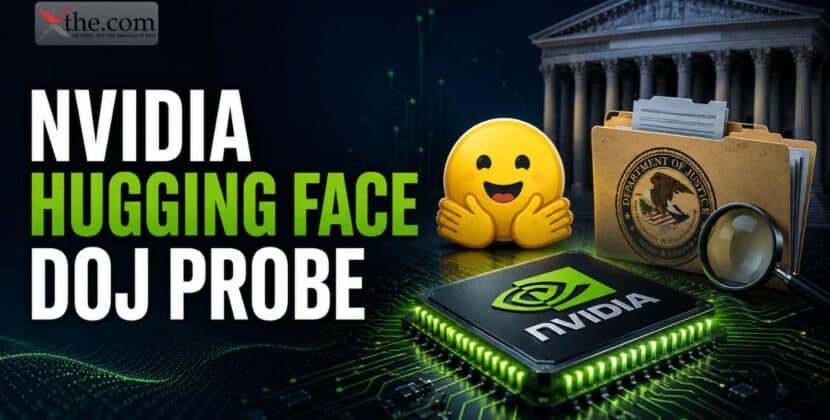
The Justice Department is asking whether Nvidia’s proposed $12.93 billion purchase of Hugging Face would give the chip giant too much control over how AI models reach developers, according to an exclusive Reuters report published October 28, 2026. The inquiry does not mean the deal is dead, but it puts the most important open-source AI platform on the antitrust map. Here is what the Nvidia Hugging Face review covers, why regulators care about model distribution, and what US developers and businesses should watch next.
Key Takeaways:
- – The DOJ is examining how Nvidia’s $12.93 billion Hugging Face deal would affect competition, focusing on control of a key route through which AI models reach developers.
- – Nvidia agreed to buy Hugging Face in early September 2026; the deal has not been formally blocked or approved.
- – The inquiry is part of a broader review of Nvidia’s acquisitions, investments, and sales practices.
- – An inquiry is not an accusation of wrongdoing, and Reuters notes it may not lead to legal action.
- – Hugging Face hosts and distributes hundreds of thousands of open AI models used by US startups, universities, and Fortune 500 teams.
Why the Nvidia Hugging Face deal drew the DOJ’s attention
Hugging Face is not a chip company. It is the de facto public library of open AI models, datasets, and tools, where developers download everything from language models to image generators. That makes it infrastructure, and infrastructure is where antitrust enforcers pay the closest attention. The DOJ’s core question, as reported by Reuters and picked up by Yahoo Finance and AI Weekly, is whether one company could own both the dominant hardware for training AI and a central distribution channel for the models that run on it.
The inquiry fits a pattern. Nvidia’s chips dominate the data centers where most serious AI gets built, and its deals with cloud providers and model developers are already under regulatory scrutiny. Adding Hugging Face would extend that footprint from the supply side of AI, the hardware, to the demand side, the place where most of the world’s developers actually get their models. Regulators have historically treated that kind of vertical stacking, where a supplier owns a marketplace, as a competition risk because the owner can favor its own products, charge rivals more, or quietly change terms.
What the $12.93 billion acquisition actually buys
Nvidia announced in early September 2026 that it had agreed to acquire Hugging Face for $12.93 billion, per Reuters and reports that tracked the announcement. The price reflects more than revenue: it buys community goodwill, a standard model packaging format, and the default destination for teams publishing open models. For Nvidia, the strategic pitch is easy to see. If the company that makes the GPUs also owns the platform where models are shared, it can optimize every step of the pipeline and steer more workloads onto its own hardware.
For the developer community, the concerns are more concrete. Open projects thrive on neutrality. If a hardware vendor owns the library, questions follow quickly. Would models that run best on competing hardware get equal treatment in search results and featured placements? Would licensing terms shift to favor the owner’s ecosystem? Would the platform’s traditional openness, which let academics and startups publish freely, survive a corporate integration? The DOJ’s inquiry suggests those questions are not theoretical.
What the inquiry can and cannot do
An antitrust inquiry is a fact-finding step, not a courtroom verdict. Reuters specifically notes that the examination does not establish wrongdoing and may not lead to legal action. The realistic outcomes are several. The DOJ could close the inquiry with no action if it finds the competition concerns overstated. It could push for remedies, such as commitments that Hugging Face stays open and neutral, before clearing the deal. Or it could file suit to block the acquisition, which would move the fight to federal court and likely add a year or more of litigation.
Timing matters here too. The deal has not yet closed, so the companies still have room to negotiate conditions with regulators before finalization. Deals in concentrated tech markets routinely get restructured under this kind of pressure, either through divestitures, firewalls between business units, or public commitments to neutrality. The practical signal for the market is that the acquisition will not sail through quietly.
What US developers and businesses should watch
If your team relies on Hugging Face, the immediate takeaway is not to panic and migrate, but to reduce single-point-of-failure risk. Mirroring the models you depend on, pinning specific versions, and keeping a second distribution source in your deployment pipeline are cheap insurance regardless of how the deal ends. Startups that build products on top of the platform should watch for any change in terms of service or in how the platform prices compute, since those are the levers an owner could realistically pull.
The broader signal for the AI industry is that regulators are no longer focused only on chips and training runs. Distribution is now treated as a market. Whoever controls where models get published, discovered, and downloaded controls a chokepoint that can shape the entire ecosystem, and the DOJ appears prepared to police it the same way it polices app stores and cloud marketplaces.
What happens next
Expect three markers over the coming months. First, any formal second-step review or deeper investigation would appear in regulatory filings and reporting, which would extend the timeline and raise the odds of conditions on the deal. Second, watch Hugging Face’s own communications: platform owners under scrutiny often publish openness commitments and governance changes to preempt criticism. Third, watch Nvidia’s deal-completion timeline. If the companies push closing past announced targets or quietly amend the agreement, that is the clearest evidence that regulators extracted changes.
The stakes go beyond one deal. How regulators treat a hardware-and-platform combination like Nvidia and Hugging Face will set the template for the next generation of AI acquisitions, where model marketplaces, agent toolkits, and compute marketplaces are the prize. For US startups, the best case is a clear set of neutrality rules that keep the open ecosystem genuinely open. The worst case is a long legal fight that freezes investment in the platform while both sides litigate.
Frequently Asked Questions
Why is the DOJ investigating the Nvidia Hugging Face deal?
Reuters reported on October 28, 2026 that the Justice Department is examining how the proposed $12.93 billion acquisition would affect AI competition, including whether owning Hugging Face would give Nvidia control over an important route through which AI models reach developers.
Does the inquiry mean the deal will be blocked?
No. An inquiry is not a determination of wrongdoing, and it may not lead to legal action. Possible outcomes range from clearance to negotiated conditions to a court challenge to block the deal.
What should developers do while the review continues?
Teams that depend on Hugging Face can lower risk by mirroring the models they use, pinning versions, and keeping a backup distribution path. Watch for any changes in platform terms, search ranking of models, or compute pricing as the review progresses.
Sources:
- https://www.reuters.com/world/us-doj-is-inquiring-about-nvidias-purchase-hugging-face-sources-say-2026-10-28/
- https://finance.yahoo.com/technology/ai/articles/nvidia-faces-doj-antitrust-scrutiny-202028682.html
- https://aiweekly.co/alerts/nvidias-1293b-hugging-face-deal-draws-doj-antitrust-probe
- https://www.cnbctv18.com/world/us-doj-is-inquiring-about-nvidias-purchase-of-hugging-face-report-20021962.htm