



USCIS Will Reopen Denied CBP One Parole Cases for Free: Who Qualifies
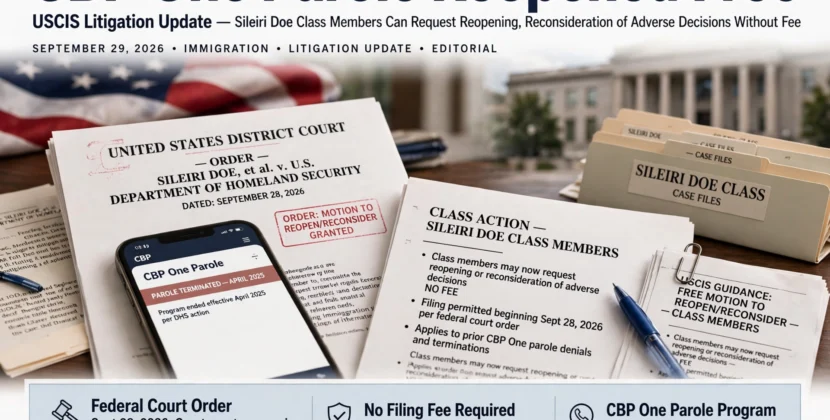
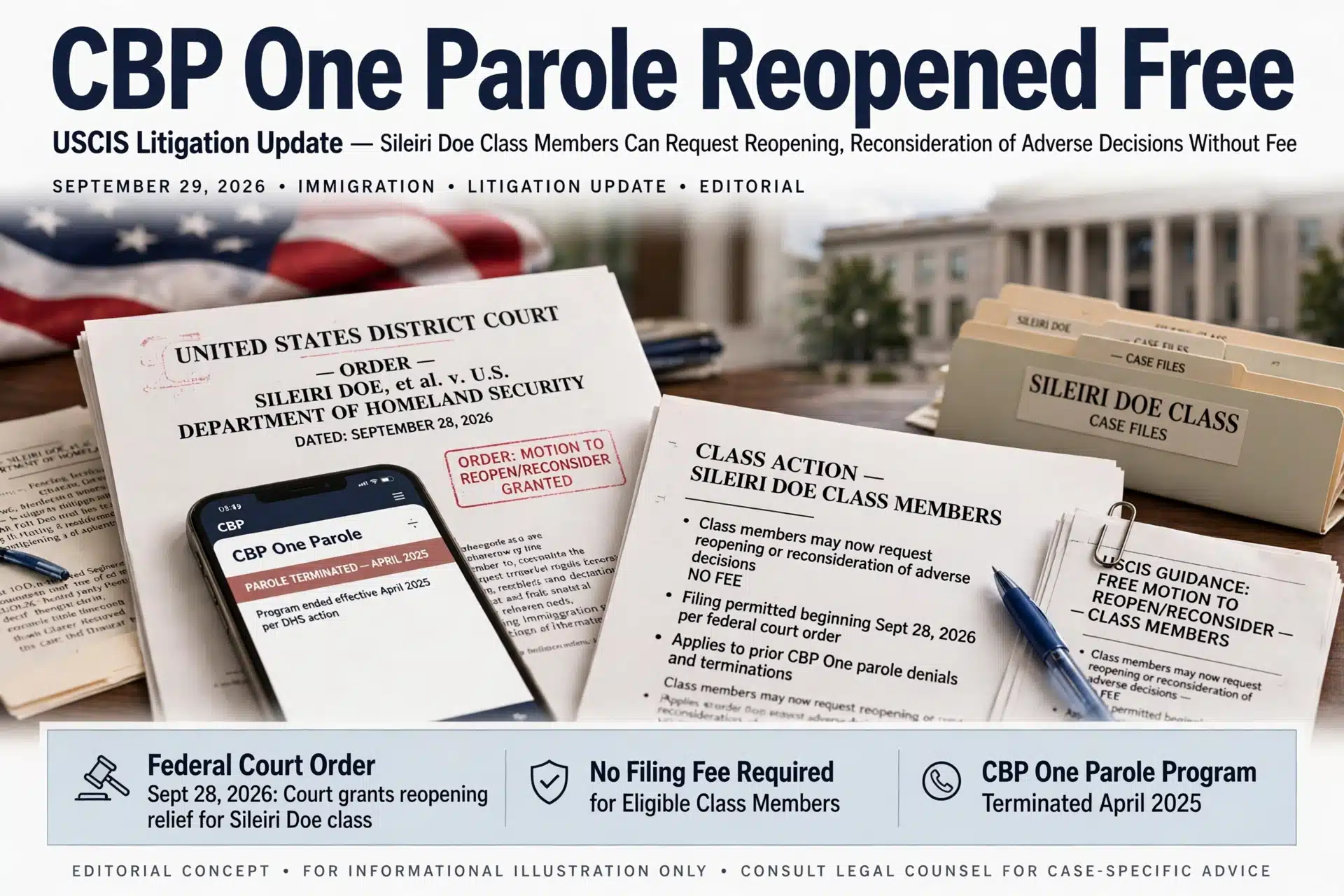
USCIS announced on October 26, 2026 that certain migrants whose CBP One parole cases were denied after the government’s April 2025 mass termination emails can ask the agency to reopen or reconsider those adverse decisions without paying any filing fee, implementing a September 28 federal court order in Sileiri Doe v. DHS. Here is exactly who qualifies as a Sileiri Doe class member, what the CBP One parole case reopening process requires, and where the limits are.
Key Takeaways:
- – USCIS posted the litigation update on October 26, 2026, and the American Immigration Lawyers Association circulated it October 27.
- – The class covers people paroled into the US between May 16, 2023 and January 19, 2025 after scheduling a CBP One appointment, whose parole was terminated by mass email in April 2025, and who remain in the US.
- – Requests to reopen or reconsider are free of charge and there is no filing deadline, per the court order.
- – Only decisions USCIS issued between April 1, 2025 and April 21, 2026 qualify; parole-based employment authorization requests are excluded.
- – Requests must explain how the April 2025 parole termination affected eligibility and are reviewed case by case.
Who counts as a Sileiri Doe class member
The class definition is narrow and has four parts, all of which must apply. The person scheduled an entry appointment for the United States using the CBP One mobile app; was paroled into the United States between May 16, 2023 and January 19, 2025; had that parole terminated in April 2025 by an email stating it was time to leave the United States or using similar language; and remains in the United States. People who entered without the app-based appointment, or whose parole was revoked under other processes, are not covered.
The background matters for understanding why the remedy exists. In September 2026, the US District Court for the District of Massachusetts ordered DHS to remediate certain adverse consequences of the April 2025 terminations in Sileiri Doe v. DHS, case 1:25-cv-12245-ADB. Earlier in the same litigation, in March 2026, the court had vacated the termination emails themselves and ordered DHS to reinstate parole, and on April 21, 2026 CBP updated databases to restore class members’ parole periods and issued new termination notices. The October 26 USCIS process is the remediating step for collateral damage: benefit applications denied, dismissed, deemed abandoned, administratively closed, or referred to immigration court between April 1, 2025 and April 21, 2026.
How to request reopening of a CBP One parole case
The mechanics are deliberate and page-specific. Requests must be filed on the form USCIS designates: Form I-589, the asylum application, for asylum cases, and Form I-290B, the notice of appeal or motion, for other benefit types, each with dedicated instructions for Sileiri Doe class members that USCIS says must be followed for the request to be accepted and processed correctly. Two content requirements carry the burden: the request must explain how the April 2025 parole termination affected the person’s eligibility for the underlying benefit, and why USCIS should reopen or reconsider its decision.
There is no filing fee, and the court order sets no deadline for class members to file. USCIS reviews requests on a case-by-case basis and may approve one only if the person demonstrates current eligibility for the benefit, without consideration of the April 2025 parole termination, meaning the prior denial’s reasoning is corrected but eligibility rules still apply.
What the CBP One parole process does not cover
Three exclusions prevent the class-wide misconception from spreading. Parole-based employment authorization, EAD requests based on parole, are excluded from the free reopening process. Appeals are not part of this process either: where a benefit type allows an appeal on Form I-290B or another form, normal appeal procedures and requirements apply, meaning fees and deadlines return on that parallel track. And people currently in removal proceedings before an immigration judge face a jurisdiction rule: they generally must have proceedings terminated or dismissed by the judge before asking USCIS to reopen an asylum or, in some cases, adjustment application, and if USCIS no longer has jurisdiction, it will reject or deny the request. Limited exceptions exist and are spelled out in the instructions.
Timing also matters in one respect: the process reaches only decisions USCIS issued between April 1, 2025 and April 21, 2026. A denial issued in March 2025, before the window, is not reachable; a denial issued in June 2026, after it, is not either.
What CBP One parolees should do now
Practical steps for class members run in order. Gather the April 2025 termination email and any USCIS denial notices issued in the covered window, since both are the documentary basis of the request. Read the class-specific instructions on the Form I-589 or Form I-290B pages before filing, because USCIS is explicit that class members must follow the special instructions for the request to be accepted. Get an eligibility review from a licensed immigration attorney or an accredited representative before filing, especially where removal proceedings are involved, because filing the wrong motion in the wrong forum can cost months. Legal-aid organizations and AILA’s attorney-referral resources are the standard starting points for people without a lawyer.
Family members and employers of class members should know the request does not by itself restore status or work authorization; it reopens the underlying benefit case, and any interim relief depends on what USCIS grants on the merits.
What happens next
Three developments will shape the usefulness of the process. First, filing volume: USCIS will publish processing data eventually, and the size of the affected class, spanning paroles issued across the CBP One era, suggests a substantial first-year caseload that could strain adjudication timelines. Second, compliance monitoring: the district court retains jurisdiction, and class counsel will be watching whether USCIS accepts and processes requests correctly under the special instructions. Third, parallel effects: class members also salvage immigration positions in other ways, since the March 31, 2026 order established that the April 2025 termination emails had no legal effect, and DHS cannot use them as a basis for denial, admissibility decisions, detention, or unlawful-presence accrual under the proportional statute.
For the hundreds of thousands of people whose cases were rolled up in the April 2025 terminations, the October 26 announcement converts a year-old grievance into a fee-free administrative remedy with no deadline, but like every band-aid procured at the end of a long legal process, it reaches only the documented people and requires them to prove, case by case, that they still qualify for whatever benefit they originally sought.
Frequently Asked Questions
Who qualifies as a Sileiri Doe class member?
People who scheduled US entry through the CBP One app, were paroled into the US between May 16, 2023 and January 19, 2025, had parole terminated by the April 2025 mass email, and remain in the United States, per USCIS’s October 26, 2026 announcement implementing the September 28 court order.
Is there a deadline or fee for the reopening request?
No. The court order sets no filing deadline and USCIS charges no fee for eligible class members’ requests to reopen or reconsider covered adverse decisions issued between April 1, 2025 and April 21, 2026.
What form do I use to reopen my case?
Form I-589 with the Sileiri Doe class member instructions for asylum applications, and Form I-290B for other benefit types; USCIS says the class-specific instructions must be followed or the request will not be accepted and processed appropriately.
Sources: