





FDA Approves Talzenna Prostate Cancer Combination for HRR-Mutated Disease
The US Food and Drug Administration approved talazoparib (Talzenna) combined with enzalutamide on October 26, 2026 for adults with metastatic prostate cancer that carries homologous recombination repair gene mutations, expanding the Talzenna prostate cancer indication from early-stage use into advanced disease. Here is who qualifies, what the pivotal trial showed, and what patients and families should ask their oncologists next.
Key Takeaways:
- – FDA approved talazoparib plus enzalutamide on October 26, 2026 for metastatic androgen pathway modulation-naive or -sensitive prostate cancer with HRR mutations detected by an FDA-authorized test.
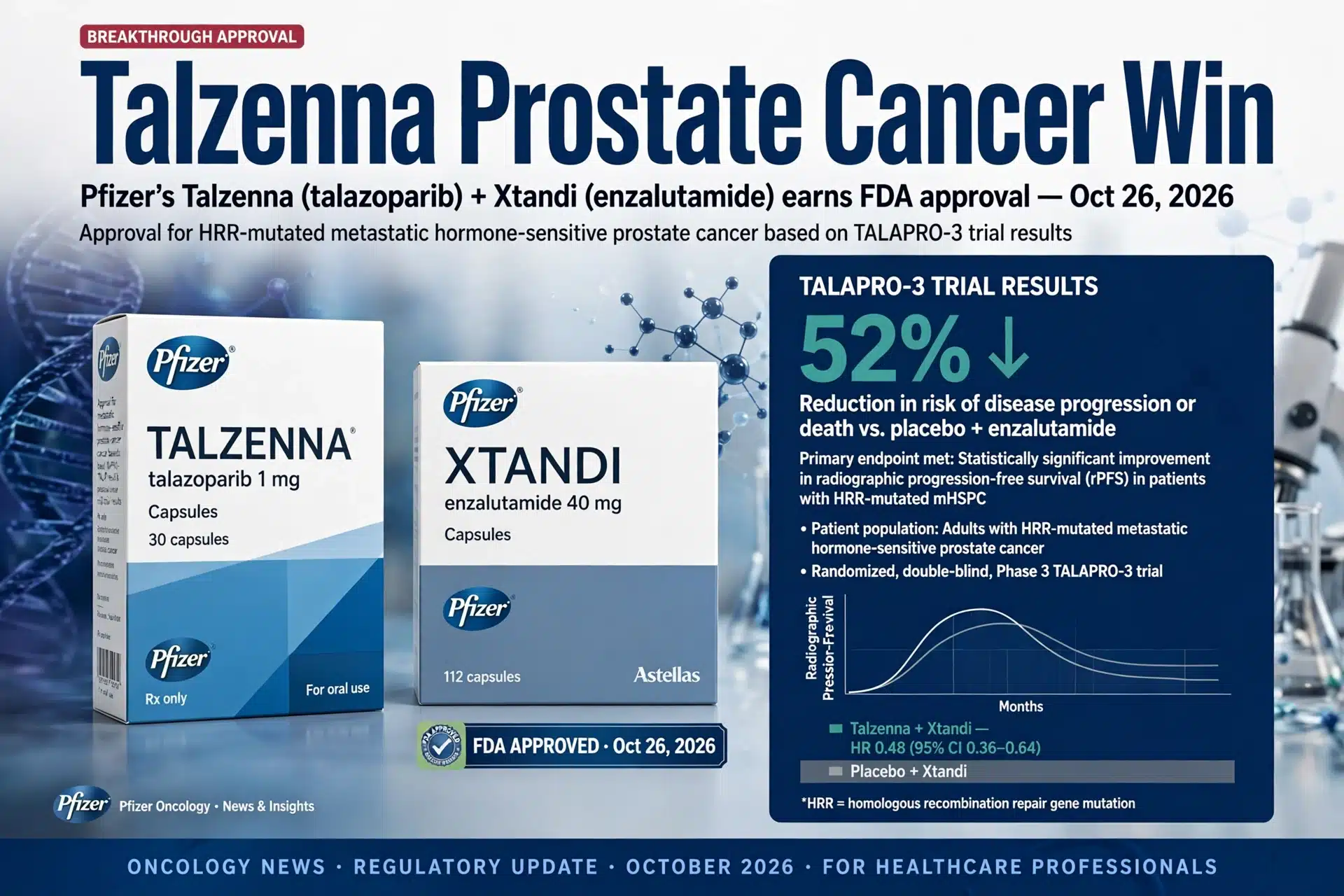
- – In the 599-patient TALAPRO-3 trial, the combination cut the risk of radiographic progression or death by roughly half: median progression-free survival was not reached versus 45.8 months with enzalutamide alone.
- – Eligible mutations span twelve genes, including BRCA1, BRCA2, ATM, and CHEK2, confirmed by companion diagnostics such as FoundationOne CDx.
- – Known risks include myelodysplastic syndrome and acute myeloid leukemia, myelosuppression, and embryo-fetal toxicity, all listed in prescribing information.
- – The review ran under Project Orbis with Australia’s TGA and Health Canada, and patients continue androgen deprivation therapy alongside the combo.
What the Talzenna prostate cancer approval covers
The approved population is precise. The FDA greenlit talazoparib, a PARP inhibitor made by Pfizer, in combination with enzalutamide, an androgen receptor pathway inhibitor, for adults with metastatic androgen pathway modulation-naive or -sensitive prostate cancer, abbreviated mAPMN/S, whose tumors carry homologous recombination repair gene mutations as detected by an FDA-authorized test. In plain terms, these are patients whose advanced prostate cancer has not yet been treated with androgen-pathway drugs and whose tumors have defects in the DNA-repair machinery that PARP inhibitors exploit, a targeted approach often called synthetic lethality.
The HRR gene list in the trial comprises twelve genes: ATM, ATR, BRCA1, BRCA2, CDK12, CHEK2, FANCA, MLH1, MRE11A, NBN, PALB2, and RAD51C. Mutation status was determined prospectively using tumor tissue or circulating tumor DNA, ctDNA, through next-generation sequencing. The FDA previously authorized the FoundationOne CDx tissue assay and FoundationOne Liquid CDx blood assay as companion diagnostics to identify eligible patients, which anchors the practical workflow: genetic testing comes first, and this regimen is only on the table for patients whose results show an HRR alteration.
What the TALAPRO-3 trial showed
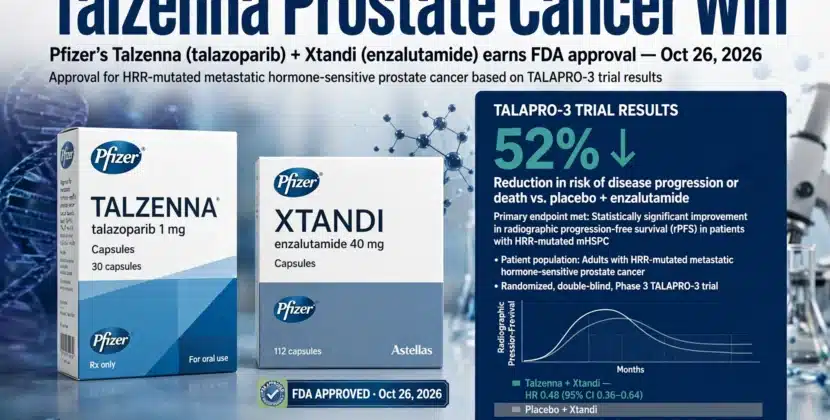
TALAPRO-3 was a randomized, double-blind, placebo-controlled trial in which 599 patients were assigned one-to-one to daily enzalutamide plus either talazoparib or placebo, with all patients also receiving continuous androgen deprivation therapy, ADT. The primary endpoint was radiographic progression-free survival, rPFS, judged independently by imaging criteria. The combination arm’s median rPFS had not been reached at the time of analysis, while the control arm’s was 45.8 months, with a hazard ratio of 0.48, meaning patients on the combination experienced roughly half the risk of radiographic progression or death during follow-up. Overall survival data were still immature at the rPFS analysis, so longer follow-up will be needed to answer the ultimate survival question.
For patients, the practical translation is that the combination delays the point at which scans show the cancer advancing. Because the control arm already did well, at more than three years of median progression-free survival, the incremental benefit matters most for younger or otherwise healthy patients who will live long enough to realize the full delay, and the trial’s hazard ratio measured across the whole population rather than in any subgroup.
Side effects and safety monitoring
The prescribing information carries serious warnings. The FDA lists myelodysplastic syndrome, MDS, and acute myeloid leukemia, AML, myelosuppression, meaning suppressed bone marrow production of blood cells, and embryo-fetal toxicity, requiring contraception counseling, among the precautions. Recommended dosing is 0.5 mg of talazoparib orally once daily with enzalutamide until disease progression or unacceptable toxicity, administered alongside a GnRH analog or after bilateral orchiectomy, since all patients must maintain androgen deprivation.
These are the standard guardrails of the PARP-inhibitor class, and they explain why the approval is not a substitute for monitoring: patients on the combination need regular blood counts and long-term vigilance for second malignancies, which the label requires prescribers to discuss. The approval also arrived through Project Orbis, the FDA Oncology Center of Excellence’s international collaboration framework, with reviews ongoing at Australia’s Therapeutic Goods Administration and Health Canada, meaning the same evidence package is under consideration in those systems concurrently.
What patients and caregivers should ask about
Three conversations follow from this approval. First, testing: patients with metastatic prostate cancer who have not had HRR or broader tumor genetic testing should ask whether tissue or ctDNA sequencing is appropriate now, both because this regimen depends on it and because HRR status informs other treatment options in the pipeline. Second, sequencing: androgen pathway modulation-naive status means the cancer has not yet been treated with drugs like enzalutamide, so newly diagnosed metastatic patients are precisely the population where this combination is on the table as initial systemic therapy alongside ADT.
Third, cost and access: PARP inhibitors and androgen-receptor inhibitors both carry substantial list prices, and prior-authorization pathways for biomarker-defined regimens can add weeks; patients should ask their care teams about the documents needed for coverage, including the FDA-authorized companion diagnostic report. Bristol-Myers, Merck, and Pfizer’s Janssen unit all market competing PARP or androgen-pathway regimens in this space, and clinical guidelines will evolve as this newest evidence is incorporated.
What happens next
Watch three markers. First, mature overall survival data from TALAPRO-3, which will determine whether the progression-delayed benefit converts into a survival win, the question payer medical directors and guideline writers will ask. Second, NCCN guideline updates incorporating the regimen into first-line algorithms for HRR-mutated disease, which typically follow within months of an accelerated pathway approval and reshape community-oncology practice beyond academic centers. Third, access friction: companion-diagnostic ordering rates and payer policies will determine how quickly eligible men actually receive the combination, and any disparities in testing between academic and community settings are likely to surface in the first year.
For US patients and families, the bottom line is that this approval adds a biomarker-defined first-line option to advanced prostate cancer, built on a trial that halved measured progression risk, with a clearly defined safety profile that requires ongoing monitoring under a treating oncologist’s care.
Frequently Asked Questions
What is Talzenna approved for now?
As of October 26, 2026, talazoparib is FDA-approved in combination with enzalutamide for adults with metastatic androgen pathway modulation-naive or -sensitive prostate cancer with HRR gene mutations, detected by an FDA-authorized test, taken daily alongside androgen deprivation therapy.
What did the TALAPRO-3 trial show?
In 599 randomized patients, the talazoparib-enzalutamide combination significantly improved radiographic progression-free survival: the median was not reached in the combination arm versus 45.8 months on enzalutamide alone, a hazard ratio of 0.48, while overall survival data were still immature.
What are the risks of the Talzenna and Xtandi combination?
FDA prescribing information warns of myelodysplastic syndrome and acute myeloid leukemia, myelosuppression requiring regular blood monitoring, and embryo-fetal toxicity; patients should discuss these risks and the monitoring plan with their oncology team.
Sources:
- https://www.fda.gov/drugs/resources-information-approved-drugs/fda-approves-talazoparib-enzalutamide-metastatic-androgen-pathway-modulation-naive-or-sensitive
- https://www.ons.org/publications-research/voice/news-views/10-2026/fda-approves-talazoparib-enzalutamide-metastatic-androgen-pathway-modulation-naive-or-sensitive
- https://clinicaltrials.gov/study/NCT04821622