




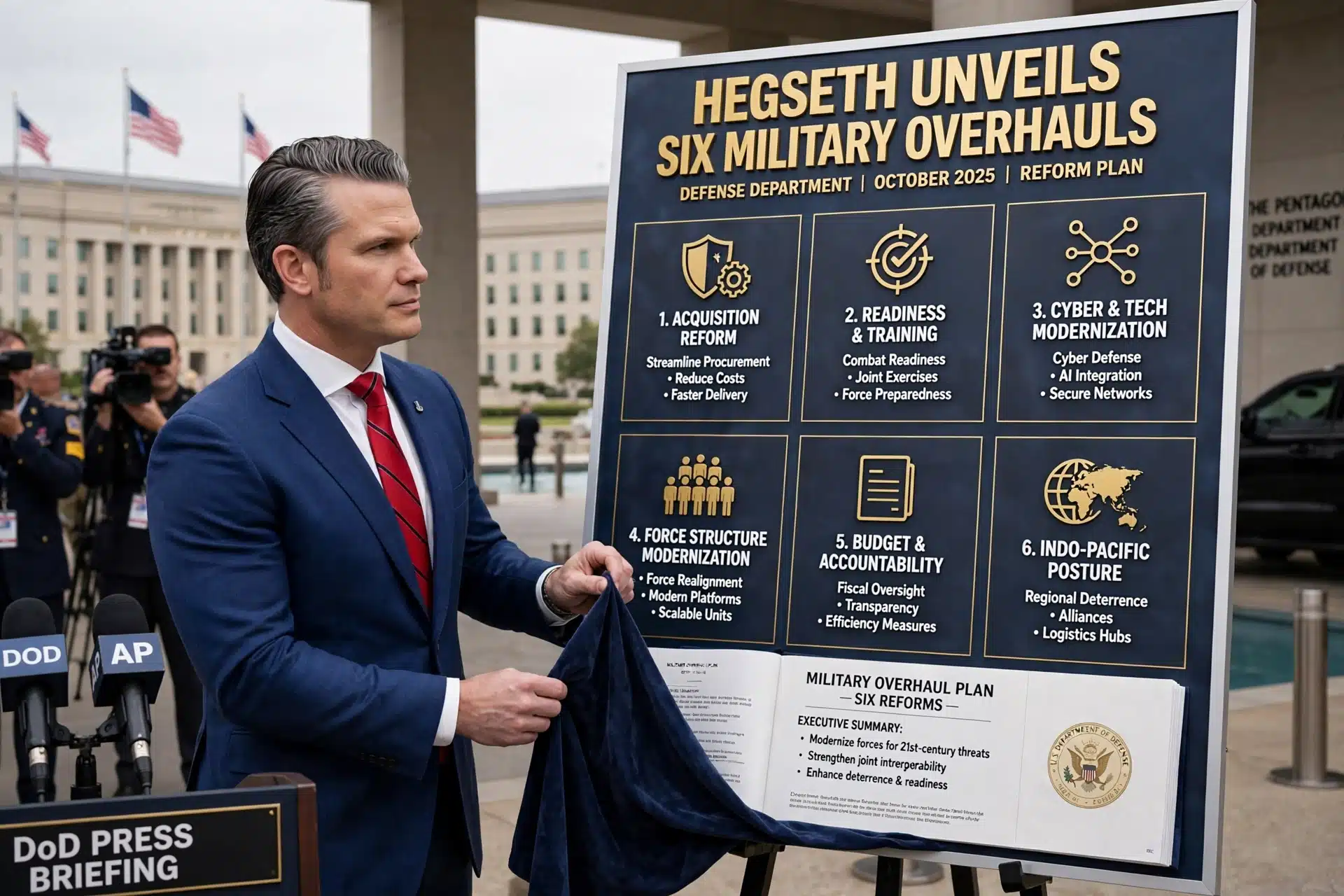
Hegseth Quantico Speech: Six New Initiatives Reshaping the US Military
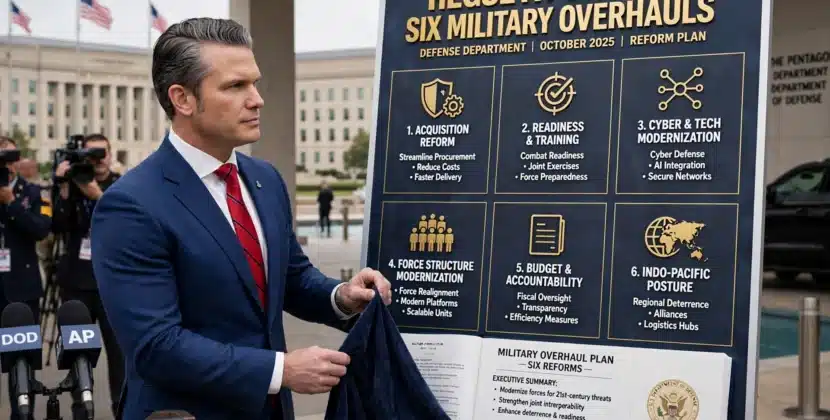
Defense Secretary Pete Hegseth used his second annual State of the Force address at Marine Corps Base Quantico on Wednesday to announce six major initiatives he says will reorganize the Pentagon around autonomous warfare, tighter civilian oversight of the officer corps and a renewed push to recruit the next generation of service members. Speaking to roughly 600 junior troops rather than Washington’s usual audience of flag officers, Hegseth delivered a 52-minute speech that blended personnel cuts, new commands and outside advisory projects into a single vision for the force.
The initiatives arrive at a delicate moment for the Defense Department, now operating under the renamed Department of War, as budget planners weigh manned platforms against drones and as the services struggle with recruiting targets. Alongside the six announcements, Hegseth confirmed reports that the department is targeting roughly 20 percent of the military’s admirals and generals for elimination. Together, the package is the clearest signal yet of where the Pentagon intends to spend and cut over the next budget cycle.
The Six Initiatives Unveiled at Quantico
The official release from the department lists the six initiatives in order. First is the creation of Autonomous Warfare Command, a new four-star level combatant command responsible for integrating autonomous drone technologies across the force. Second is America’s Corps of Cadets, a program aimed at building a pipeline of young Americans toward military service. Third is FORTRESS America, an initiative focused on protecting domestic infrastructure from attack.
Fourth is Project Meridian, an effort to study the future of warfare that outside figures including Elon Musk, Palmer Luckey and Newt Gingrich are expected to shape. The remaining initiatives cover new partnership structures between the Pentagon and industry, and deeper reforms to how the department evaluates and promotes its senior leadership. Each is early stage, but together they sketch a department trying to move authority toward new technology and away from entrenched process.
A New Command for Autonomous Warfare
The headline creation is AUTOWARCOM, the working name for the autonomous warfare command. As a four-star combatant command, it would sit alongside the established geographic and functional commands with a specific mandate: bring drones, autonomous systems and uncrewed platforms into a coherent operational concept instead of leaving adoption to individual services.
The rationale is straightforward. The war in Ukraine and flashpoints across the Middle East and Indo-Pacific have shown that mass, cheap autonomous systems can impose costs on far more expensive platforms, and the Pentagon has been criticized for slow adoption relative to adversaries. A dedicated command would own doctrine, training and procurement standards for those systems. Critics inside the building warn that another combatant command adds bureaucratic weight, but supporters argue nothing less than a full command will shift the culture.
Cutting 20 Percent of the Top Brass
Hegseth’s plan to reduce the number of admirals and generals by about a fifth is the most personally consequential initiative for the current leadership. ABC News reported that officials have been developing the cuts for weeks, and the speech confirmed the target. The message to the officer corps was direct: the pyramid of leadership is too heavy at the top, and the department intends to flatten it.
Historical precedent exists. Post-Cold War drawdowns trimmed flag officer ranks before, and Congress has repeatedly asked why the number of four-star positions grew while active-duty strength declined. The open questions are which headquarters lose their stars and whether the savings fund the autonomous systems the other initiatives prioritize. Personnel is policy, and removing that many senior officers in one sweep would be the largest reorganization of the rank structure in a generation.
Project Meridian and the Outside Advisors
Project Meridian may be the most unconventional element: a study of the future of warfare run with input from figures outside government entirely. Elon Musk brings his experience scaling manufacturing and satellite networks, Palmer Luckey brings the defense technology playbook that built Anduril, and Newt Gingrich brings decades of political experience including a speakership.
Their involvement signals that the department wants its thinking disrupted rather than refined. Previous commissions produced binders that gathered dust; attaching recognizable operators creates public accountability for whether recommendations turn into programs. Skeptics note that outside advisors have before been more symbol than substance, but the combination chosen here is deliberately high profile, which makes retreat harder to hide.
Why Quantico and Why Junior Troops
The setting was a choice. Hegseth addressed hundreds of rank-and-file Marines at Quantico instead of flag officers in a Washington auditorium, and reports described the tone as deliberately partisan. Speaking to lieutenants and staff sergeants frames the reforms as generational change rather than a memo to the existing hierarchy, and it plays to the audience most likely to operate the autonomous systems the speech centers on.
It also sidesteps the room where resistance would be loudest. Announcing a 20 percent cut of generals in front of generals invites institutional pushback on camera; announcing it to junior troops casts dissent as defending privilege. Whether that bet holds will become clear in the weeks after the speech as the services translate each initiative into implementation guidance and the officer corps calculates what the cuts mean for their careers.
What Comes Next for the Pentagon
Implementation is the test. A combatant command requires legislation, a combatant commander nomination and a budget line; those move on congressional timelines, not speech timelines. The officer cuts require a personnel plan that survives pushback from the services. FORTRESS America and America’s Corps of Cadets need appropriations and, for the cadets program, answers about what civilian service actually entails.
Watch for three signals: whether Congress funds AUTOWARCOM in the next authorization, whether the flag officer reduction target survives the first personnel board, and whether Project Meridian produces recommendations with dollar figures attached. The address was a vision statement; the next budget documents will show whether the vision has weight. Allies and adversaries both will be reading them closely.
Frequently Asked Questions
What did Hegseth announce at the Quantico speech?
Six initiatives: Autonomous Warfare Command, America’s Corps of Cadets, FORTRESS America, Project Meridian, new industry partnership structures and deeper reforms to senior leadership evaluation.
What is AUTOWARCOM?
A proposed new four-star combatant command that would consolidate the development, procurement and employment of autonomous drone technologies across the US military.
How many generals and admirals will be cut?
Hegseth said the department is targeting roughly 20 percent of the military’s flag and general officer ranks for elimination as part of a broader flattening of the leadership structure.
Who is involved in Project Meridian?
The future-of-warfare study is expected to involve outside figures including Elon Musk, Palmer Luckey and Newt Gingrich, working alongside department officials.