





Armonk, New York | July 15, 2026
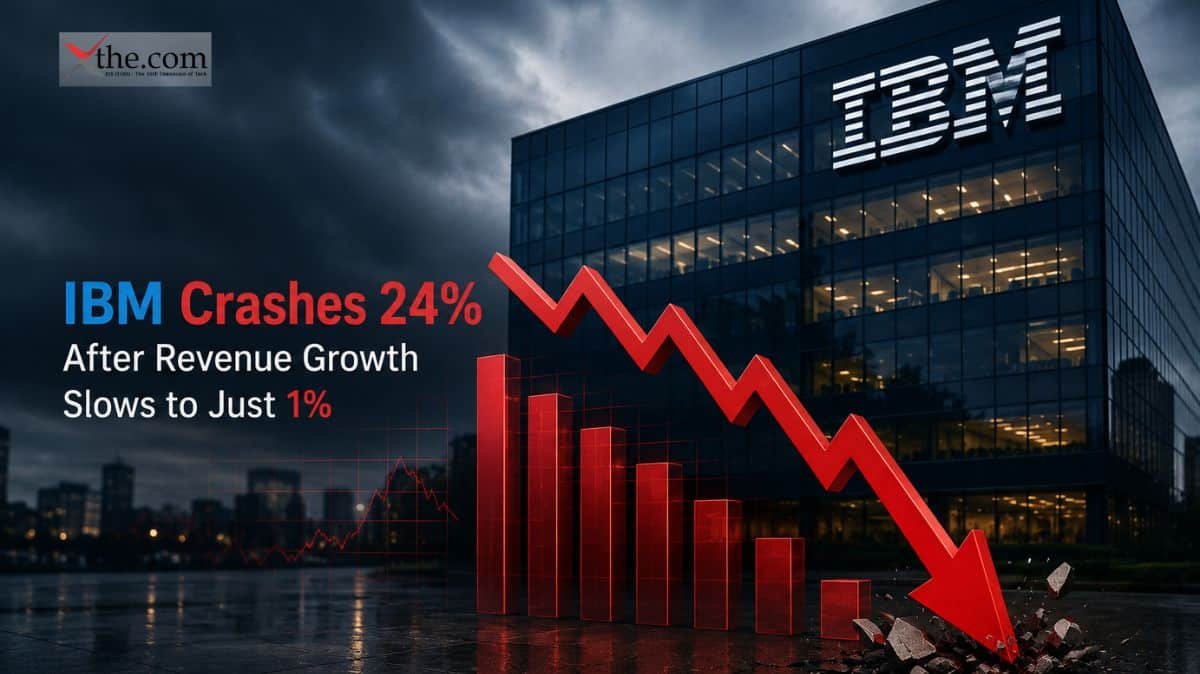
Sixty-seven billion dollars in market value does not usually disappear before the opening bell rings. On Tuesday, it did. IBM’s preliminary second-quarter numbers landed hours before trading began, and by the time the closing bell sounded, the IBM stock crash 24 percent headline circulating on trading desks that morning had already been overtaken by events. Shares finished the session at $217.07, down from Monday’s close of $290.23 — a decline that worsened to roughly 25% by the close, exceeding even the company’s own worst expectations and rivaling IBM’s steepest single-day drop since Black Monday in 1987.
The trigger was almost banal in its simplicity: IBM revenue slows 1 percent, a growth rate so far below what a 115-year-old technology bellwether needs to justify its valuation that Wall Street stopped asking whether IBM would miss and started asking by how much. Chairman and CEO Arvind Krishna did not soften the message. “This quarter we faltered,” he wrote in a letter filed with the Securities and Exchange Commission. “We did not adapt and move quickly enough, and numerous large deals failed to close on the schedules we expected.”
The Numbers Behind the Rout
Strip away the market theatrics and the underlying IBM Q2 earnings shock rests on a small number of figures. IBM revenue $17.2 billion Q2 — up just 1% year-over-year — landed roughly $660 million short of the $17.86 billion Wall Street analysts had penciled in. Operating earnings came in at IBM Q2 EPS $2.93 operating, missing a consensus estimate near $3.01, while GAAP diluted earnings per share slipped 2% to $2.27. Pretax margin contracted by 90 basis points to 14.4%.
No single number explained the historic drop, but together they revealed a problem investors hadn’t expected: IBM’s hardware business was weakening faster than its software and consulting could make up for. Krishna said much of the trouble stemmed from enterprise clients shifting their spending in late June toward servers, storage, and memory rather than IBM’s Z mainframes and related software. “While we anticipated some supply chain-related impact in our expectations, we did not anticipate the magnitude of the capex reprioritization,” he wrote.
We won’t have the full story until IBM’s earnings call on July 22. Krishna warned that the company is still finalizing its numbers, so the final results may change slightly from Tuesday’s early release.
Infrastructure’s Reckoning
The biggest problem was in hardware. IBM’s infrastructure business declined 7 percent, a segment that usually helps steady the company thanks to regular upgrades of its Z-series mainframes. This quarter, that support disappeared. Enterprise customers, concerned about limited AI infrastructure and potential price hikes for servers and memory, chose to buy hardware outside IBM’s ecosystem rather than wait for IBM’s systems.
Software performed better, rising 5% year-over-year, and Red Hat grew 11%. Consulting stayed about the same. However, software growth alone can’t offset a major hardware decline when infrastructure remains a major part of IBM’s revenue. This gap between strong software and weak hardware worried analysts. HSBC downgraded IBM from Hold to Reduce on Monday, before the news, and lowered its price target to $191 from $231—a move that proved accurate within a day.
The Dow’s Reluctant Anchor
IBM’s decline did not stay contained within its own ticker. As the IBM Dow Jones drag Salesforce, Microsoft dynamic played out through Tuesday’s session, IBM single-handedly weighed the blue-chip index even as broader markets found their footing. Salesforce fell 3.4%, and Microsoft dropped 2% in sympathy, amid a broader software-sector sell-off that also hit ServiceNow, Workday, and Oracle.
The ironic fact was that the rest of the market shrugged. A cooler-than-expected June inflation report — headline CPI easing to 3.5% annually — gave the Nasdaq room to climb even as the Dow struggled under IBM’s weight. Semiconductor names, including Lam Research, AMD, and Micron, rallied, and Goldman Sachs’ blowout quarter added enough points to the Dow to blunt IBM’s drag. The IBM Q2 earnings shock, $17.2 billion, Dow Jones biggest drag July 2026 framing that circulated among traders captured a market that was simultaneously punishing one company and rewarding the sector next to it — proof that this was read as an execution failure specific to IBM, not a referendum on enterprise technology spending broadly.
Can AI Consulting and Red Hat Offset the Decline?
The harder question is structural, and it will outlast this week’s headlines. IBM has spent years repositioning itself around AI consulting and Red Hat’s hybrid-cloud software as the growth engines meant to offset a maturing hardware business. Both delivered this quarter — Red Hat’s 11% growth is the strongest signal IBM has that its software bet is working. But the IBM crashes 24 percent Q2 revenue 1% slowdown infrastructure decline July 15 story that formed around this earnings cycle points to a deeper concern: infrastructure’s decline accelerated at precisely the moment enterprises are migrating workloads to cloud-native AI platforms, a shift that erodes the very hardware refresh cycles IBM has traditionally depended on to smooth over slow years.
So far this year, IBM’s free cash flow has reached $4.8 billion. Management will likely highlight this during the July 22 call to show that the company’s finances remain strong, even though revenue fell short. IDC analysts said Wall Street may have overreacted the earnings shortfall, but they also agreed that Krishna’s warning is serious. The real issue is whether this was just a one-time mistake or part of a bigger, long-term change in how companies spend money. IBM’s leaders will need to address this on the next call, and investors will be watching closely.
IBM’s next earnings call on July 22 will show whether Tuesday’s drop was just a correction or the start of a bigger change. For now, the market has given its initial judgment, and it was harsh.
Source: IBM Shares crashed, Forbes News