





Why RAM Costs So Much in 2026: Inside the Memory Chip Shortage Hitting US Shoppers
If your next laptop costs hundreds of dollars more than the model it replaces, the reason is not the processor or the screen. It is the memory. A global shortage of DRAM and NAND flash, the chips that store everything a computer or phone needs to work, has sent prices up 200 to 400 percent since 2025 and is now filtering through to American shoppers just as the holiday buying season begins. Analysts call the crisis RAMmageddon and the RAMpocalypse, and for once the nicknames are not exaggerating.
The shortage is not a shipping accident or a natural disaster. It is the direct result of the artificial intelligence boom: the same factories that make the memory inside laptops and phones have been retooled to make the high-bandwidth memory that powers AI data centers, and the hyperscalers are paying far more per wafer than any consumer electronics company can match. The result is a market where one widely cited estimate puts OpenAI alone consuming roughly 40 percent of global DRAM supply, while students and home buyers fight over what is left.
What Is Driving the Crunch
Memory manufacturing is concentrated in three companies: Samsung Electronics, SK Hynix and Micron Technology. After a brutal downturn in 2022 and 2023, all three cut production to stabilize prices, and when generative AI demand exploded in 2024 they redirected their most advanced capacity toward high-bandwidth memory for GPUs. HBM consumes far more wafer space per bit than ordinary DDR5 modules, so every stack of chips sold to an AI customer is capacity that never becomes a stick of laptop RAM.
Demand from the AI side has no ceiling. Google, Amazon, Microsoft and Meta have placed open-ended orders with memory suppliers, telling them they will accept as much supply as available regardless of cost, and OpenAI’s Stargate partnership with Samsung and SK Hynix locks up additional output for years. Geopolitics adds pressure: U.S.-China trade tensions have capped equipment sales and shifted supply chains, while suppliers now demand prepayment or shorter payment windows, which squeezes smaller buyers out of the market entirely.
The Numbers Behind the Price Hikes
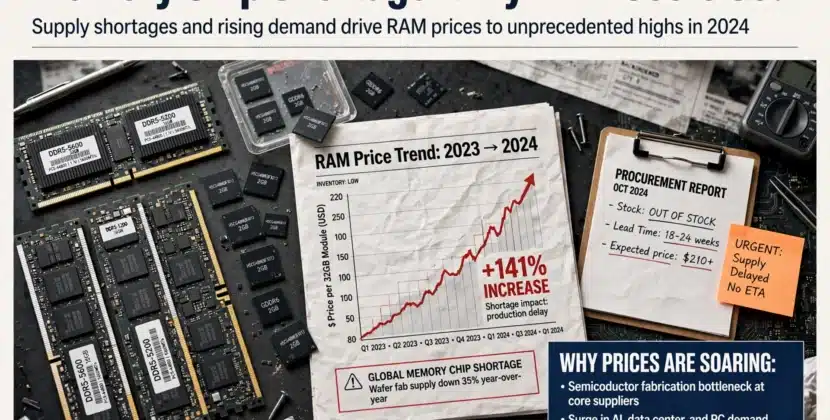
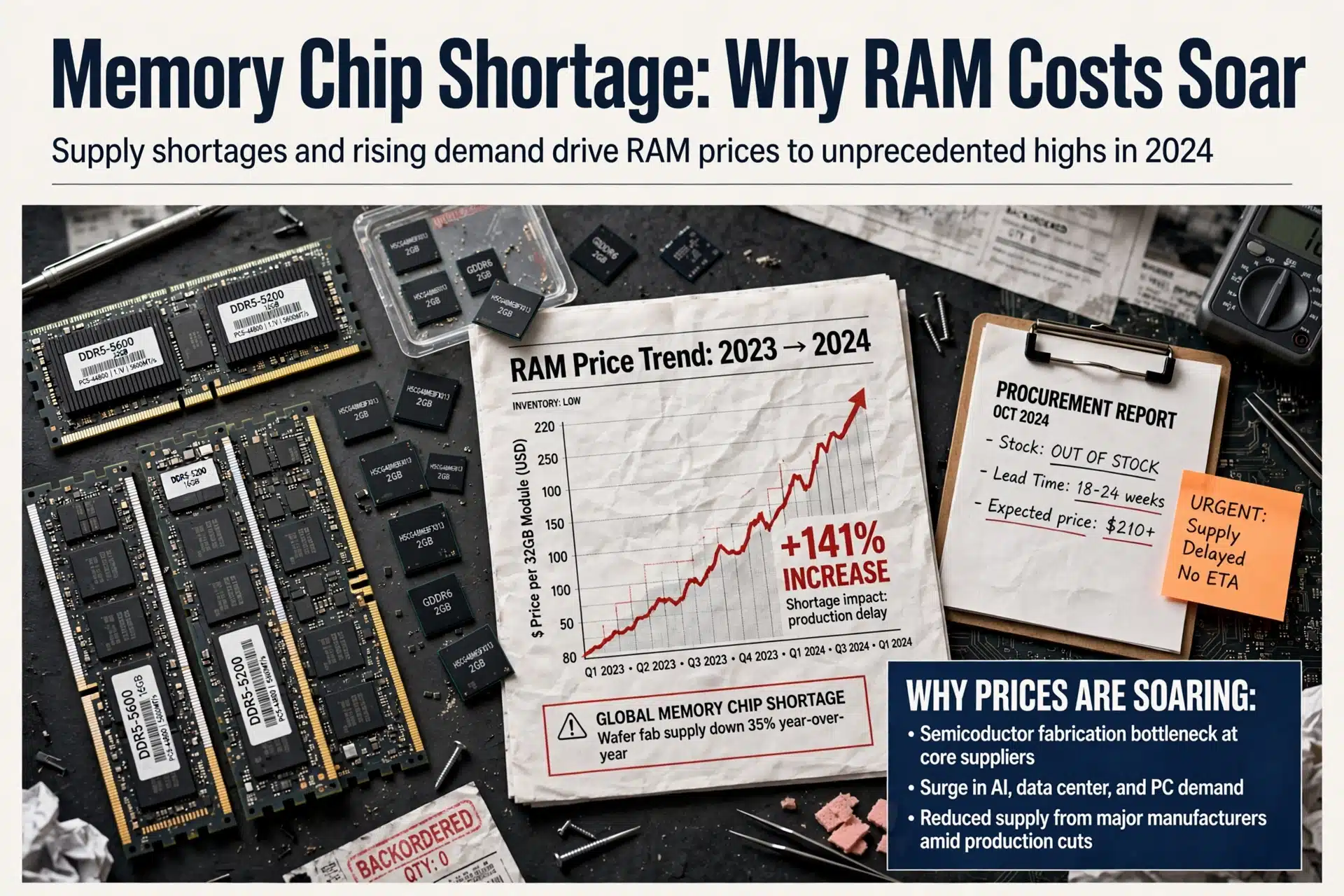
The scale is hard to overstate. DRAM prices rose about 172 percent during 2025, and industry trackers put DDR5 kits that cost under $100 two years ago at $429 for 32GB in October 2026, an increase of nearly 485 percent at retail. NAND flash, the storage memory in solid-state drives, has followed: in November 2025 alone, contract prices for some NAND wafers jumped more than 60 percent month over month as manufacturers retired legacy capacity. Forecasts reported this summer pointed to another 40 to 50 percent rise in DRAM contract prices through the third quarter and roughly 30 percent more in the fourth.
Companies are absorbing what they can and passing on the rest. HP disclosed on its earnings call that memory now accounts for about 35 percent of the materials cost of a personal computer, up from 15 to 18 percent a quarter earlier, and warned investors about margins as a result. Dell’s chief operating officer said in late 2025 that the company had never witnessed costs escalating at the current pace, and Lenovo’s chief financial officer called the surge unprecedented, saying his company was carrying inventories about 50 percent above normal just to stay ahead of the next increase.
What It Means for American Buyers
For consumers, the abstract chip war shows up on price tags. Analysts estimate memory adds $90 to $165 to the cost of an average PC, Gartner and IDC expect worldwide PC shipments to fall 10 to 11 percent in 2026 with smartphones down 8 to 9 percent, and Gartner has projected that sub-$500 entry laptops could become financially unviable within two years at current trajectories. Framework made headlines when it raised the price of an 8GB memory module from $60 to $80, and Apple raised prices on iPads, Macs and other products in June, a move that helped trigger the worst day for its stock since 2025.
The shortage reaches beyond computers. Valve delayed its second Steam Machine, then released it at $1,049, saying its original pricing goal was no longer viable. Game consoles, smart home devices, cameras and graphics cards all carry more memory than they did two years ago, and each incremental gigabyte now costs multiple times what it once did. Retailers in markets from Tokyo to Texas have begun limiting purchases of memory modules to prevent hoarding, a behavior last seen during the pandemic-era chip shortage.
When Will the Memory Shortage End?
Nobody credible is promising a quick fix. A 2026 Kearney analysis concludes the shortage will last at least until 2030. Micron chief executive Sanjay Mehrotra said in June he expects it to persist through 2027 with supply gradually improving by 2028; Samsung’s Jaejune Kim expects relief no earlier than 2028; and SK Hynix’s Kwak Noh-Jung, whose company supplies the bulk of the world’s high-bandwidth memory, puts the timeline at 2030.
Supply is finally responding, but slowly. Micron broke ground in July on a $9.3 billion memory fab that will not produce a wafer until the third quarter of 2028, Samsung and SK Hynix are expanding HBM lines rather than consumer DRAM, and Intel said in August it is investigating an entirely new memory architecture. On the software side, Google announced a compression technique in March called TurboQuant that it claims cuts memory use sixfold for some large language model workloads, a reminder that demand can be eased by code as well as by steel.
What Shoppers Should Do Now
The practical advice from analysts is unglamorous. If you need a laptop or are planning a PC build this year, buying sooner usually beats waiting, because fourth-quarter increases land exactly during holiday shopping. Prioritize configurations with 16GB of memory or more, since soldered low-memory machines will feel their age fastest as operating systems and AI features grow, and consider machines with upgradeable RAM if you want an escape hatch from the next price jump.
Watch for deals on refurbished and previous-generation hardware, which carries older inventory bought at older prices, and treat any promotion that lets you add memory cheaply as the discount it is. For sellers, the shortage cuts the other way: used RAM modules and aging gaming PCs hold their resale value unusually well right now. The memory chip shortage is a story about data centers, but for most American households it is really a story about the receipt at the end of the shopping cart.
Frequently Asked Questions
Why are RAM prices so high in 2026?
AI data centers are consuming most of the world’s high-bandwidth memory output, so DRAM makers diverted wafer capacity from consumer chips, sending DRAM and NAND prices up 200 to 400 percent since 2025.
When will the memory chip shortage end?
Timelines vary: Micron expects gradual improvement by 2028, Samsung no earlier than 2028, SK Hynix and Kearney’s analysts point to 2030, and new fabs like Micron’s $9.3 billion plant start production in 2028.
How much do memory chips add to laptop prices?
Analysts estimate memory adds $90 to $165 per PC, HP says it now accounts for about 35 percent of a computer’s material cost, and Gartner warns entry laptops under $500 may disappear within two years.
Should I buy a laptop now or wait for prices to drop?
Analysts recommend buying sooner rather than later if you need a machine now, since another round of increases is expected in the fourth quarter, and choosing 16GB or more with upgradeable memory if possible.