




October 2026 Visa Bulletin: Retrogression Hits EB-2 and EB-3 as Filing Window Opens
The State Department published the October 2026 Visa Bulletin on September 29, the first issue of fiscal year 2027, ending an unusually late release that had applicants refreshing the page for days and fueling speculation that the government had run out of numbers. The bulletin instead delivers a split verdict: modest advances for some categories, painful retrogression for others, and a significant opening for millions of applicants because USCIS will use the more generous Dates for Filing chart for employment-based green cards in October.
The filing decision is the headline opportunity. For the first time since April 2026, USCIS will accept I-485 adjustment applications based on the Dates for Filing chart, giving applicants between 5 and 17 extra months of filing time depending on nationality and category. That window lets people submit their green card paperwork, obtain employment authorization documents and advance parole, and lock in their place in line even where final approval dates have not caught up.
Why the October Bulletin Was Released So Late
The delay itself was newsworthy. Throughout fiscal year 2026, the State Department released the bulletin around the middle to third week of the preceding month, and each October bulletin for the past five years arrived between September 14 and 20. This year it landed on September 29, just two days before the new fiscal year began, prompting speculation that one or more categories had hit their annual cap and that immigrant visa interviews would stop.
None of that happened. Instead, analysts at Hunton & Andrews Kurth concluded that the expected demand simply did not materialize, so the government is acting to open the pipelines and start fiscal 2027 with strong number use. The delay may have come down to internal bottlenecks or IT and data processing problems. Whatever the cause, the outcome was a bulletin that confirms annual limits were not exhausted and gives applicants real movement instead of a freeze.
Which Categories Moved Forward
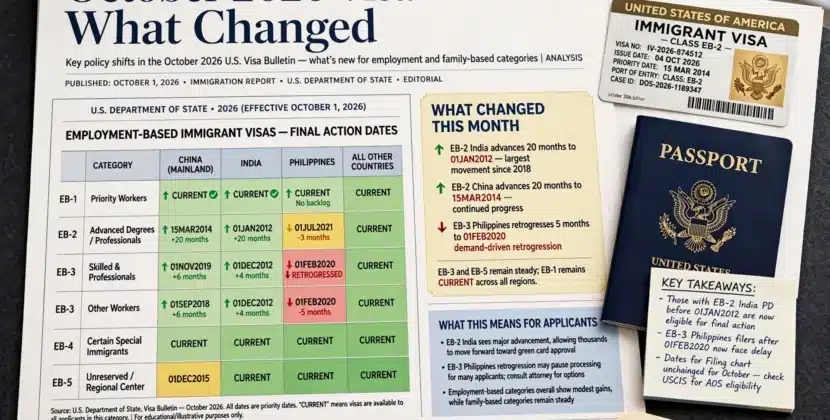
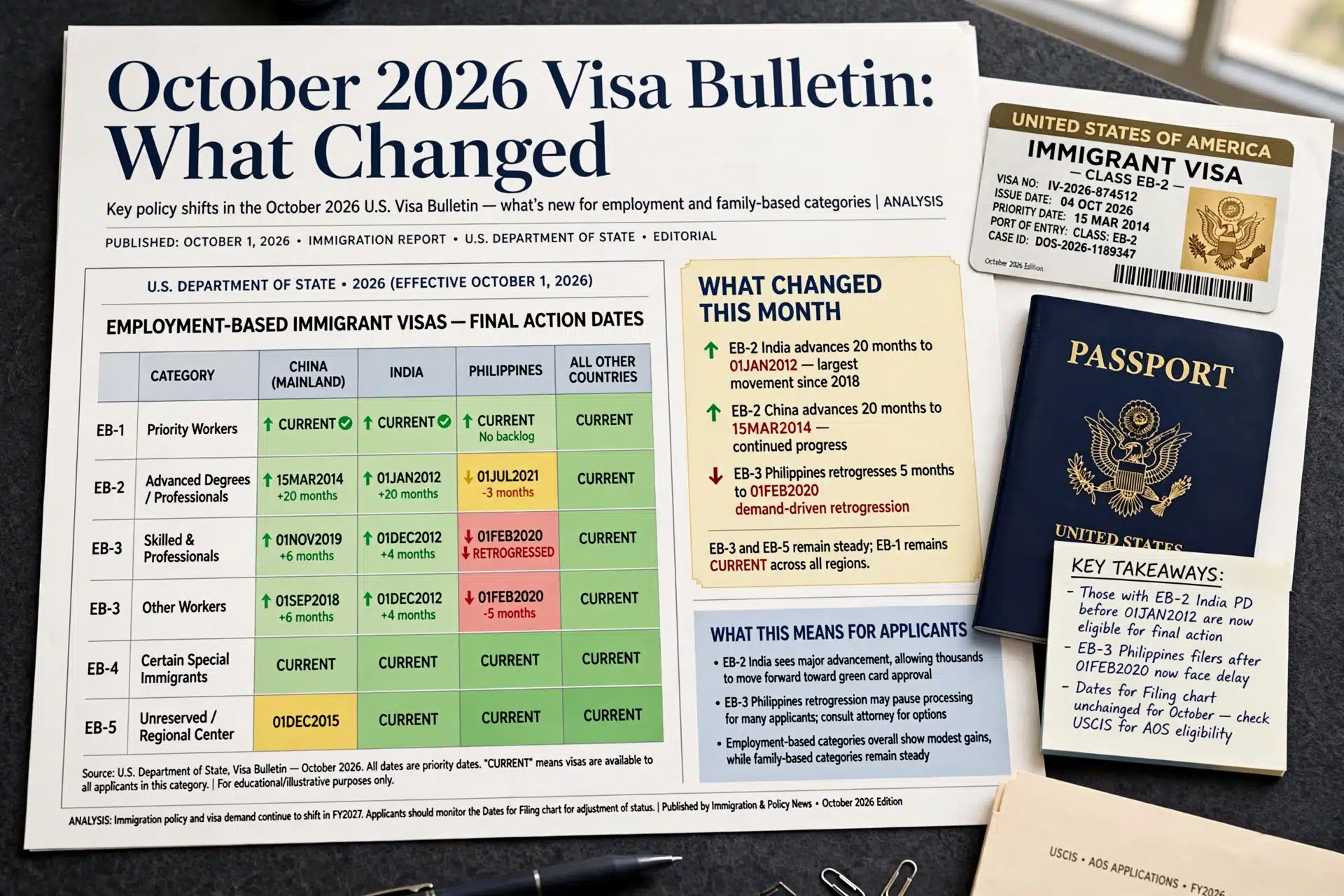
Priority date advances in the final action chart range from one week to five months. India’s EB-1 leapt five months to February 1, 2023, and India’s EB-2, which had been completely unavailable since July, reopened and advanced two months to November 1, 2013. India’s EB-3 held at January 1, 2014. China saw gains nearly across the board: EB-2 advanced a month to October 1, 2021, EB-3 professionals moved a week to January 8, 2022, and EB-3 other workers jumped five months to October 1, 2019.
Family-based applicants and special categories saw movement too. Boundless reported that India’s EB-5 categories reopened and that the EB-4 category, which covers special immigrant workers including religious workers and others, moved forward by more than two years. For applicants who have watched dates sit frozen for months, those are the kinds of jumps that change life plans, from job offers to school enrollment to family timing.
Where Retrogression Hit
The caution sits in the rest-of-the-world rows, which cover most applicants from Mexico, India, the Philippines and every other country without a dedicated line. EB-2, which had been current since April, retrogressed to January 1, 2025. EB-3 professionals moved backward five months to May 15, 2024, and EB-3 other workers slipped three months to January 1, 2022. EB-1 remains current for nearly everyone.
The Philippines was partially shielded: EB-3 professionals there advanced two weeks to August 15, 2023, and EB-3 other workers advanced a month to January 1, 2022. The State Department said retrogression was necessary to keep visa issuance within annual limits, an unusually cautious way to begin a fiscal year that starts with money in the bank. Retrogression is routine when demand outruns supply, but it still lands hard on applicants who had just watched dates move in their favor.
Why the Dates for Filing Window Matters More
Here is the practical opportunity buried in the technical charts. USCIS designates which chart applies each month for I-485 filings, and in October it chose Dates for Filing for employment-based applicants, the first time that chart has applied since April 2026. The gap between the two charts is worth 5 to 17 months: Indian nationals gain 17 months in EB-1, 14.5 months in EB-2, and 12.5 months in EB-3. Chinese nationals gain a year in EB-1 and about 15 months in EB-2. Applicants from all other countries can file 14.5 months early in EB-2 and 5 months early in EB-3 other workers.
Filing early matters even if your final action date is not current. A properly filed I-485 triggers the ability to apply for an employment authorization document and advance parole travel permission, freezes the biometrics and review process in your favor, and means you are in the adjudication queue the moment your date becomes current. Consular processing applicants take note: the filing chart applies only to USCIS, while embassies continue to use final action dates.
How to Use This Bulletin This Month
Start by finding your priority date, the date your labor certification or immigrant petition was filed, and compare it against the October charts for your category and chargeability country. If your priority date precedes the Dates for Filing cutoff, gather your paperwork now because October is the month to file. Work authorization, medical exam timing and supporting affidavits take weeks to assemble, and the window closes when USCIS switches charts in November.
Employers should treat October as an action month. Every I-485 filed now is one less dependency on a labor certification down the road, and the retrogression in final action dates makes the filing window the primary way to keep cases moving. Watch the November bulletin, expected in mid-October, to see whether the retrogression deepens or the filing chart remains in effect, and keep your address and biometrics current with USCIS so nothing stalls.
What Comes Next for Fiscal Year 2027
Fiscal 2027 opened with number availability that surprised analysts who had braced for a freeze, and the cautious retrogressions suggest the State Department expects heavy demand in the months ahead. The next bulletins will show whether October’s advances hold, whether the rest-of-the-world EB-2 date stabilizes near January 2025, and whether USCIS keeps the Dates for Filing chart in place or retreats to final action dates as filings surge.
Applicants should assume volatility. Watch for the November bulletin, keep immigration documents ready to file at short notice, and treat this month’s window as the opportunity it is: after a late release that nearly froze the system, October turned out to be one of the most active filing months of the year.
Frequently Asked Questions
When was the October 2026 Visa Bulletin released?
The State Department published it on September 29, 2026, two days before the fiscal year began and far later than the mid-September releases of prior years.
What is retrogression in the visa bulletin?
Retrogression is when a cutoff date moves backward because demand has outpaced the annual supply of visas, as happened to rest-of-the-world EB-2 and EB-3 dates in October.
Can I file my I-485 in October 2026?
If you are employment-based and your priority date precedes the Dates for Filing cutoff, yes. USCIS chose that chart for October, giving applicants 5 to 17 extra months of filing time.
Which chart do embassies use for visa interviews?
Consulates always use Final Action Dates. The Dates for Filing chart applies only to I-485 applications filed with USCIS inside the United States.